Started this thread at 20, the summer I graduated university. A lot has changed since then, including what this thread h
Shark266 posts
Posted Jul 7, 2020, 2:14 AM#1
286 replies
Started this thread at 20, the summer I graduated university. A lot has changed since then, including what this thread h
Congrats on having carved out a version of the poker world that works for you. You should be proud of yourself to have done it at such a young age. I'm also in socal and am getting back into playing plo after a long time away from it while I hit some monetary goals. I remember your thread from back in the day and am happy to see your significant progress!
by OVERSTIMULATED m (https://www.twoplustwo.com/post?postId=58499314#post58499314)
Congrats on having carved out a version of the poker world that works for you. You should be proud of yourself to have done it at such a young age. I'm also in socal and am getting back into playing plo after a long time away from it while I hit some monetary goals. I remember your thread from back in the day and am happy to see your significant progress!
Thank you, super appreciate the kind words! All the best.
How is everyone?! I know it’s been a while. I appreciate those of you who have stayed in touch over the years. You all are amazing. I recently started working as a behavioral interventionist for special needs children. I love it. I am traveling to India again! I don’t have a plan for the thread but in the airport and remembered the thread. I don’t expect much engagement and I don’t plan to post any poker. 17 hour flight awaits. I’m looking forward to it, hopefully a distraction free environment to read nonfiction. I purchased 10 new hardcover non-fiction books that I would like to deep dive into during my time there.
Congrats on the fulfilling job! Sounds like you are really enjoying contributing to society, and for a good cause as well. Bravo. Have a sweet trip! I’m going to put some water in my latte tomorrow morning too.
congrats man, happy to hear things are going well nice to hear from you
Hey friend, great to hear from you again!!! by RoadtoPro m (https://www.twoplustwo.com/post?postId=58821378#post58821378)
I recently started working as a behavioral interventionist for special needs children. I love it.
This is music to my ears friend, I love it ♥ The poker world - the World in general, tbh - needs more compassionate people like you ♥ Think about your evolution in so many few years : from chess prodigy to poker high stakes to the ultimate goal : helping out your peers and being a good human ♥ Spoiler Show
how old are you again... 😉. Much love bro ♥♥♥
by RoadtoPro m (https://www.twoplustwo.com/post?postId=58821378#post58821378)
I recently started working as a behavioral interventionist for special needs children. I love it. It was time to transition into something more fulfilling in the short term.
This is Ossum! Big congrats my man, have a great trip
Happy to hear you’re pursuing your passions and thriving in life.
I plan to use this space to record my PLO study progress. Most entries will focus on PLO Mastermind. Each post will call out one thing I found notable, one concept I picked up, or one moment where I thought I grasped the node… and didn’t. I’m doing this partly for accountability. Writing things down should help me remember the material better, and maybe it’ll assist others learning the game. There’s a real shortage of quality PLO content compared to NL, so even modest observations could be valuable.
Spot: EP versus MP (6-max) — A♠ A♥ 3♦ 2♣ Action: 3-bet Solver verdict: The clear call. 3-bet is a grave error (EV difference −0.39)
(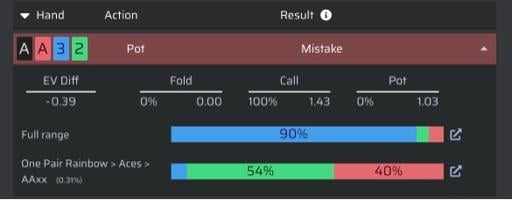 )
This was a spot where I thought I understood the node… and I didn’t. My initial reasoning for 3-betting •Surprised we’d ever flat AAxx MP vs EP. •We’re IP on the original raiser. •We block a large share of EP’s strongest 4-bets. •3-betting lets us pick up SB/BB dead money. •We can win the pot pre or head to the flop with initiative. All of that felt natural. What I missed After reviewing and talking it over with a strong reg: •Getting 4-bet by CO/BTN is disastrous with this hand group. •A♠ A♥ 3♦ 2♣ has poor playability in medium SPR situations. •When we 3-bet and get called, we often create awkward postflop spots where we’re heavy on overpairs but structurally weak. •The hand works better in spots where: •We cold call, •BTN squeezes, •EP overcalls, •We back-raise 4-bet and get it in pre, •Or we see a low SPR flop with nut advantage. Put another way, this hand prefers polarized, low-SPR structures — not bloated, medium-SPR pots. Key takeaway Not all AAxx want to 3-bet MP vs EP, especially disconnected, low-side rainbow textures. Good reminder that: •Blockers ≠ mandatory aggression. •Initiative isn’t everything. •Playability and SPR geometry matter more than I credited. One spot where I was way off.
Great post! Thanks a lot! I'd enjoy reading more of these as I'm currently learning PLO myself.
Appreciate it, wholesome mod! If you or anyone has questions, go ahead and post them here. I don’t mind the thread getting a bit messy. Wholesome, productive conversation is always welcome.
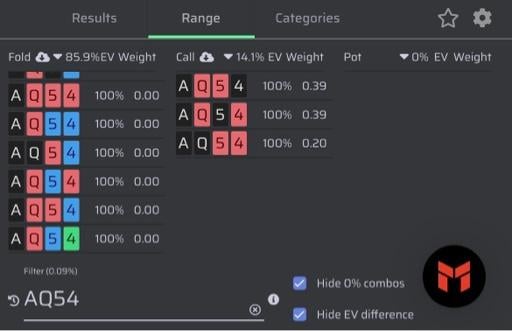
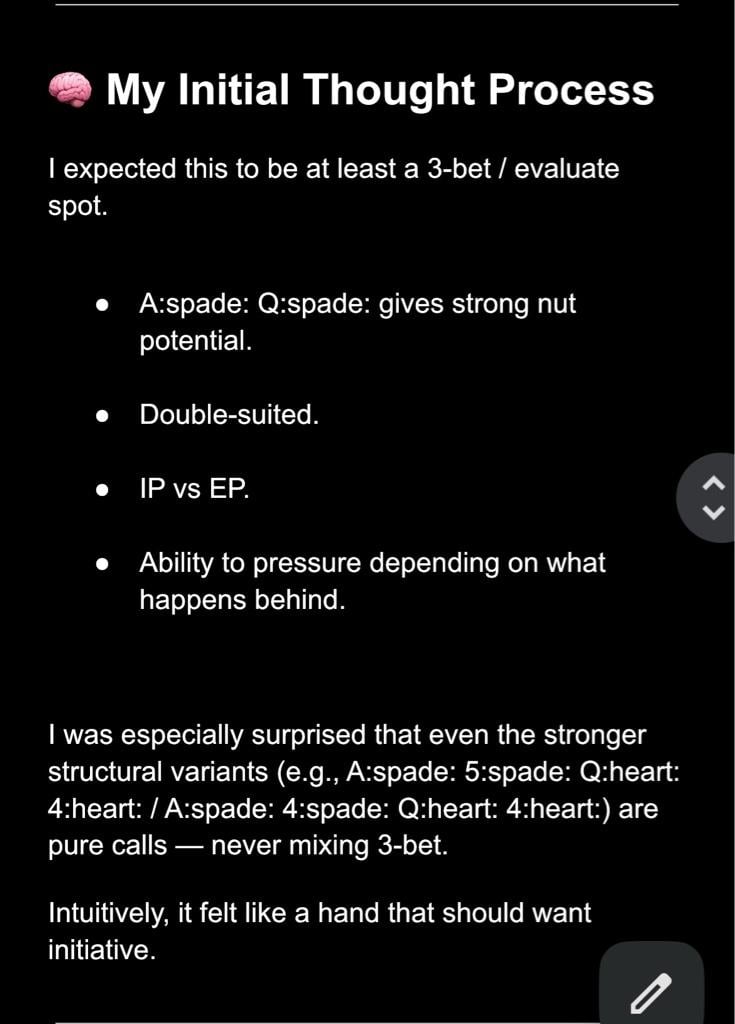
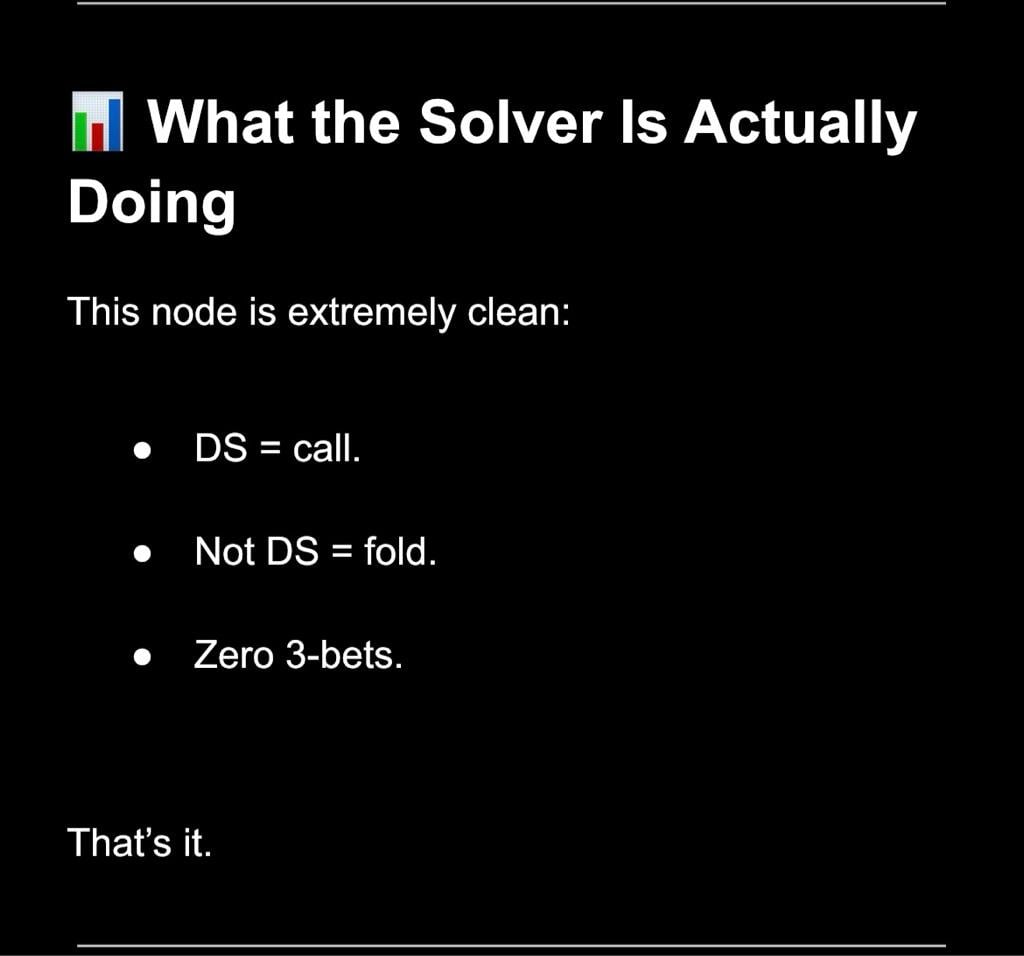
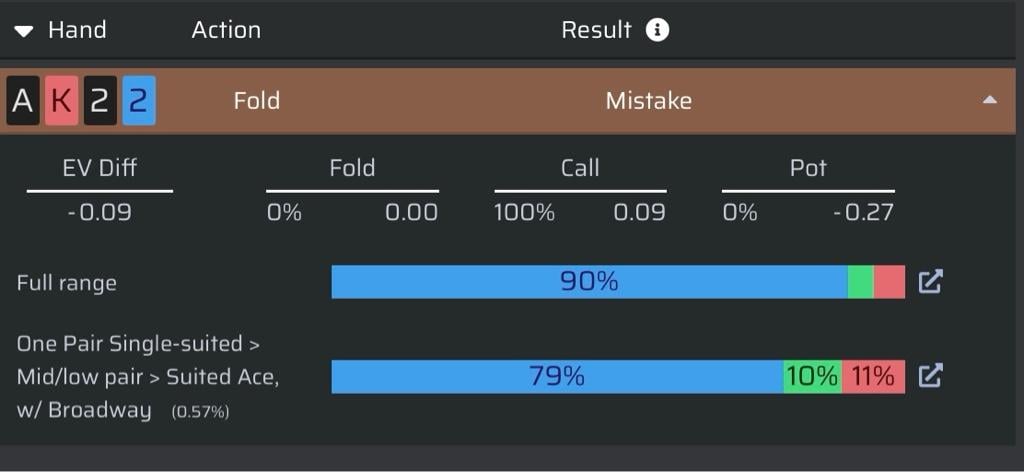
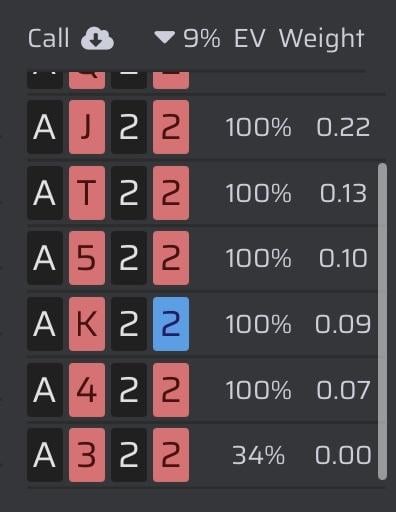
Game: 6-max PLO Environment: High rake Positions: EP opens, MP (Hero) Stacks: 100bb Hand: A♠ Q♠ 5♥ 4♥ Action Taken: Pot 3-bet Solver Output: Pure call EV: Call = +0.20 3-bet = −0.01 EV diff ≈ −0.21 Clear mistake. Solver structure: All double-suited combos = pure calls. All non-double-suited combos = pure folds. Never 3-bet.
( )
( )
(
 )
(
 )
(
 )
( )
(
 )
(
 )
(
 )
(
 )
( )
(
 )
(
 )
(
 )
( )
(
 )
( )
(
 )
(
 )
Thanks Tuma! Wishing you the best of luck on your own poker journey
was actually hoping to transition to the dark side myself i wrote this last week and got zero response - any thoughts?
by rickroll m (https://www.twoplustwo.com/post?postId=59233105#post59233105)
accomplished live nl player, will probably play plo 2–3x a month. local room seems clear that plo is the gameread the sticky and a good chunk of the guide thread. most of it is older and newer replies lean solver/training site. i don’t have time or interest in coaching or subscriptions. just want a solid book i can work through casuallyi know obvious folds and raise... See full post
I'm trying to move to PLO too. Strictly a rec, so not getting a ton of reps. I played last night and thought I was probably playing way too tight, but looking at those last posts, maybe not. Maybe I'm a savant, haha.
What would you say to someone with likely a 1500 ELO (intermediate) grasp / skill level in PLO? Top pieces of advice. Key pointers. Anything else.
by rickroll m (https://www.twoplustwo.com/post?postId=59239465#post59239465)
I was actually hoping to switch to the dark side myself I wrote this last week and got no replies - any feedback?
If you want a book you can work through casually, Hwang looks like a solid, structured starting point. Some sections are probably dated, but the framework it presents can be helpful. That said, if your aim is genuine technical sharpness, practice beats reading. Think of chess tactics: you don’t get better by rereading a chapter on forks and pins. You get better by solving thousands of positions until the patterns are second nature. PLO trainers fulfill that function. They let you drill range interaction, board coverage, and equity distribution. It’s systematic pattern recognition. There are free or inexpensive choices. The free tier of PLO Genius should be sufficient to begin. This thread is centered on becoming as technically strong as possible. I’m basically sharing my study routine and drilling approach. If that matches what you want from poker, follow along. If not, no worries. GL.
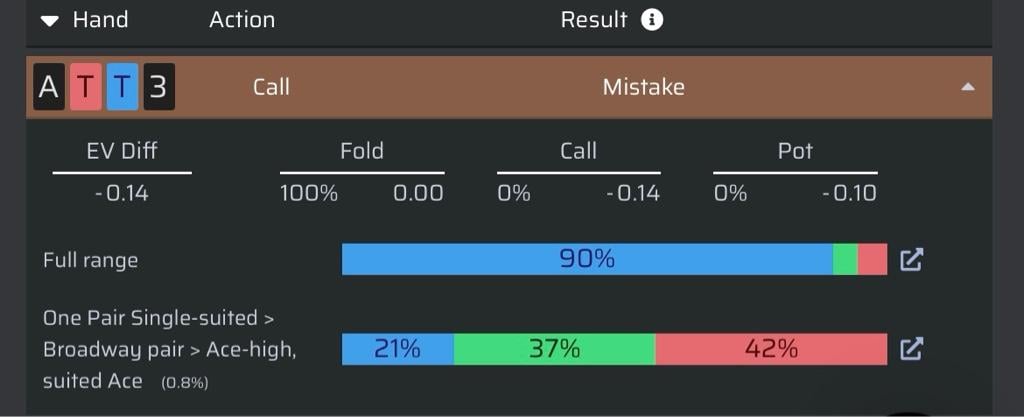
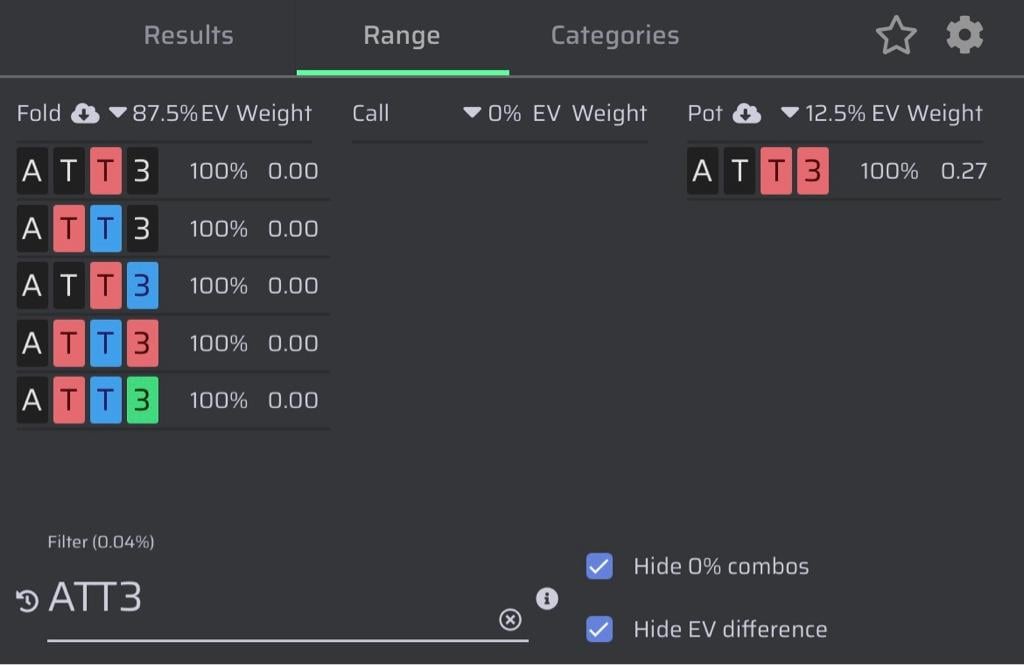
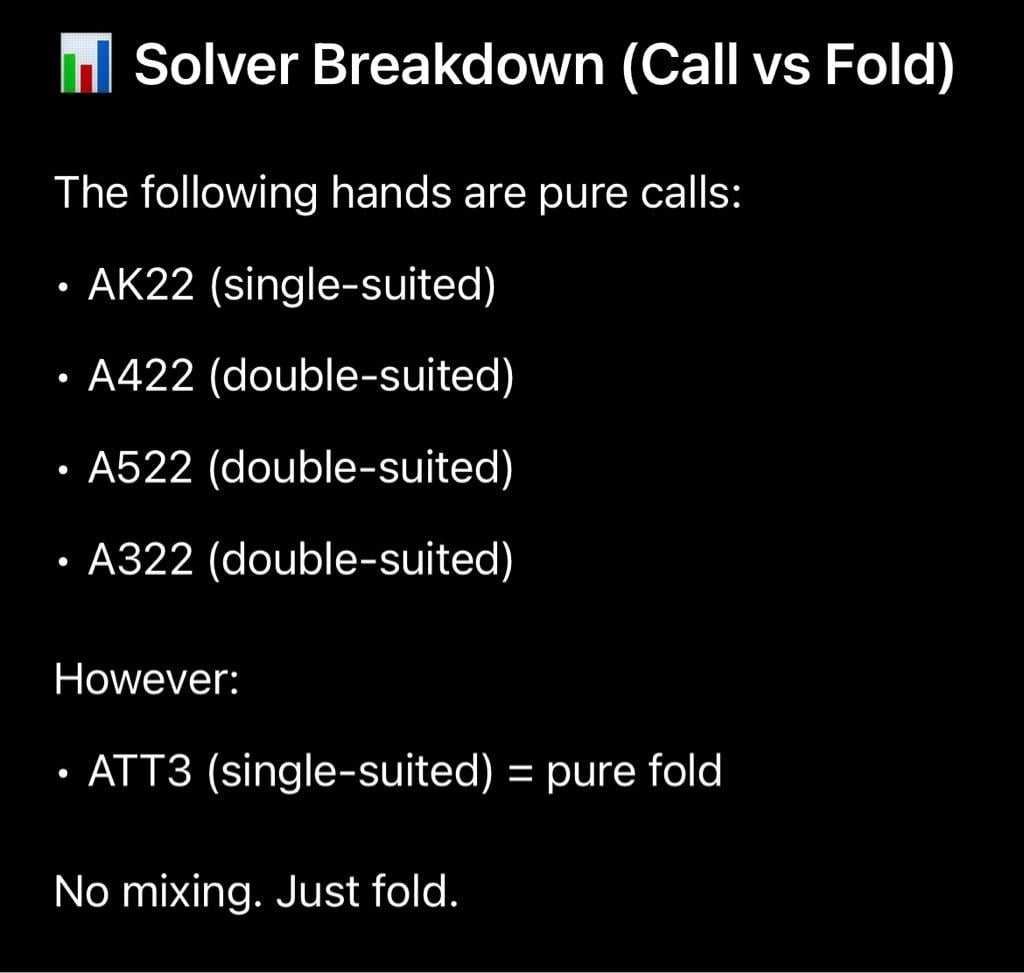
Thanks for posting these analyses. I'm not new to PLO but was surprised by the ATT3ss v A322ds example. Counter intuitive, for sure, but appreciate the reasoning about "range collision" etc. Also a little surprised that AQ54ds from MP is a 100% call (would think it's more 3bet or fold spot).
by marknfw m (https://www.twoplustwo.com/post?postId=59239481#post59239481)
I'm trying to move to PLO too. Strictly a rec, so not getting a ton of reps. I played last night and thought I was probably playing way too tight, but looking at those last posts, maybe not. Maybe I'm a savant, haha.
Yeah, it’s tough. When you’re in a live game playing 30 hands an hour with double board bomb pots, 4-way flops, and cold calls everywhere, it’s hard to see how this kind of structured study applies. For my own purposes, I try to account for multiway implications and action behind in all the spots I post, at least from a theory baseline. Live games won’t always resemble that clean structure session to session, but having that reference point helps me make better adjustments in the chaos. Tight savant > loose genius in most live PLO games. Just layer structure on top of it. GL sir. Keep us posted in here!
by All-inMcLovin m (https://www.twoplustwo.com/post?postId=59239513#post59239513)
What would you say to someone about PLO who likely has a 1500 ELO (intermediate) comprehension / skill level? Top advice. Key pointers. And so on.
The responses above to rickroll and marknfw are certainly food for thought for the 1500-ELO profile you outlined. That’s also the direction of this thread. Think ELO building rather than bankroll building. They’re not mutually exclusive, but the emphasis here is on improving the former. Preface: most of this framework comes from my coach. It’s not my own stroke of genius. If I had to pick one central concept at for that level, it’s SPR. As SPR drops toward 3–4 and below: •Removal (blockers) falls sharply in value. •Raw equity gains importance and eventually dominates. •Bet sizes trend larger, often toward the pot, because urgency to realize equity increases. •Position matters less since fewer streets are contested. As SPR climbs above ~8, further increases matter less. 15 SPR and 20 SPR are effectively just “deep.” Sensitivity rises as SPR nears low levels. On blockers: A good blocker removes strong hands more than weak ones. A bad blocker removes weak hands more than strong ones. That simple framing clears up a lot of confusion. Probably most important: plan one step ahead. If you bet BTN vs BB on the flop, you should already know how you’ll respond to a pot-sized raise. It’s like 4-betting QQ HU and then pausing versus a jam realizing 4b/f and 4b/c were both poor in that exact spot against that player given the dynamic and now you must choose one. Define actions as full lines, not isolated decisions. I’ll dive deeper into postflop structuring in future sessions.
cheers, thanks man
Love this!!! Thank you. ♥
by DrTJO m (https://www.twoplustwo.com/post?postId=59239581#post59239581)
Thanks for posting these analyses. I'm not new to PLO but was surprised by the ATT3ss v A322ds example. Counter intuitive, for sure, but appreciate the reasoning about "range collision" etc. Also a little surprised that AQ54ds from MP is a 100% call (would think it's more 3bet or fold spot).
Thanks for sharing what surprised you and for being specific about the spots. Glad to hear it felt digestible. I appreciate you taking a close look and finding it worthwhile enough to comment. Thanks a lot.
by rickroll m (https://www.twoplustwo.com/post?postId=59239653#post59239653)
cheers, thanks man
by All-inMcLovin m (https://www.twoplustwo.com/post?postId=59239722#post59239722)
Love this!!! Thank you. ♥
No, thank you all. I truly appreciate that you're still around after all this time and keep engaging. I don't take that for granted.
( )
(
 )
(
 )
( )
(
 )
(
 )
(
 )
( )
(
 )
(
 )
(
 )
(
 )
( )
(
 )
(
 )
(
 )
Regarding the AK22ds VS ATT3ss, one element you didn't touch on in your analysis (or I may have overlooked it) is the "ds" versus "ss". Might that factor carry more weight than you assume?
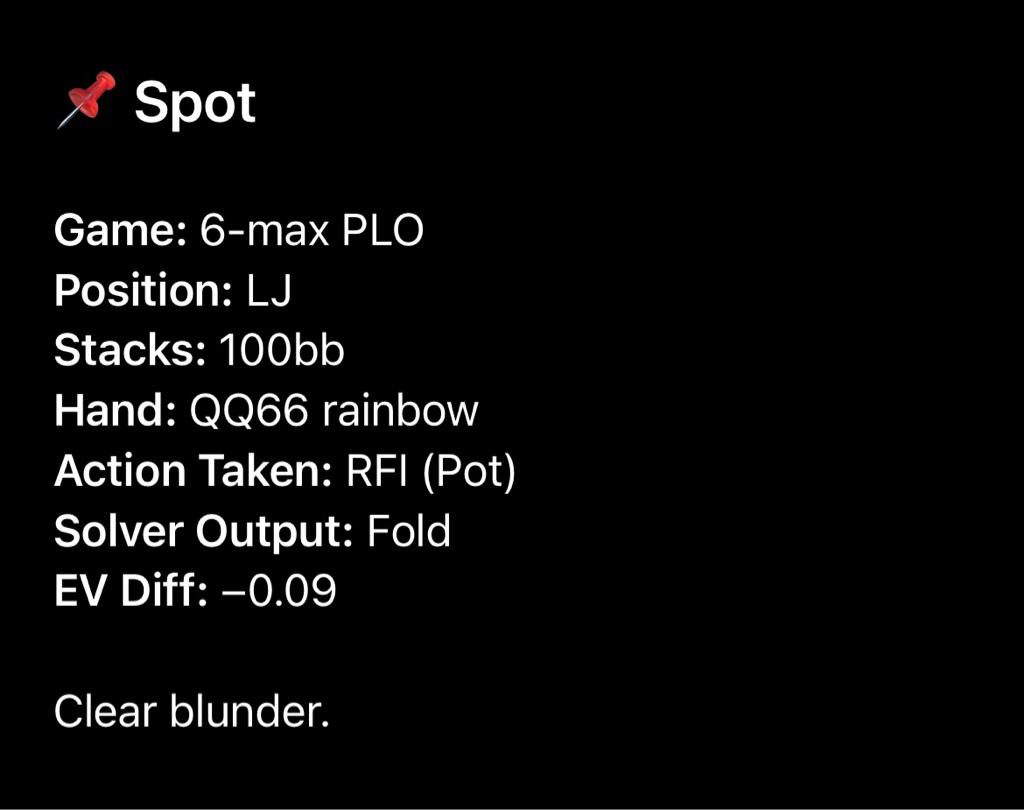
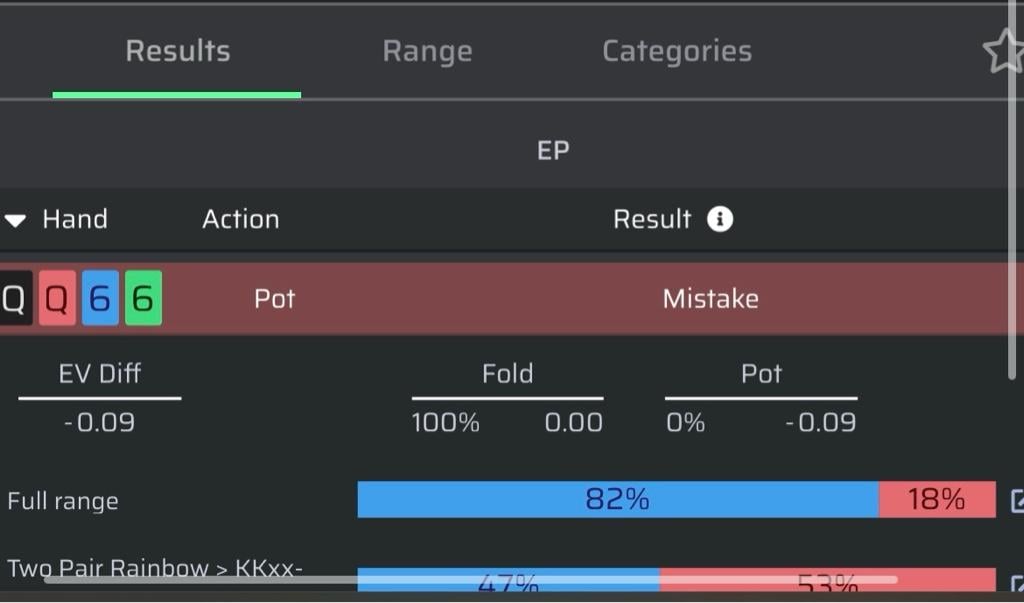
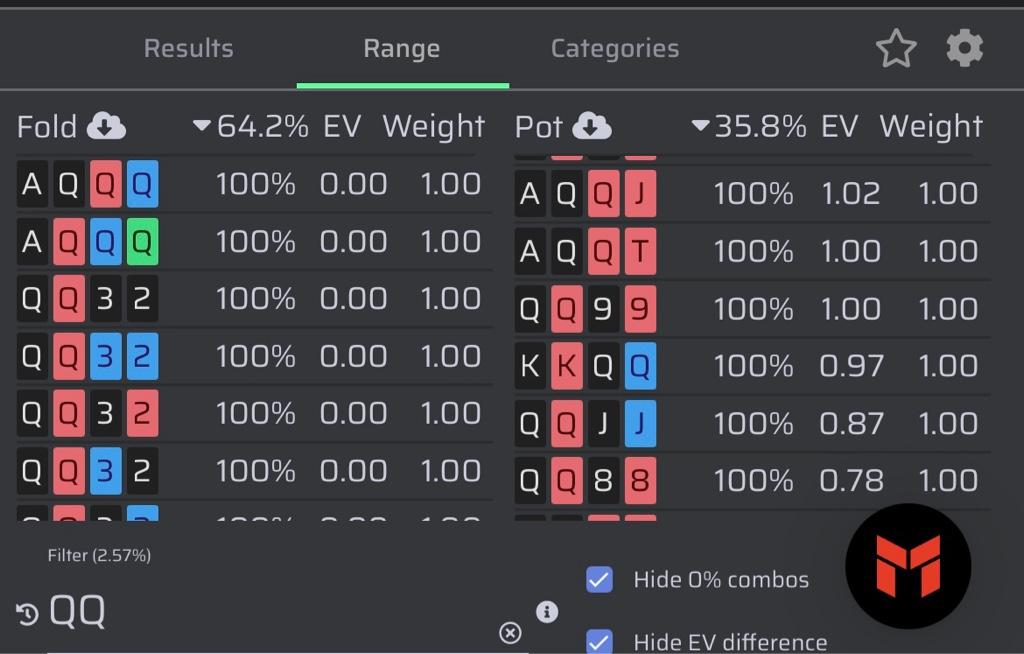
Regarding QQ66r: if a player with a very high VPIP is in the blinds, would you say that changes the decision to open preflop? The fold equity on the open would be close to 0, but does the postflop value increase?
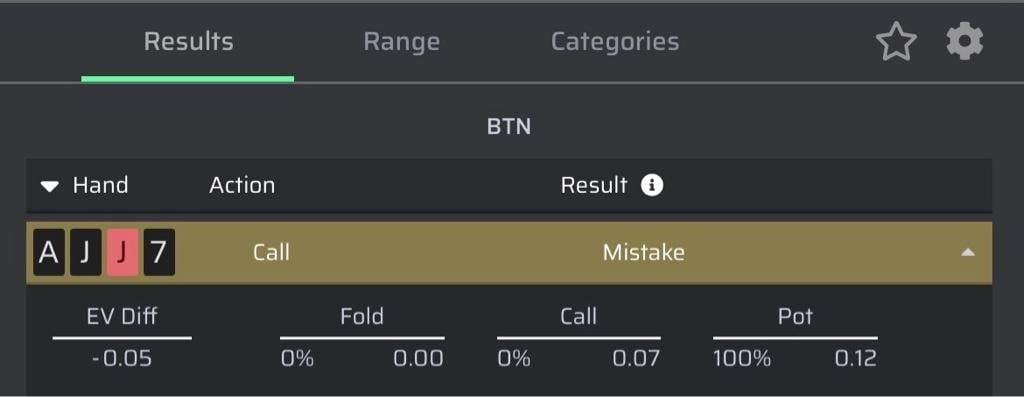
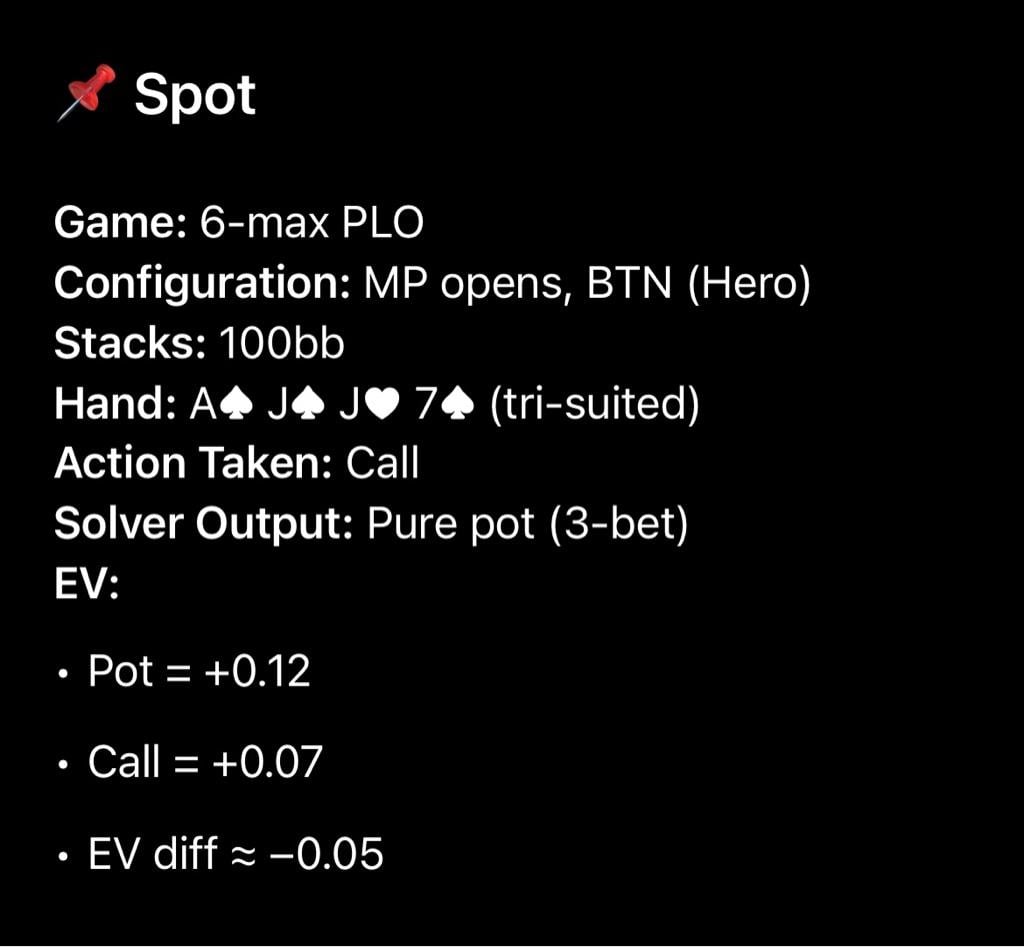
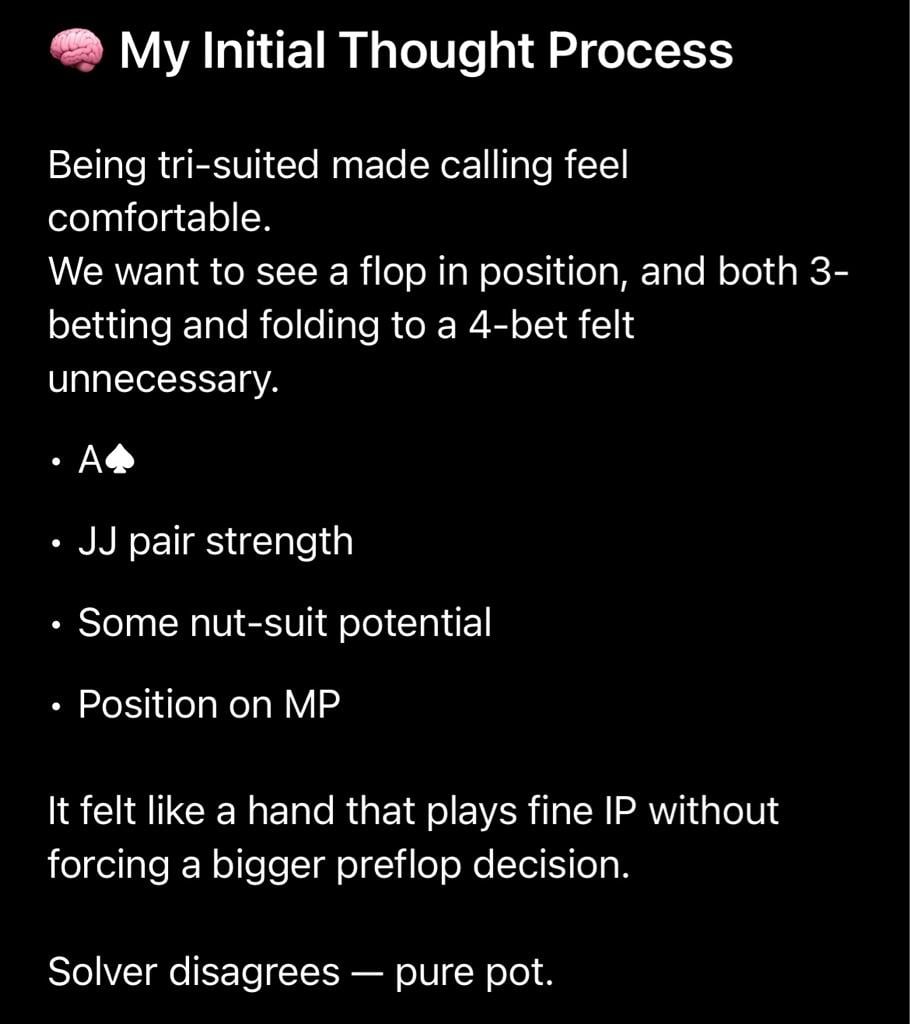
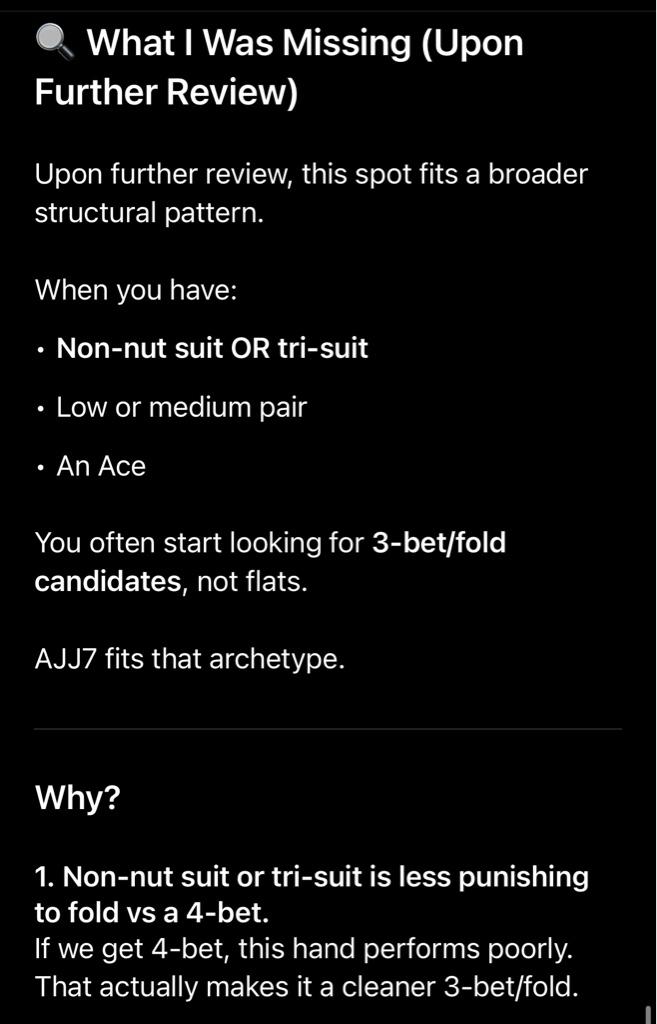
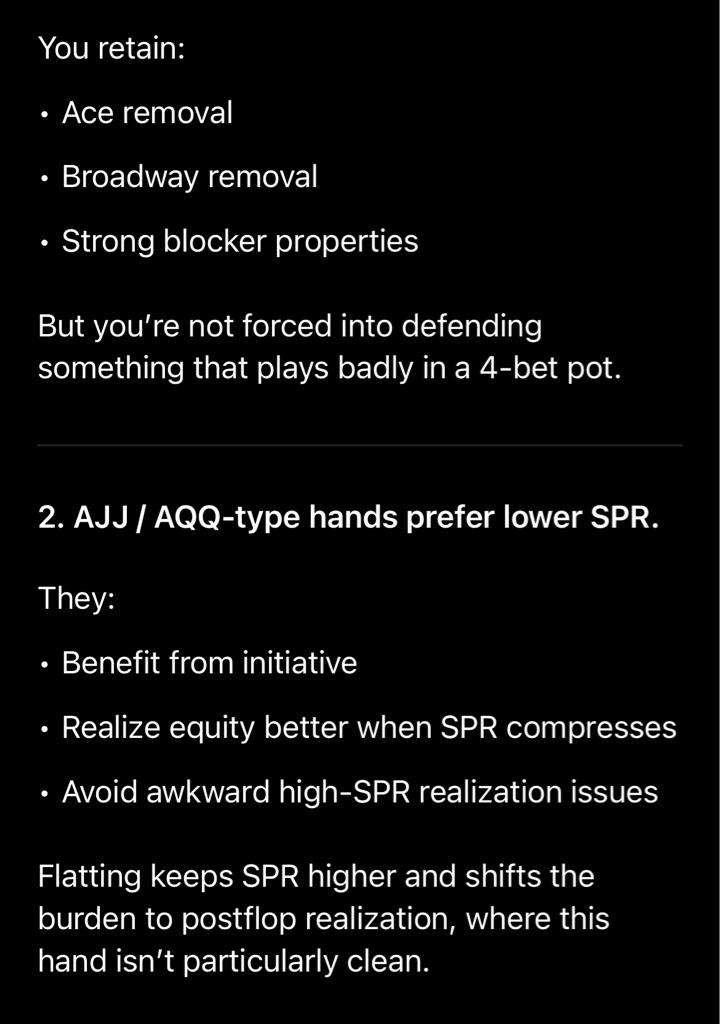
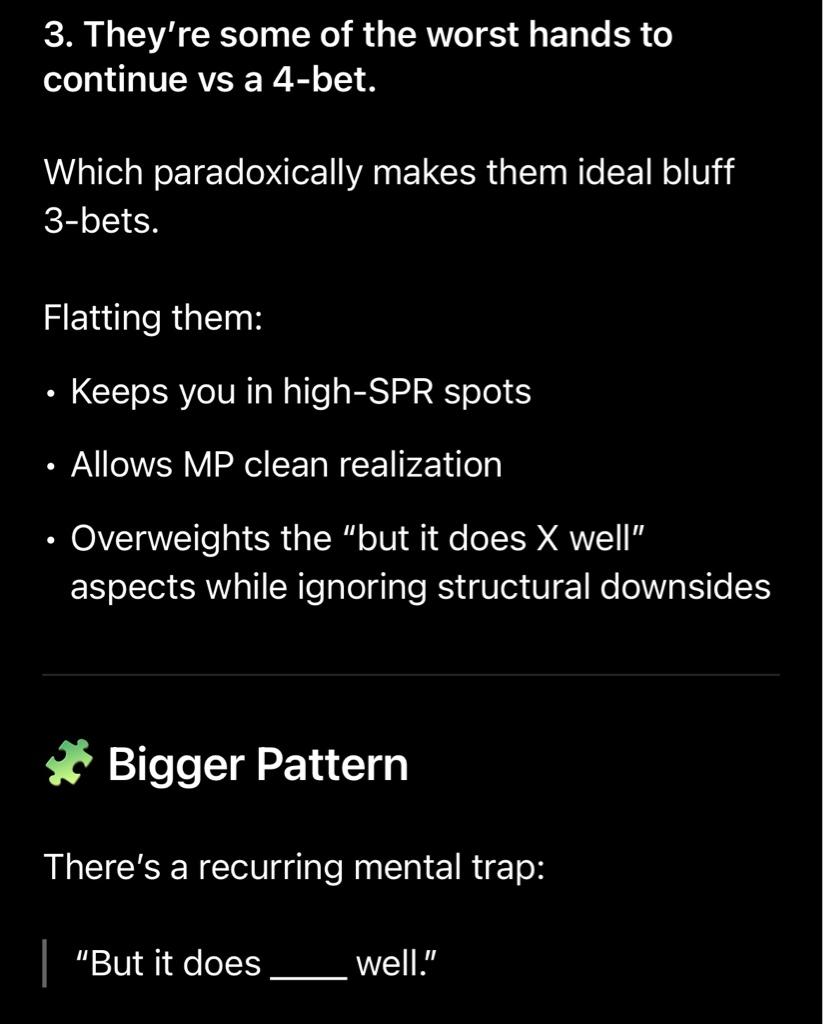
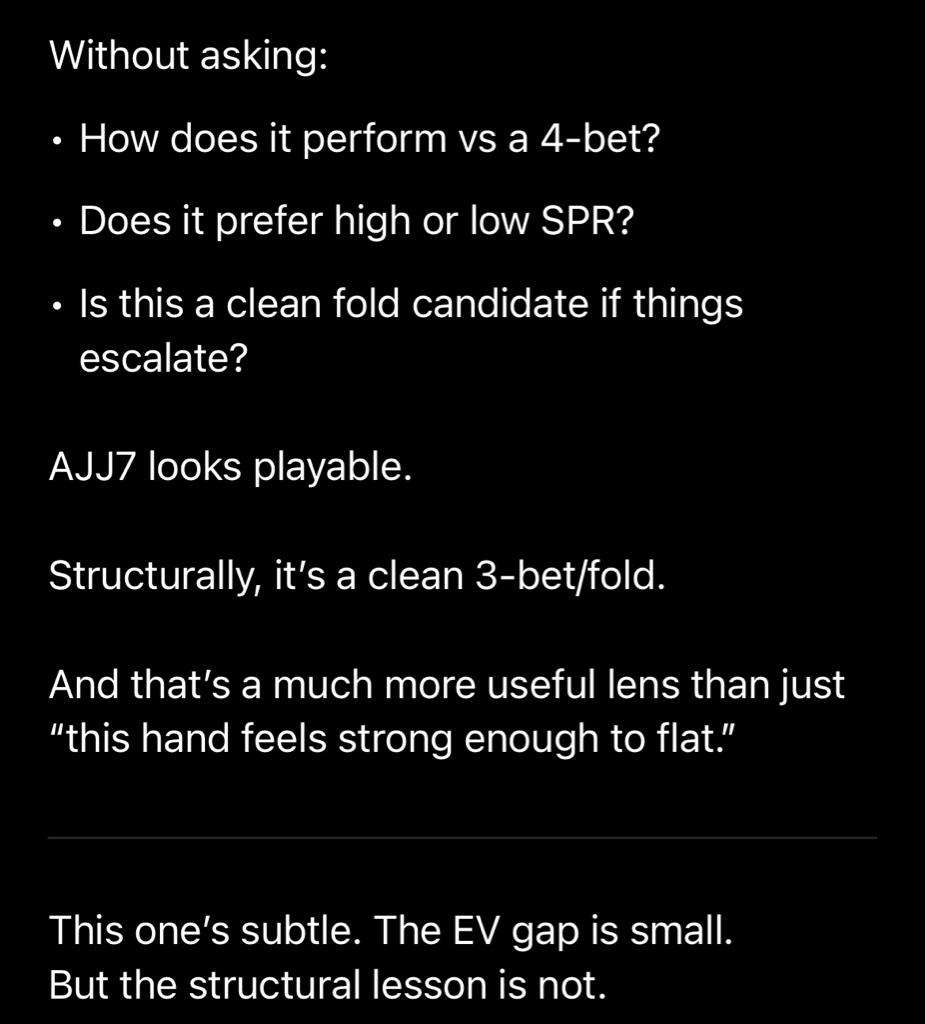
Thanks for sharing your findings. A few remarks regarding the AJJ7:
Initiative isn't a GTO concept.
I wouldn't combine tri-suited and non-nut-suited hands. Non-nut-suited hands frequently 3bet more to keep the pot heads-up.
These spots appear highly sensitive to rake. In my sim AJJ7 tri-suited calls.
by da_ve m (https://www.twoplustwo.com/post?postId=59240763#post59240763)
Regarding the AK22ds VS ATT3ss, one aspect you did not mention in the analysis (or i've missed it) is the "ds" VS "ss". Could it be that this weighs in more heavily than you'd think
The AK22 was single suited, it was surprising that the solver prefers AK22ss vs ATT3ss
by da_ve m (https://www.twoplustwo.com/post?postId=59240765#post59240765)
Regarding QQ66r: if there would be a high VPIP player in the blinds, would you say it changes to an open the preflop fold equity will be near 0, but does the postflop value improve
this is a great question, thank you! Generally yes, assuming all else equal, let me look deeper and ask someone better at plo though. It varies by hand class and also a high VPIP player being in the BB is far more impactful than one in the SB (generally speaking).
by Jimbotbs m (https://www.twoplustwo.com/post?postId=59241040#post59241040)
Thanks for sharing your findings. Some points concerning the AJJ7:
Initiative isnt a GTO-concept
I wouldnt group tri-suited and non-nut-suited hands together. Non-nut-suited hands often 3bet more to get the pot heads up.
These spots seems to be very sensitive to rake. In my sim AJJ7 tri-suited calls.
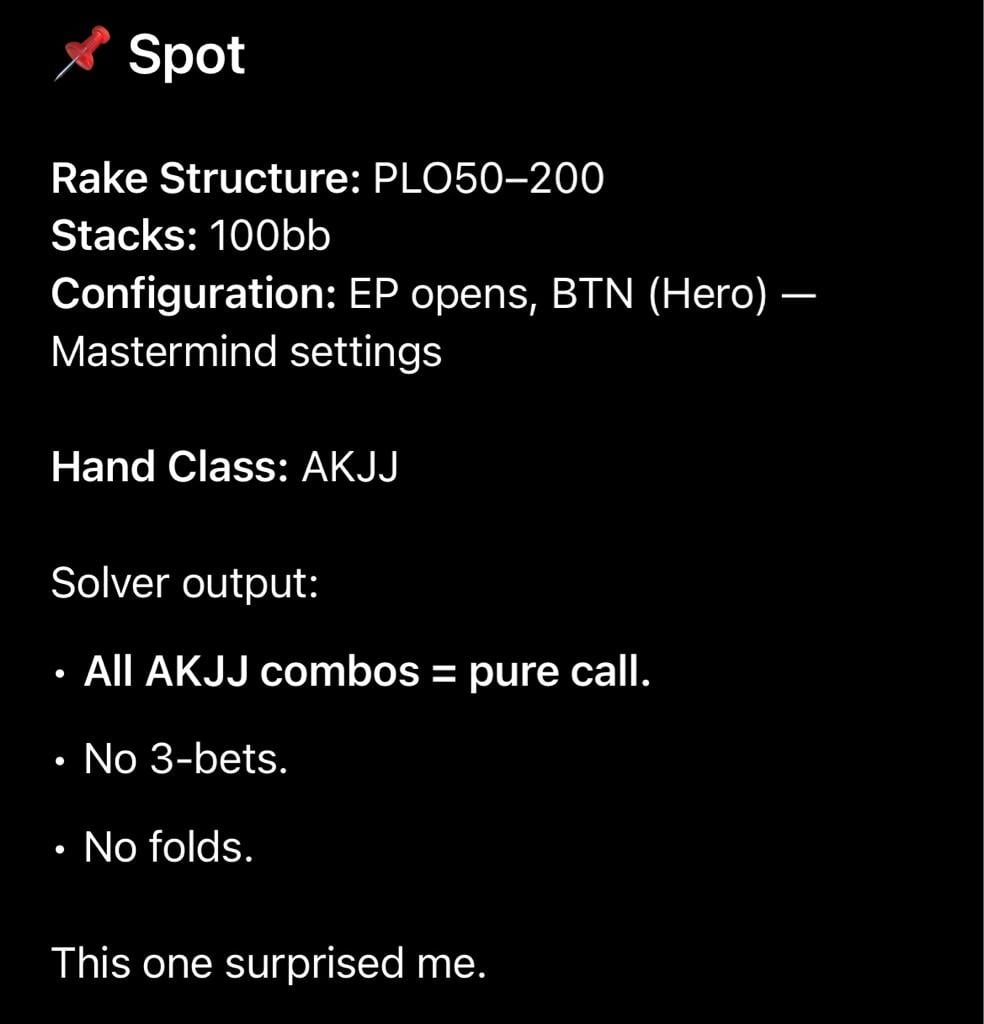
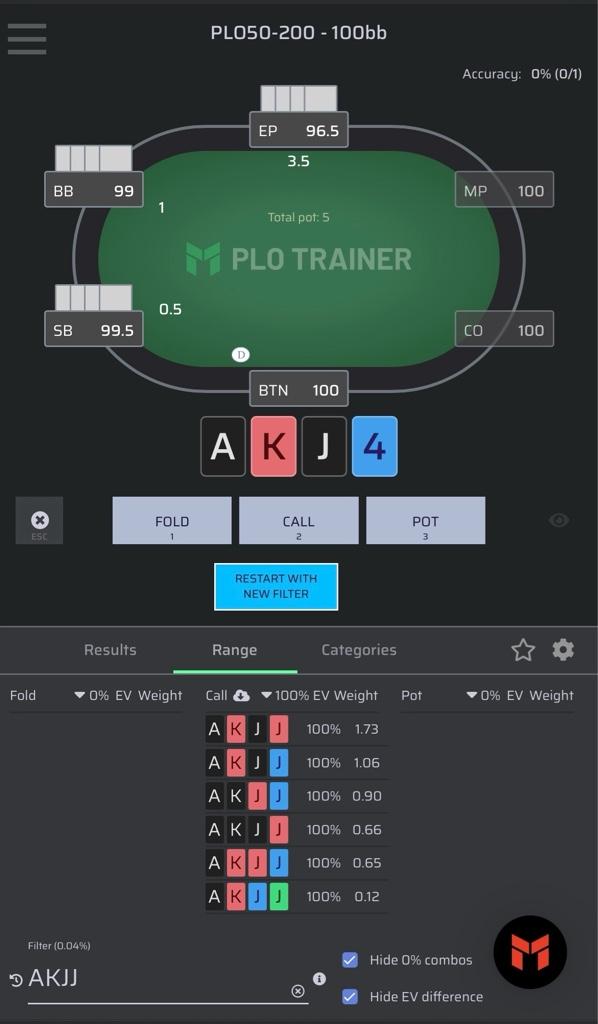
Thank you! Rake is set to plo 50-200. Definitely very impactful. I made a mistake by not including that, thanks! I’ll mention the rake structure starting the next analysis. I’ll try to share analyses from varying rake structures for edge cases. It’s something i do on my own but for the thread i want to add as much value as possible and high rake environments are the unfortunate reality for most. So that will be the default when only one is featured. I really appreciate the feedback
( )
(
 )
If we’re not 3betting this hand type for value in position, which Ax hands that aren’t AAx do we 3bet for value? Or phrased differently: how much does the blocking effect of holding Ax reduce the chance of being 4bet? I get that AKKx is typically a value 3bet because of its mix of value and blocker properties, but I’m also curious about hands like AKQJds and similar.
AKJJ: One important point is that we block villains folding range by having a K.
by DrTJO m (https://www.twoplustwo.com/post?postId=59241326#post59241326)
If we aren’t 3betting this class of hands for value when IP, then which Ax holdings that aren’t AAx do we 3bet (for value)? Or put another way: how much does the blocking effect of holding Ax offset the chance of being 4bet? I get that AKKx is commonly a value 3bet, because of its mix of value and blocking, but I’m also curious about AKQJds and similar hands.
Here are some Ax examples that aren’t AAx that we 3bet and then call a 4bet. (-12 would be if we fold after 3betting the pot) AKQJds 3bet pure and then call pure versus 4bet. (-10) AQJTds 3bet pure and then call pure versus 4bet (-8.2) AKQTds 3bet pure and then call pure versus 4bet (-10.4). It’s obviously very bad for us when we face a 4bet, but in most cases we have no realistic alternative but to continue. Thanks for the excellent questions, sir! I hope my answers are useful. If not, tell me why and I’ll revise accordingly. by Jimbotbs m (https://www.twoplustwo.com/post?postId=59241427#post59241427)
AKJJ: One key note is that holding a K blocks parts of villain’s folding range.
Yeah, good point. Thanks, sir
Appreciate the PLO stuff RTP, love seeing it as — it’s mostly been 4 cards for me over the last few years.
by Petrucci m (https://www.twoplustwo.com/post?postId=59241564#post59241564)
Really value the PLO content RTP, glad to see it as it’s largely been 4 cards for me over the last few years.
No worries, thank you so much for expressing your appreciation! How have life and your poker grind been these past few years? Still living abroad?
by RoadtoPro m (https://www.twoplustwo.com/post?postId=59241569#post59241569)
No worries, really appreciate you sharing your support! How have life and poker been treating you these last few years? Still living abroad?
Thanks for asking, man! It’s mostly been good — I’ve been placing extra emphasis on exercise and cleaner eating over the past couple of years as I’m not getting any younger (mid-forties now), so working on my health and lifestyle is a real motivator. I can’t complain about poker either, although downswings seem to sting more than they used to. I mostly play in loose private games, so when variance turns against you in PLO it can get ugly with lots of multiway all-in pots, for example. I don’t play online — only live — where I feel I can leverage my biggest edges: reading people, pattern recognition, live tells, that sort of thing. How about you? Are you flexible and playing both online and live? Do you still play any NL, or are you strictly on the gambling side?
by Petrucci m (https://www.twoplustwo.com/post?postId=59241594#post59241594)
Thanks for asking man! Its been mostly good,focusing extra on exercising and eating clean the past couple of years as i am not getting any younger (mid fourties now)-so working on health/lifestyle really motivates me.I am not complaining on poker either,even though the downsvings does hit deeper compared to when i was younger i feel like. I play in loose private games mostly,so... See full post
[emoji3590] Thanks for sharing. Respect the focus on health and lifestyle. I’m mostly playing apps and live right now. Most of my volume is still NL — I’ve logged well over a million hands at this point and still love the game. If I wasn’t paying the bills through gambling, I’d probably play mostly PLO. From a pure EV/hour standpoint it doesn’t make sense for me to grind it seriously yet. I’m hoping when I’m ready I can jump straight into the bigger games and avoid the high-rake, low-hourly midstakes grind. I’ve also been allocating energy into a few other profitable ventures, so bandwidth matters. That said, even a couple hours of efficient, consistent study per day compounds fast. The goal is to keep it structured and steady instead of frittering that time away. If we can make the group study in here something to genuinely look forward to, that’s a win.
As we speak of study/discussing PLO strat-dont know if its appropriate OP so thats why i ask,but is it okay for you if i post a topic regarding adjusting to some live PLO dynamics i am looking for others opinion on in this thread? I am not sure if you prefer this thread to be mostly personal blogstyle for you,or if other posters is welcome introducing topics for debate and such.
sure, just don’t get carried away lol. thanks for asking
by RoadtoPro m (https://www.twoplustwo.com/post?postId=59241692#post59241692)
sure, just don’t get carried away lol. thanks for asking
TY no problem,its just a broad adjusting/exploiting scenario i am looking for second opinions on. Gonna get to it when i have the time,looking forward to follow this thread with PLO focus moving forward[emoji4]
These spots seems to be very sensitive to rake. In my sim AJJ7 tri-suited calls.
I guess this is based on the assumption that there is no preflop rake, so at high rake you want to end the hand preflop and pay none. But on GGpoker specifically this is not the case, I recall there is preflop rake when there is a 3bet+. I wonder if that is taken into account by the ggpoker sims on PLOMM.
by RoadtoPro m (https://www.twoplustwo.com/post?postId=59241117#post59241117)
by da_ve m (https://www.twoplustwo.com/post?postId=59240765#post59240765)
Regarding QQ66r: if there would be a high VPIP player in the blinds, would you say it changes to an open the preflop fold equity will be near 0, but does the postflop value improve
this is a great question, thank you! Generally yes, assuming all else equal, let me look deeper and ask someone better at plo though. It varies by hand class and also a high VPIP player being in the B... See full post
While SB or BB should make a difference, I wouldn't be surprised if high VPIP players don't see it that way. I suspect it's more along the lines of: "I already put money in the pot so I'm not going anywhere.", or just that most 4card hands appeal to them enough to see a flop regardless of the price. But I don't have any data to back this up. But I'm very curious about the answer, as I also play a lot of PLO with at least one high vpip player on most tables. I often isolate them pretty light in position and the QQ66r I would currently open (or isolate a limp IP) for sure. So I wonder if this is a mistake. Instinctively I'm inclined to think the value from their too big of a range + postflop mistakes makes it more profitable than the GTO EV, especially when they're loose-passive and honest postflop.
Hey Interesting thread I like how you’re documenting your solver journey in a thoughtful, clear and concise way Regarding ATT3 v A/small pair, apologies if someone else mentioned this but I didn’t hear how valuable TT functions as straight blockers. TT is a unicorn pair as it blocks every nut straight from 6-A. Being able to blast with TT on those boards generates a ton of EV
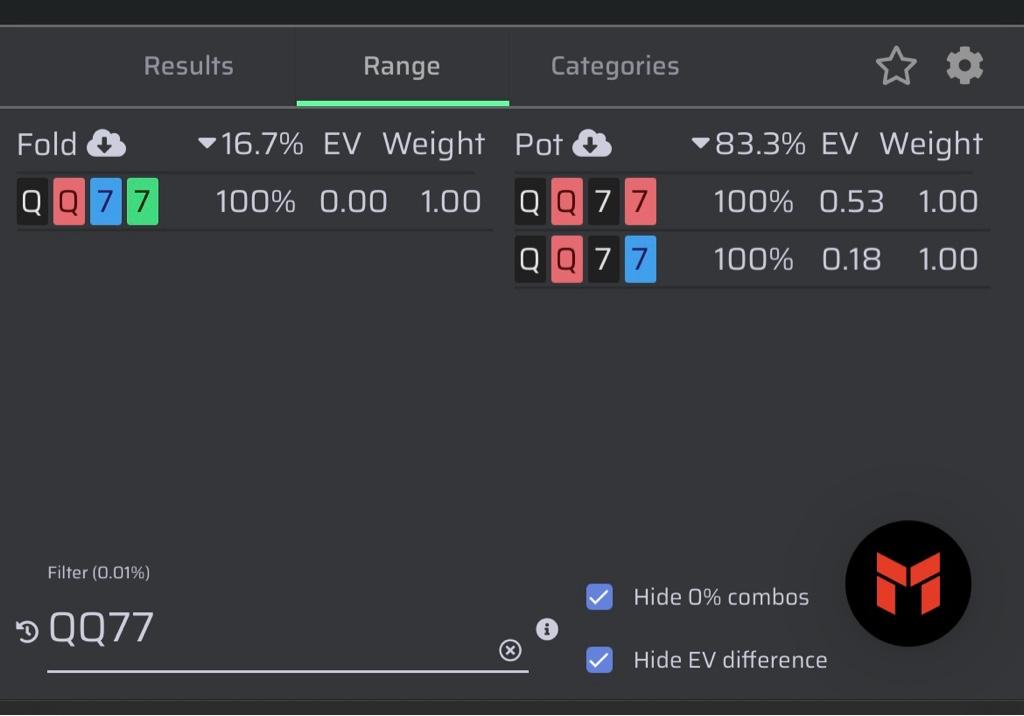
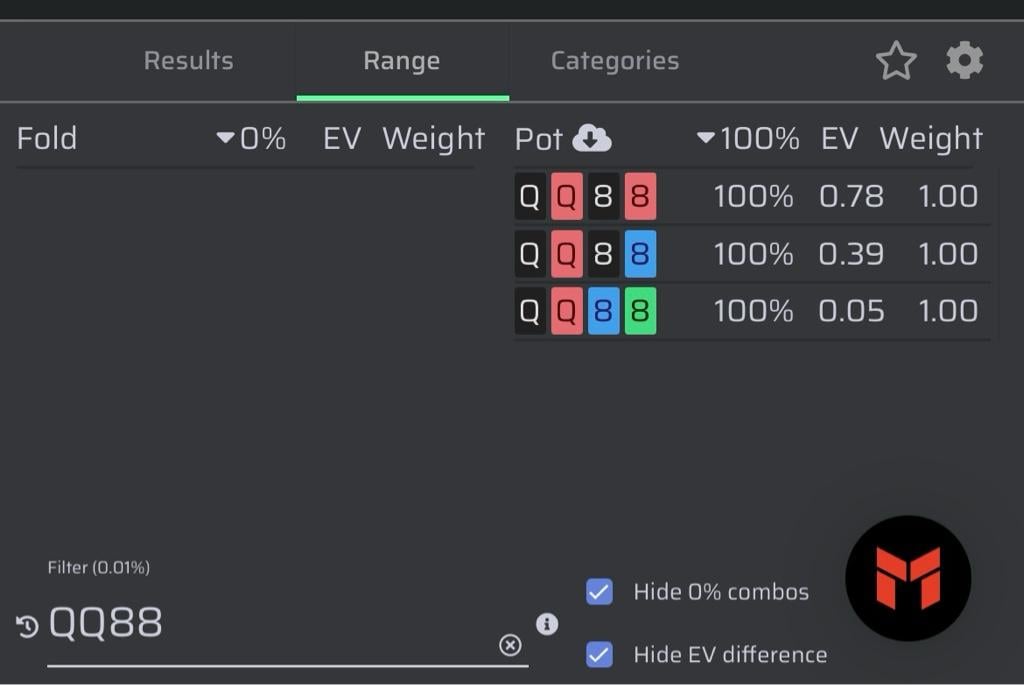
Apologies if someone else mentioned it but the thing that most makes QQ77r and lower second pairs pure folds isn’t the second pairs rank, imo (and I believe in the solvers opinion as well) is the fact that QQ88 makes a straight. The fact that you have a set of 8s v a set of 7s isn’t pushing the needle very much. You did mention connectivity in your key takeaways but it wasn’t clear to me that you meant the 8 connects to the Q, just that medium pairs need connectivity in general, which is of course true
by da_ve m (https://www.twoplustwo.com/post?postId=59241749#post59241749)
I guess this is based on the assumption that there is no preflop rake, so at high rake you want to end the hand preflop and pay none. But on GGpoker specifically this is not the case, I recall there is preflop rake when there is a 3bet+. I wonder if that is taken into account by the ggpoker sims on PLOMM.
I actually asked a strong reg about this who knows the backend stuff pretty well. He said PLOMM runs on Monker and there’s a rake toggle built in, so it should be accounting for rake correctly. My guess is most regs studying are using a PLO500 rake environment rather than zero rake anyway. Zero rake would obviously skew a lot of these close preflop spots. Realistically, I don’t think established 500+ online regs that come across this are getting a ton of incremental value from these baseline configs either, so I’m comfortable defaulting to PLO50–200 or PLO100 depending on the ante structure. I also have access to some PLO app games with antes similar to what you see on Coin, so I’ll mix some of that in too to keep things practical.
by da_ve m (https://www.twoplustwo.com/post?postId=59241759#post59241759)
While SB or BB should make a difference, I wouldn't be surprised if high VPIP players don't see it that way. I suspect it's more along the lines of: "I already put money in the pot so I'm not going anywhere.", or just that most 4card hands appeal to them enough to see a flop regardless of the price. But I don't have any data to back this up.But I'm very curious about the answer... See full post
I checked in with a strong reg about this and it does seem like your thinking is spot on. Intuitively that was my sense as well, but I think it’s really important not to operate on assumptions — especially in PLO where small structural differences can matter a lot. I appreciate you pushing the question and looking at it from different angles. That said, this is very much an all else equal conclusion. The presence of an ante, aggressive players behind, squeeze dynamics, stack depth, etc., can absolutely have a larger impact than a single high VPIP player in the blinds. Those factors often shift EV more meaningfully than just blind composition alone. Still, great curiosity and a really worthwhile discussion point
by throwaway1million m (https://www.twoplustwo.com/post?postId=59241966#post59241966)
Hey Interesting thread I like how you’re documenting your solver journey in a thoughtful, clear and concise way Regarding ATT3 v A/small pair, apologies if someone else mentioned this but I didn’t hear how valuable TT functions as straight blockers. TT is a unicorn pair as it blocks every nut straight from 6-A. Being able to blast with TT on those boards generates a ton of EV
by throwaway1million m (https://www.twoplustwo.com/post?postId=59242008#post59242008)
Apologies if someone else mentioned it but the thing that most makes QQ77r and lower second pairs pure folds isn’t the second pairs rank, imo (and I believe in the solvers opinion as well) is the fact that QQ88 makes a straight. The fact that you have a set of 8s v a set of 7s isn’t pushing the needle very much. You did mention connectivity in your key takeaways but it wasn’t c... See full post
Hey, thank you. I really appreciate that. And thanks for taking the time to share your perspective. The point about TT functioning as a unicorn straight blocker from 6-A boards was insightful, at least to me. I hadn’t framed it quite that explicitly, and you’re right that being able to lean into aggression with those blocker properties is a big part of where the EV comes from. Also your clarification on QQ88 vs QQ77 makes sense. It’s less about “8s vs 7s” as a set and more about the fact that the 8 actually completes connectivity with the Q and unlocks straight potential. That’s a meaningful structural difference, not just a rank difference. Appreciate you reading closely and adding to the discussion.
( )
(
 )
(
 )
( )
(
 )
(
 )
(
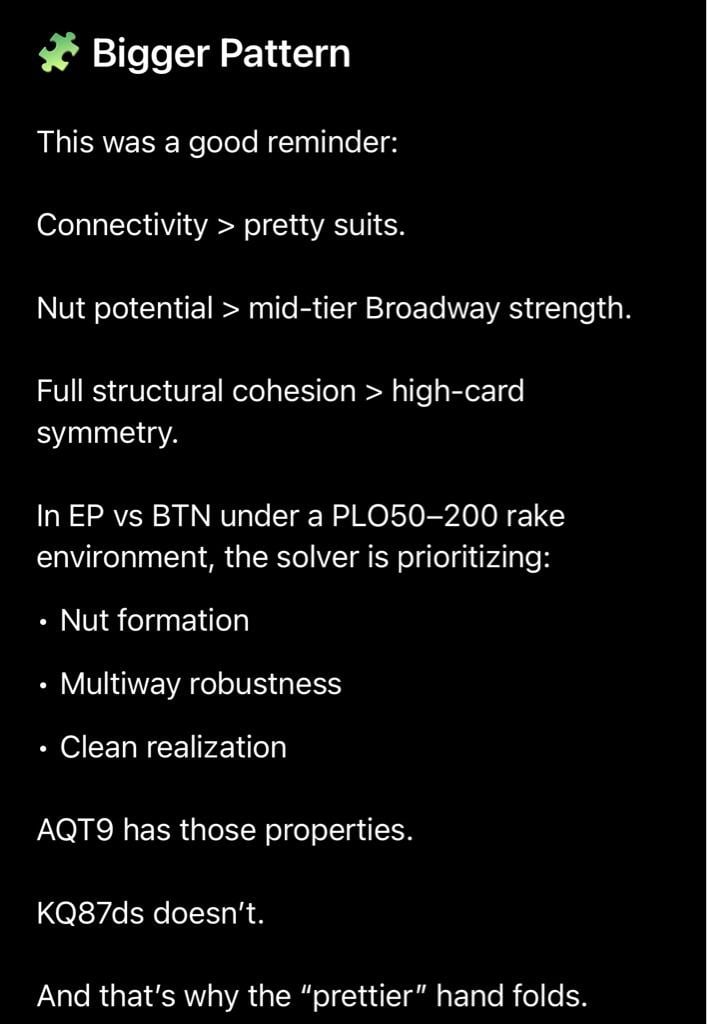 )
Another thing that comes to mind for AQT9 vs KQ78, is that when we hold an A, EP should have 50% less AA combo's in their range
Another thing that comes to mind for AQT9 vs KQ78, is that when we hold an A, EP should have 50% less AA combo's in their range
Another thing that comes to mind for AQT9 vs KQ78, is that when we hold an A, EP should have 50% less AA combo's in their range
by RoadtoPro m (https://www.twoplustwo.com/post?postId=59242396#post59242396)
That said, this is very much an all else equal conclusion. The presence of an ante, aggressive players behind, squeeze dynamics, stack depth, etc., can absolutely have a larger impact than a single high VPIP player in the blinds. Those factors often shift EV more meaningfully than just blind composition alone.
fair points, agreed! thanks for the reply
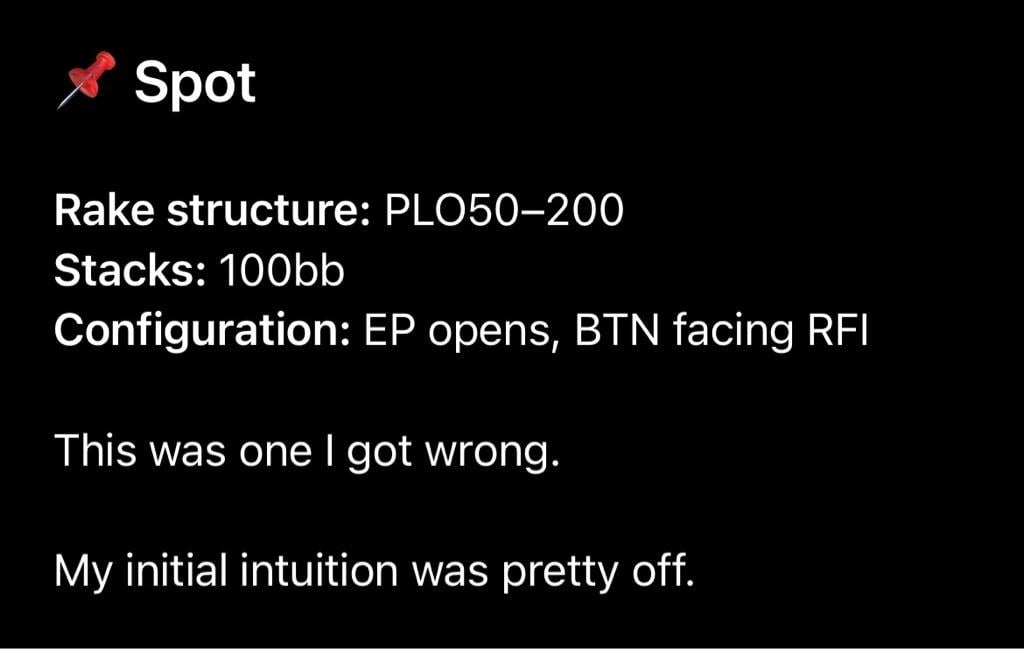
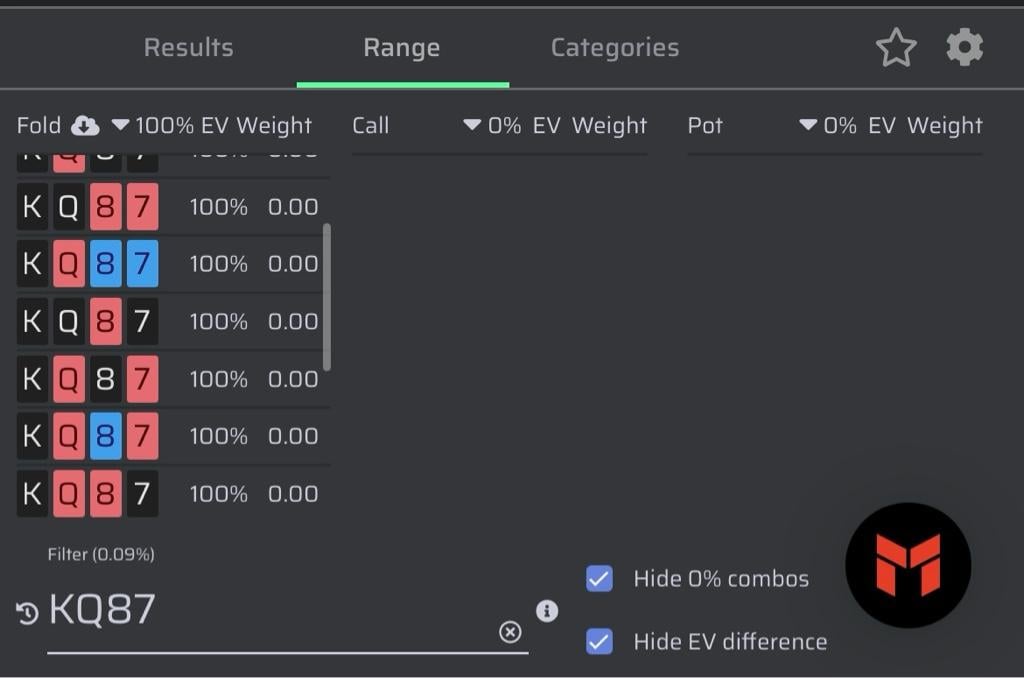
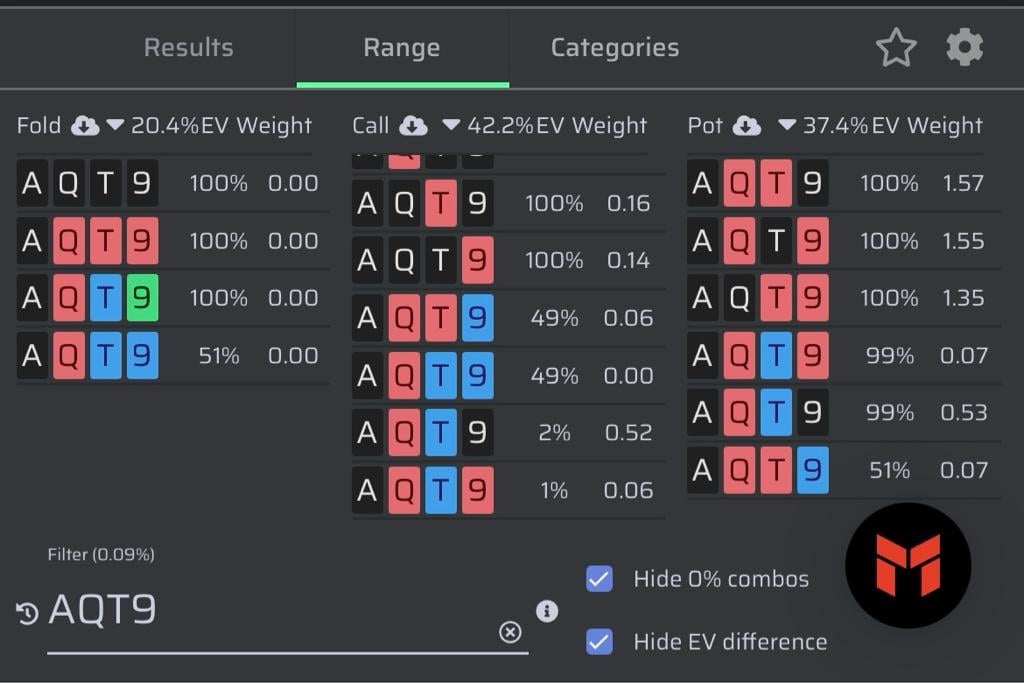
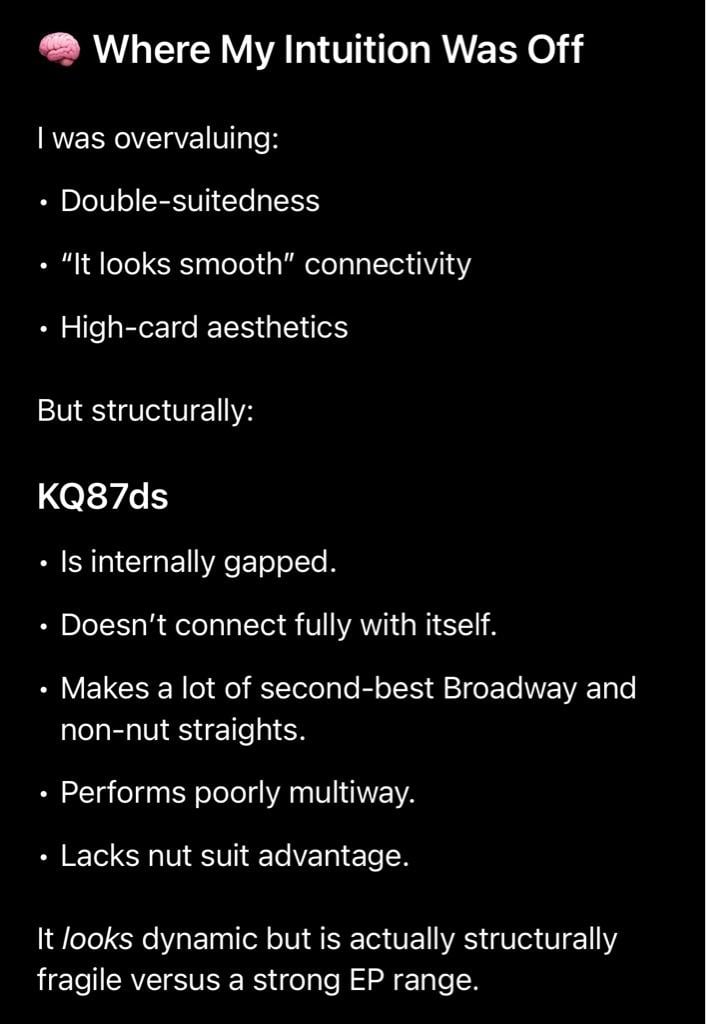
I suspect that if we substitute Ax for either the K or Q in the KQ87ds combo it'd be a pure call. One clear example where the gappedness of KQ87 matters is JTx flops on which we're vulnerable to some nut straight-draw combos as well as wraps (although vs wraps we have some handy blockers).
by da_ve m (https://www.twoplustwo.com/post?postId=59242668#post59242668)
Another thing that comes to mind for AQT9 vs KQ78, is that when we hold an A, EP should have 50% less AA combo's in their range
by DrTJO m (https://www.twoplustwo.com/post?postId=59242929#post59242929)
I suspect that if we substitute Ax for either the K or Q in the KQ87ds combo it'd be a pure call. One clear example where the gappedness of KQ87 matters is JTx flops on which we're vulnerable to some nut straight-draw combos as well as wraps (although vs wraps we have some handy blockers).
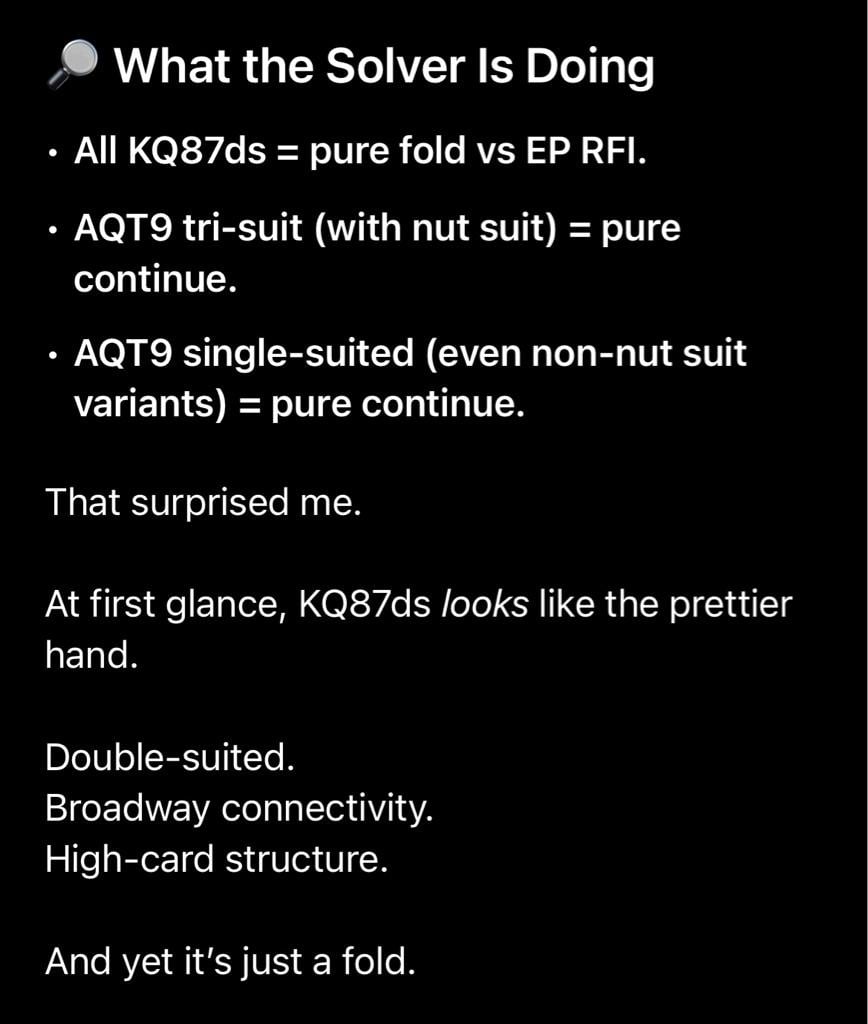
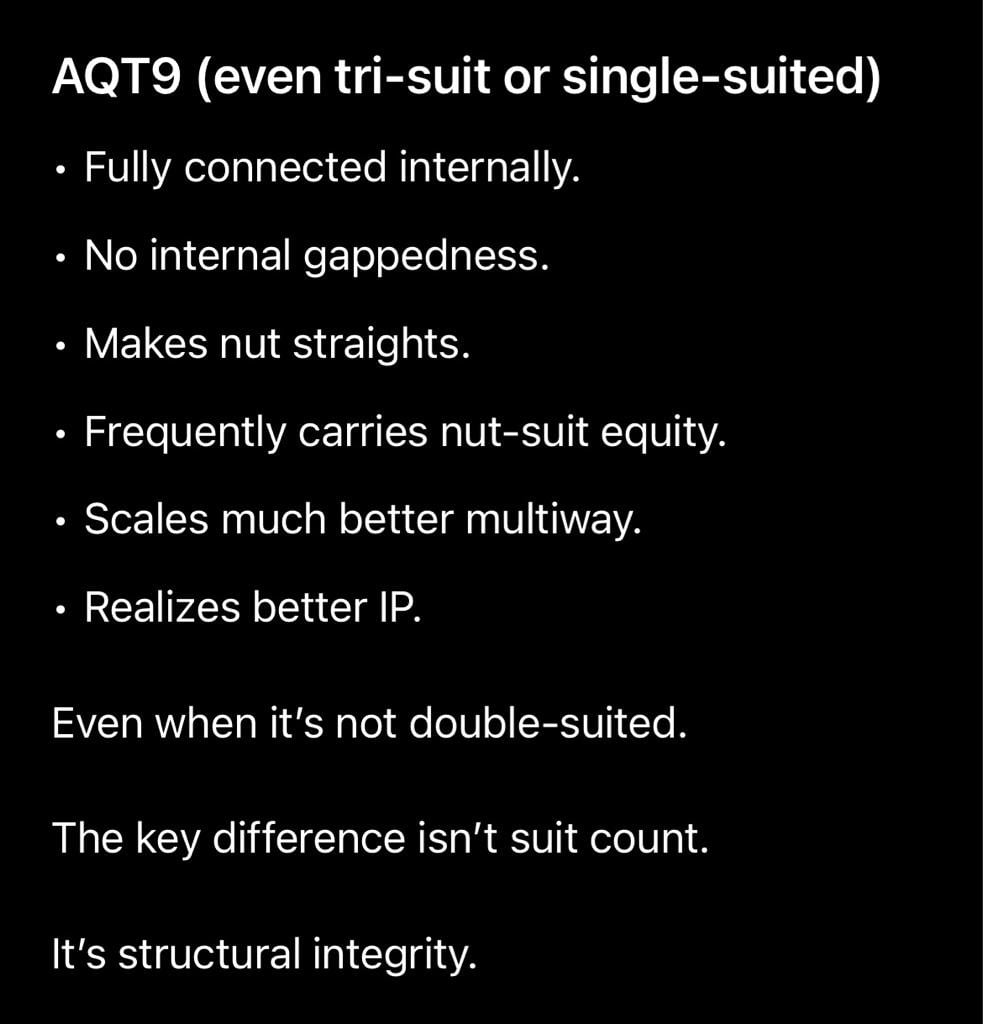
so great points for sure which I believe are accurate but coach says bigger thing here than the configuration or blocker effects is just that aqtr is a notably better hand than KQ87ds — even if tri suited (nut suit) or single suited (non nut suit) — which I didn’t realize. the ds variety of AQT9 >>> KQ87ds of course
I'm really liking these analyses, the reasoning sticks much better than trying to remember combinations. I do dabble in the preflop trainer sometimes but often fail to understanding the why's. I'm building a roll while learning PLO, currently at PLO50 and taking shots at 100 on GG. Consider me subscribed!
by da_ve m (https://www.twoplustwo.com/post?postId=59243079#post59243079)
I'm really liking these analyses, the reasoning sticks much better than trying to remember combinations. I do dabble in the preflop trainer sometimes but often fail to understanding the why's. I'm building a roll while learning PLO, currently at PLO50 and taking shots at 100 on GG. Consider me subscribed!
100% agree. I'm new-ish to plo and very new to any poker studying outside of passively watching videos, so to see this type of breakdown when it comes to solver studying has been incredibly helpful!
Thank you guys, I really appreciate that. I am glad these analyses and breakdowns are helpful. It means a lot that you are engaging and finding value in it.
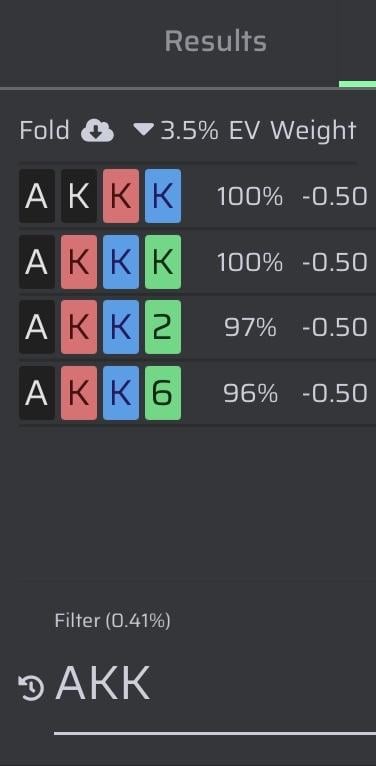
(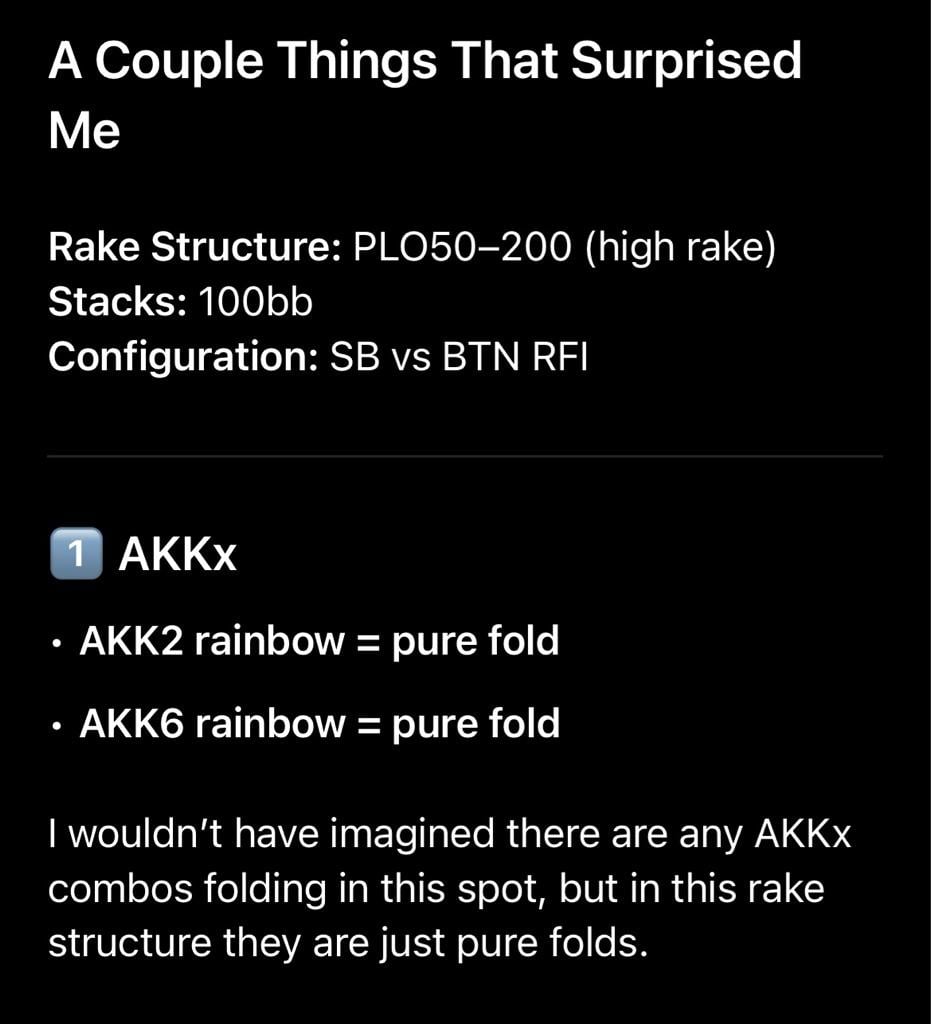*they) CAN be pure folds vs many villains.
( )
(
 )
(
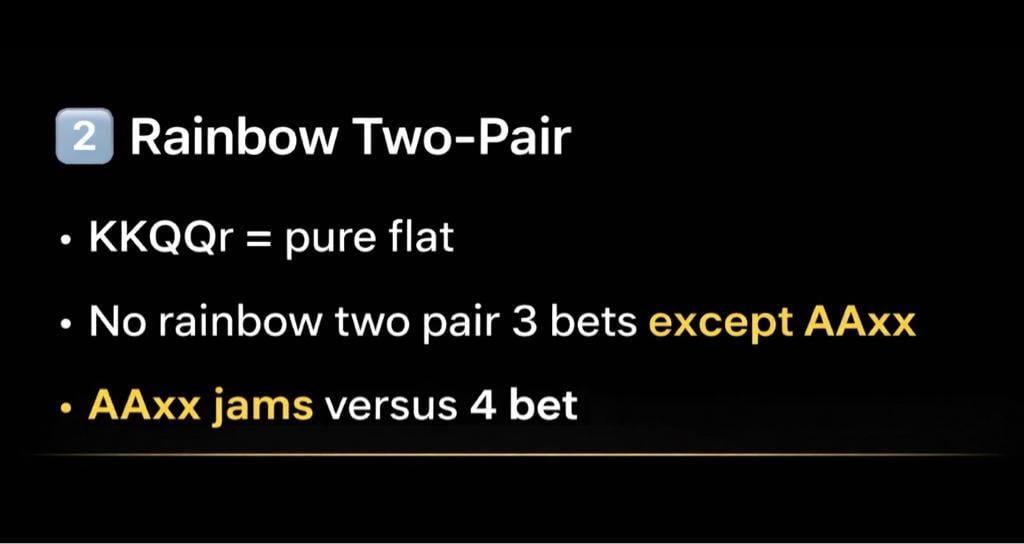
(our) two pair vs BTN 4-b)
(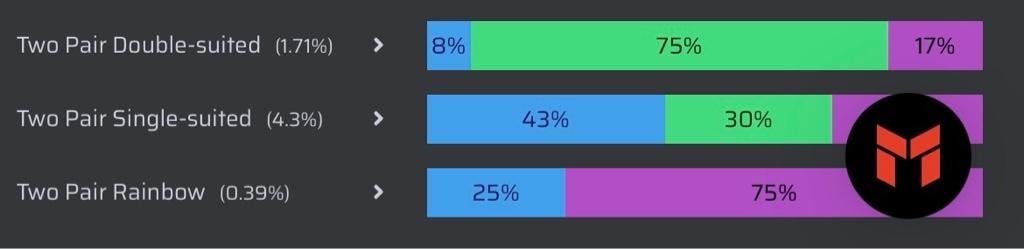 )
This reminds me of some of my rare study notes that I did make: "flatcalling from SB" vs RFI specifically (same rake structure). I studied this specifically because flatcalling too many hands from the SB was a leak for me starting out with PLO. I'll share them here: Why flatcalls from SB should be pretty rare
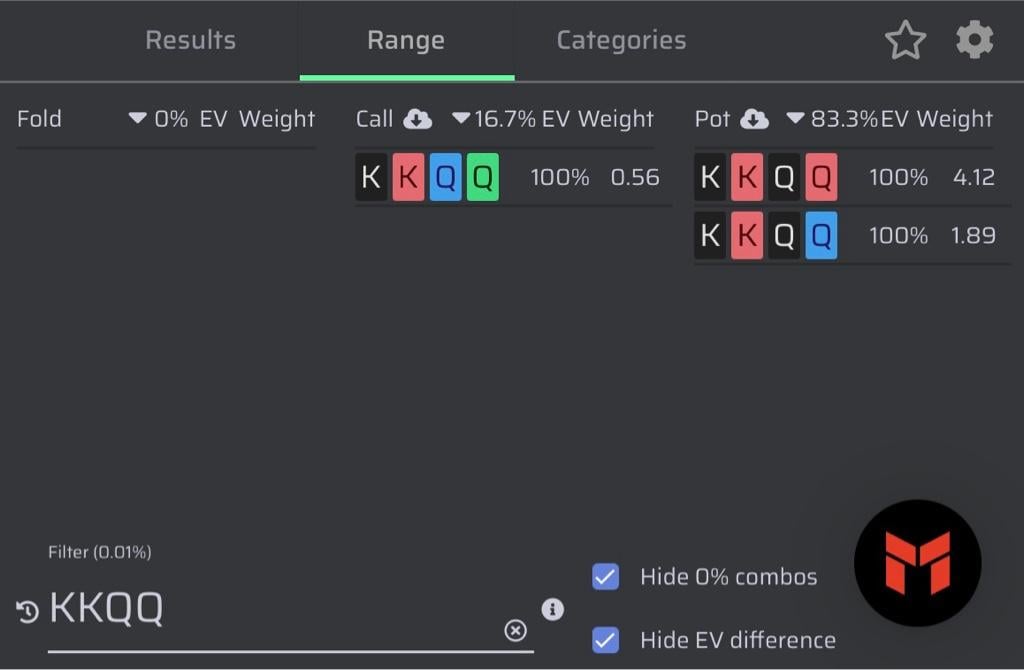
Funnily enough, the exact KKQQr SBvsBTN i left in the 3bet range for simplification, as KKJJr - KK99r are all 3bets. The ev diff for KKQQr 3bet is -0.07 in solverland so not a huge mistake (and my memory for exceptions is bad).
thank you for sharing all of that!
I started drilling live 25/25/50 PLO in the trainer today and figured seeing what “optimal” — or at least fundamentally and theoretically sound — preflop looks like 8-handed with a straddle would be interesting to document here. Most of my PLO Trainer work has been HU, 4-max, and 6-max, so a lot of this should be pretty fresh. This thread has been around for a while and tends to go in a lot of different directions. I usually clean it up when I go quiet, in part so it’s still readable, but it’s fun while it lasts. For now I’ll probably use it as a mini library — poker, theory, things I’m working on, and anything useful I pick up along the way. Even if one person now or sometime down the road finds something useful in the collection of thoughts and advice from everyone who’s posted in here over the years, I figure it’s worth keeping around. Maybe that person eventually gets good enough to support themselves and build some real freedom through the game. That would be pretty cool. I’m mostly interested in understanding and simplifying things rather than pretending to have all the answers. At the end of the day I’m clicking buttons like everyone else, so questions, thoughts, disagreements, and different ways of looking at spots are always welcome.
(Something) you may find surprising is that T987ss and 8654ss are both pure opens from EP. It seems pretty unintuitive imo that hands in this neighborhood are still clear continues from this early of a position, especially considering rake.
I’m not sure what rake structure this specific sim is using, but I would’ve expected some of these less dominant single-suited rundowns and gapped rundowns to start falling out of the opening range. It’s interesting how much value the solver is assigning to connectedness even when the hand lacks especially strong high-card or nut-suit properties.
(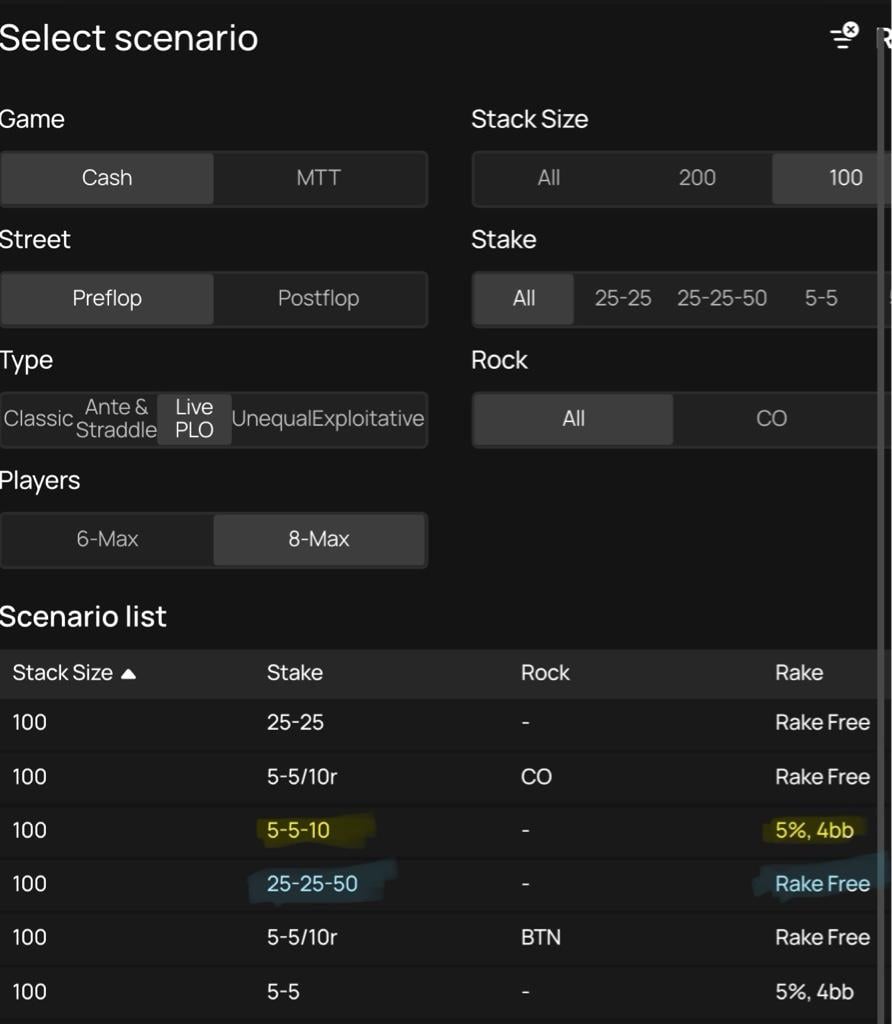Clicked) around on the new UI today and realized the 25/25/50 sim is rake-free, while the 5/5/10 sim is 5% rake with a 4 BB cap.
Worth noting that T987ss and 8654ss are both folds from EP1 in the raked environment at equilibrium.
(Today) I’m drilling 25/25/50, 100bb, 8-max, rake-free EP2 RFI, which opens 16.8%, up from 14.0% in EP1. Three marginal opens that stood out are
This is from PG’s “This Is PLO”, but wanted to bookmark it here as a reminder because I think it conceptualizes something really well. It’s been a while since I’ve gleaned insight from the great book below. Big Edges come from High-Level Thought System 1 vs System 2 Thinking, Fast and Slow by Daniel Kahneman System 1:
System 1 and System 2 at the Poker Table System 1:
(Today) I’m moving on to MP RFI in the same 25/25/50, 100bb, 8-max, rake-free structure. The range expands from 16.8% in EP2 to 20.8% in MP. Three marginal opens that stood out are:
9♥ 8♥ 8♦ 7♠ gets there despite being single-suited because the pair is embedded in a highly connected 987 structure, giving it considerably more cohesion than a typical middling pair.
7♦ 6♦ 5♥ 3♠ has very little high-card strength, but the 7653 structure provides enough connectivity and straight-making potential to cross the MP threshold.
A♠ T♠ 7♦ 4♥ is almost the opposite hand class—the lower cards are poorly connected, but the nut suit plus A-T high-card strength is enough to make it a marginal MP open.
Today’s Notes from This Is PLO by Mr. Galfond Much of this is taken directly from This Is PLO, as Mr. Galfond words things fantastically, and changing the wording may change the accuracy of the message. These are some refreshers and concepts we may find insightful.
(Today) I’m moving on to CO RFI in the same 25/25/50, 100bb, 8-max, rake-free structure. The range expands from 20.8% in MP to 26.8% in the CO. With the 6 percentage point increase, things start to feel a lot more “open good hands, fold bad hands”-esque. In the two EP positions, even in a rake-free environment, there were definitely some folds in optimal that I wouldn’t have considered folding under these conditions in-game, even in a lineup where everyone was a pro and there was rake.
Q♦ T♥ 9♥ 7♠ is a good example of a hand that now enters the range, with strong connectivity through QT97 and a suited T providing enough playability despite lacking an ace, pair, or nut suit.
A♠ 8♠ 6♠ 6♥ also enters in the CO despite being trip-suited and relatively disconnected, with the nut spade suit and paired 6s doing enough to push it across the threshold.
7♦ 6♦ 5♥ 3♠ is another new CO open, with very little high-card or nut potential, but enough low-card connectivity through 7653 to enter the RFI range despite being only single-suited.
(Today) I’m moving on to BTN RFI in the same 25/25/50, 100bb, 8-max, rake-free structure. The range takes another substantial jump, from 26.8% in the CO to 37.9% on the BTN, an increase of 11.1 percentage points.
The BTN is particularly interesting in this structure because with the straddle there are essentially three blinds left behind, rather than the standard two. So even though we have position, the RFI range still has to account for three players with money already committed to the pot.
K♠ 8♥ 7♠ 6♠ gets in despite being trip-suited, with the K876 structure providing enough connectivity to compensate for a fairly weak suit configuration.
8♠ 8♥ 5♥ 3♠ is a pretty unintuitive one to me, a middling pair with disconnected side cards, but being double-suited is enough to help push this structure into the BTN range.
A♠ K♥ 7♠ 3♠ is another trip-suited open, with relatively poor connectivity, but the suited ace plus AK high-card strength is enough to carry it across the threshold.
Also been drilling some NL Trainer here and there on mobile, though it’s not as structured as my PLO studying as of late. OOP SRP, 100bb effective. LJ opens, BB calls. Hero: T♥ 8♥ Flop: T♣ 9♦ 6♣ BB is essentially range checking here. Hero checks, LJ bets 80% pot, Hero calls. T♥ 8♥ calls 85%, mixes in a 46% pot raise 14%, and almost never folds. Turn: 8♠ This card connects extremely well with BB’s flop calling range. BB now has far more 7x straights, two pair, sets, and pair plus draw hands than LJ’s large flop betting range. The solver leads roughly 93% of BB’s entire range, using 35% pot 75% of the time, 80% pot 17%, and checking only 7%. Our exact hand leads 35% pot 92%, leads 80% pot 5%, and checks 3%. The small sizing is extremely wide and merged. It includes pretty much every Tx that reaches the turn, 99, 88, 66, 77 and plenty of the remaining 7x straights, along with various pair plus draw hands. It is not a weak blocker bet, the range is strong enough to lead broadly while still getting called by overpairs, Tx, and draws. The 80% sizing is more selective and polarized. It pulls from strong value such as QJ and parts of the 7x region, including hands like T7s, then balances those hands with high equity draws. Double club combinations provide the actual flush draws, while hands such as KJ containing one club can function as blocker bluffs, retaining open ended straight equity while blocking parts of LJ’s continuing range. The most interesting takeaway to me about our turn range construction is that BB barely needs to check at all. Unlike many leading spots where the solver consolidates around one sizing, it meaningfully splits between two. The small lead applies pressure with a broad, merged range, while the larger sizing represents a more polarized mix of value, equity, and useful blockers.
( )
(
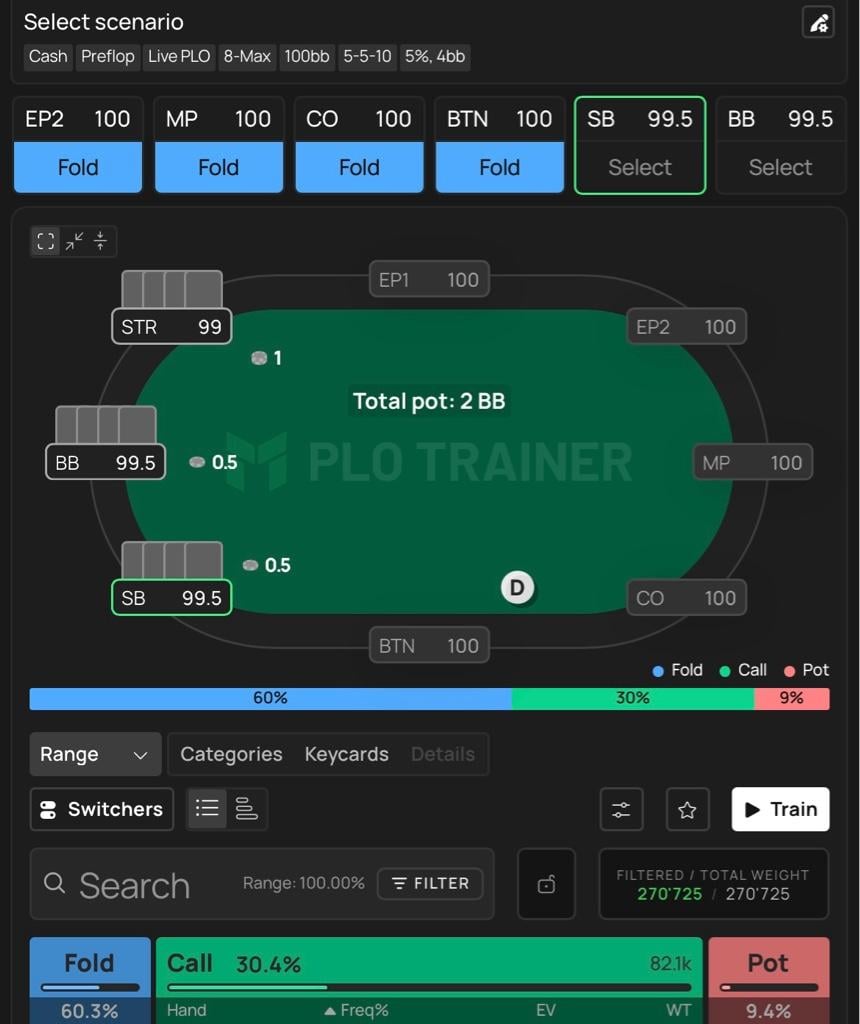
Today) I’m moving on to SB RFI/continue strategy in the same 25/25/50, 100bb, 8-max, rake-free structure. We’re calling 45.4% and raising 5.4%. Worth noting that in the 5/5/10, 5% rake, 4 BB cap sim, this shifts substantially to 30.4% call and 9.4% raise, for the standard reasons, rake makes marginal calls less attractive and pushes the continuing range toward more aggressive action. Also important to remember that folding from the SB is already -0.5 BB, so these marginal calls don’t need to be profitable from zero, they just need to outperform the -0.5 BB alternative.
Two calls that stood out, and that I probably would’ve folded pre-training, are Q♠ J♠ 8♠ 7♠ and J♠ 8♦ 6♠ 6♥. The first is especially interesting because even being monotone doesn’t kill the value of the QJ87 connectivity enough to make folding optimal, while the second shows how a middling pair plus some connectivity and a single suit can still realize enough equity to continue.
On the other side, two 100% frequency raises that I would’ve called pre-training are 4♠ 4♦ 3♠ 3♥ and Q♥ 9♠ 7♥ 6♠. 4433ds is a good reminder that double-paired, double-suited structures can have substantial equity and board coverage despite their low ranks, while Q976ds combines double-suitedness with enough connectivity that it benefits from being pushed into the aggressive portion of the range rather than simply taking the cheap call.
(Today) I’m moving on to BB in the same 25/25/50, 100bb, 8-max, rake-free structure. With the six prior positions folding, this is essentially SB vs BB at this point, just BB vs the straddle. We’re calling 55.2% (~149k weighted combos), potting 15.6% (~42k), and folding 29.2% (~79k).
Two 100% frequency calls that stood out, and that I probably would’ve folded pre-training:
T♥ 9♠ 7♠ 4♠ — despite being triple-suited with a fairly disconnected 4, the T97 connectivity and positional dynamics versus the straddle are enough to make this a pure continue.
8♥ 8♦ 5♠ 2♠ — another unintuitive continue to me; the pair is only middling and 852 has very little connectivity, but the suited 5♠2♠ component plus the value of the pair makes calling better than surrendering the 0.5 BB already invested.
On the other side, two 100% frequency raises that I would’ve called pre-training:
J♠ T♦ 5♥ 4♠ — interesting that this wants to pot despite looking like a natural call; the J♠4♠ suit combined with two separate connected components gives it enough playability and coverage to push as a raise.
A♠ T♦ 9♥ 3♥ — another hand I would’ve intuitively put into the calling bucket, but the ace, T9 connectivity and T♦9♥3♥ structure give it enough overall strength to pot at full frequency.
Sorry for the non-poker-related post, but this has been a life-intertwined poker blog from the very first entry, and that element was always very well received alongside all the theory, so I wanted to give a little context for sharing this. I bet a wide range of sports. At this point, most books no longer meaningfully take my action online or on their app. They either cut me off entirely or allow me to bet only a few cents or dollars, sometimes around $10, even on NFL moneylines with advertised or anecdotal limits of $25,000 or more for unrestricted accounts. That is largely because of how frequently the line moves after I place a wager. This screenshot is from Bet105, a non-limiting book that mirrors Pinnacle’s API and is extremely sharp. My 11 current outstanding wagers are all beating the closing line, with the market moving in my direction after every bet. I’m proud of the processes I’ve built. During some hard moments, seeing objective evidence that something I created continues to work at this level gives me a little personal validation, and I wanted to share that.
(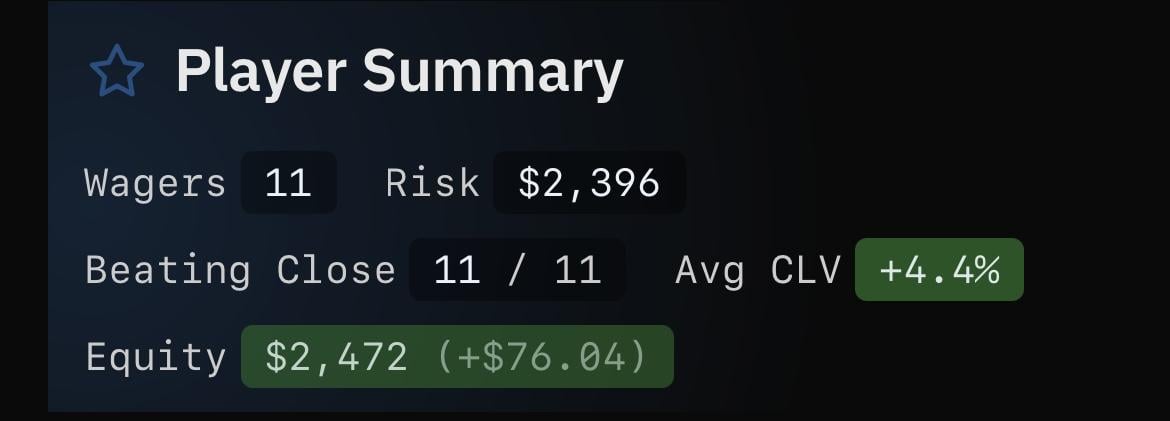 )
Not sure yet what frequency PLO5/PLO6 will fit into my training. I want to avoid bouncing around too much, but at the same time develop a solid foundational understanding of 5c and 6c, while obviously keeping NL sharp as well, so that I can play whatever vs whomever without giving up too much. It also keeps things fresh, among other benefits. Obviously I’m doing plenty of work that isn’t featured here too, but since I’m going to share parts of the process, I’ll try to keep these posts high quality, organized, and useful, and spread as much knowledge as I can to the handful of people lurking who might not have the resources, desire, bandwidth, etc. necessary to do the same work themselves. This post will be PLO6c MP RFI, 5-max, mid stakes, using 5% rake with a 1.5 BB cap, which I believe mirrors the GG Poker mid-stakes 6-card, 5-max, no-ante rake structure. The only open size in the sim is pot / 3.5x. The range is 23.7% RFI (4,825,365 combos) and 76.3% fold (15,333,155 combos). Some 100% frequency opens I found surprising: A♣ K♣ J♦ T♣ 7♣ 6♥ — surprising because being four-clubbed heavily cannibalizes the suit value, but having the nut suit alongside the AKJT high-card structure and 76 extension gives it enough connectivity and nut-straight coverage to remain a pure open from MP. A♦ A♥ A♣ Q♠ 9♣ 5♣ — surprising because trip aces and disconnected side cards look clunky, but the guaranteed AA component, extreme ace blocking, and nut-club potential are still strong enough to make it a 100% open from MP. Two 100% frequency folds I found surprising: A♣ K♦ K♣ T♥ 8♣ 3♣ — despite AKK and the nut club suit, being four-clubbed heavily devalues the flush component and the T83 side cards don’t add enough connectivity or nuttiness to make it an open from MP. J♣ T♣ 9♦ 9♥ 6♦ 6♥ — despite having two pairs and solid JT9 connectivity, the lack of an ace, nut suit, or stronger high-card structure leaves too much of the hand’s equity tied up in middling non-nut holdings to open from MP.
For the next series of 4c posts, I’m going to cover the 5/5/10 structure with 5% rake capped at 4 BB and compare the thresholds directly to the 25/25/50 rake-free environment. Starting with EP1 RFI, we’re potting 14.5% of hands (~39.2k combos) and folding 85.5% (~231k). Some 100% frequency opens that stood out to me: 6♥ 5♠ 4♥ 2♠ A♠ 9♥ 8♥ 8♦ The first one is particularly interesting because it’s a fairly low-card-heavy hand, but the double-suited connectivity is apparently enough to clear the EP1 threshold even in a fairly punitive rake structure. On the other side, two 100% frequency folds I found interesting: T♠ T♦ 4♠ 4♥ Q♠ Q♥ J♥ 7♠ Both look superficially stronger than 6♥ 5♠ 4♥ 2♠ from a raw high-card/pair perspective, but they illustrate pretty well how heavily the solver is prioritizing playability, connectivity, suit quality, and the ability to make robust nutted hands over simply having a decent pair structure this early.
(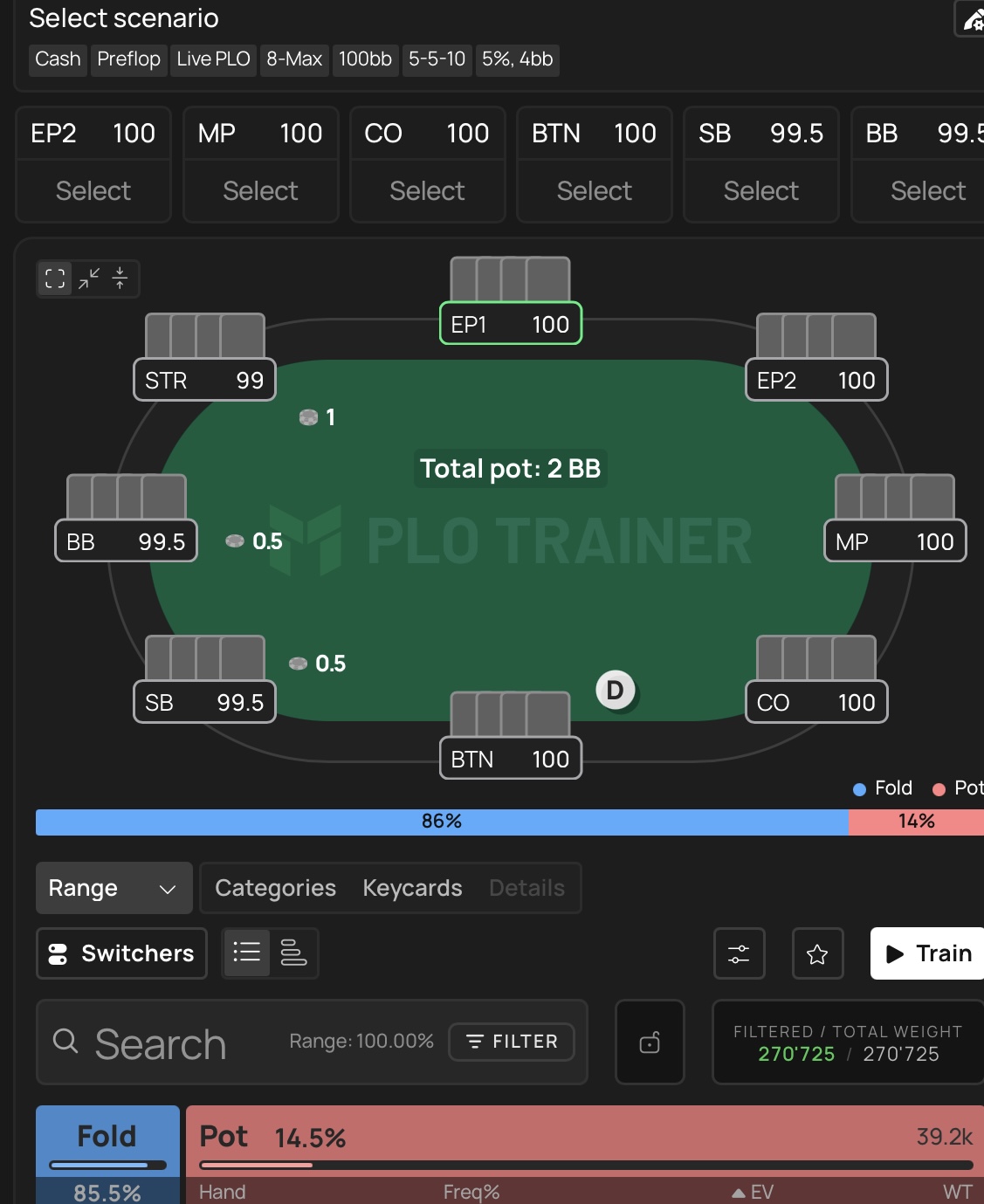 )
One counterintuitive note when we compare this to 25/25/50 rake-free: our optimal EP1 RFI frequency actually goes down slightly, from 14.5% to 14.0%. A♠ Q♦ J♥ 9♥ goes from roughly +0.01 BB in the rake-free 25/25/50 sim to +0.05 BB in the 5% / 4 BB-cap 5/5/10 sim. That can absolutely happen. The key mechanism is that rake makes calling and defending marginal hands less attractive. The players behind EP therefore have to continue tighter. That gives our EP open more immediate fold equity and lets us win the 2 BB of dead money preflop more often. For a marginal-but-playable hand like A♠ Q♦ J♥ 9♥, that extra fold equity can be worth more than the rake it expects to pay in the subset of hands that actually reach a raked pot. Rake-free:
(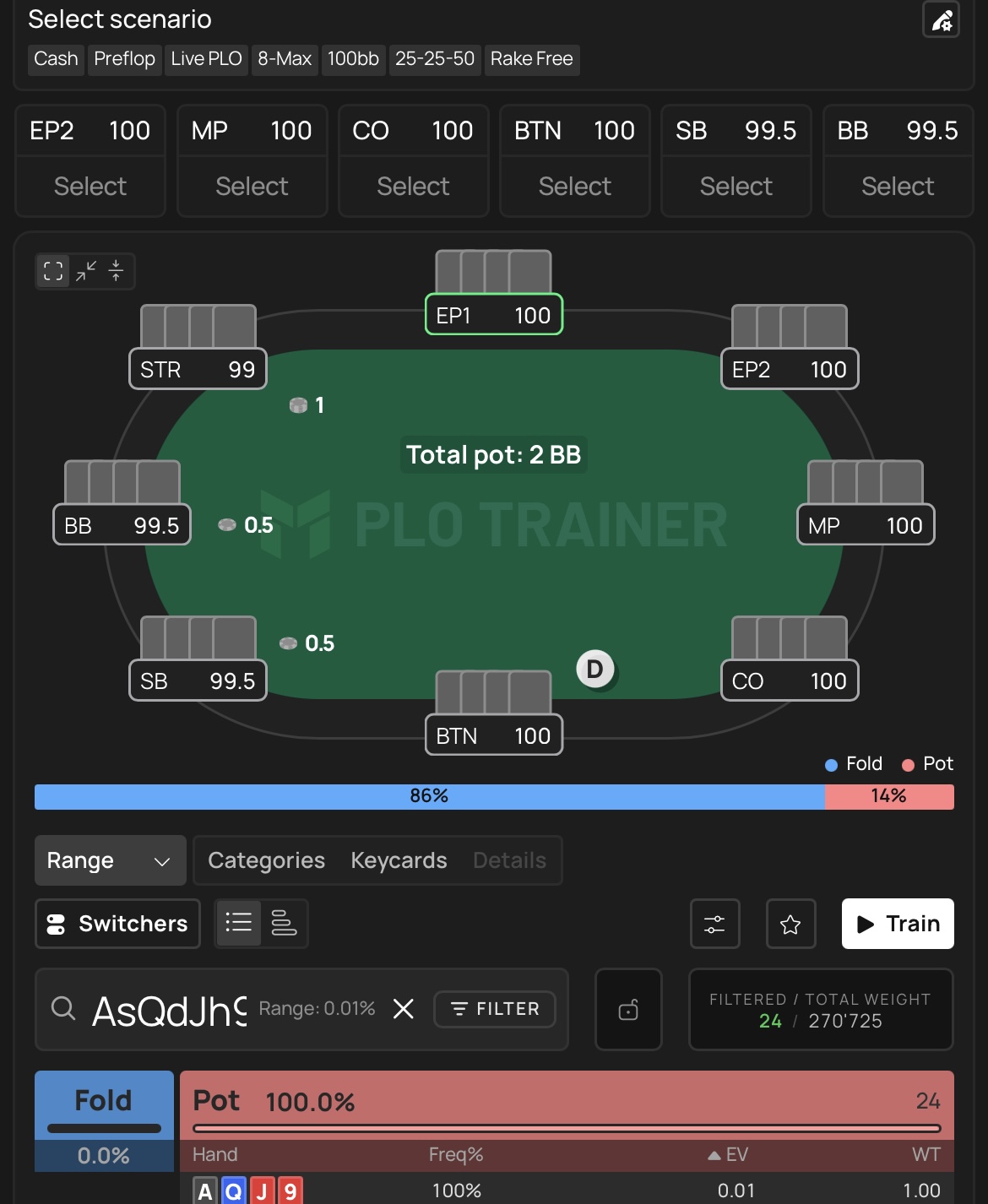 )
Raked:
(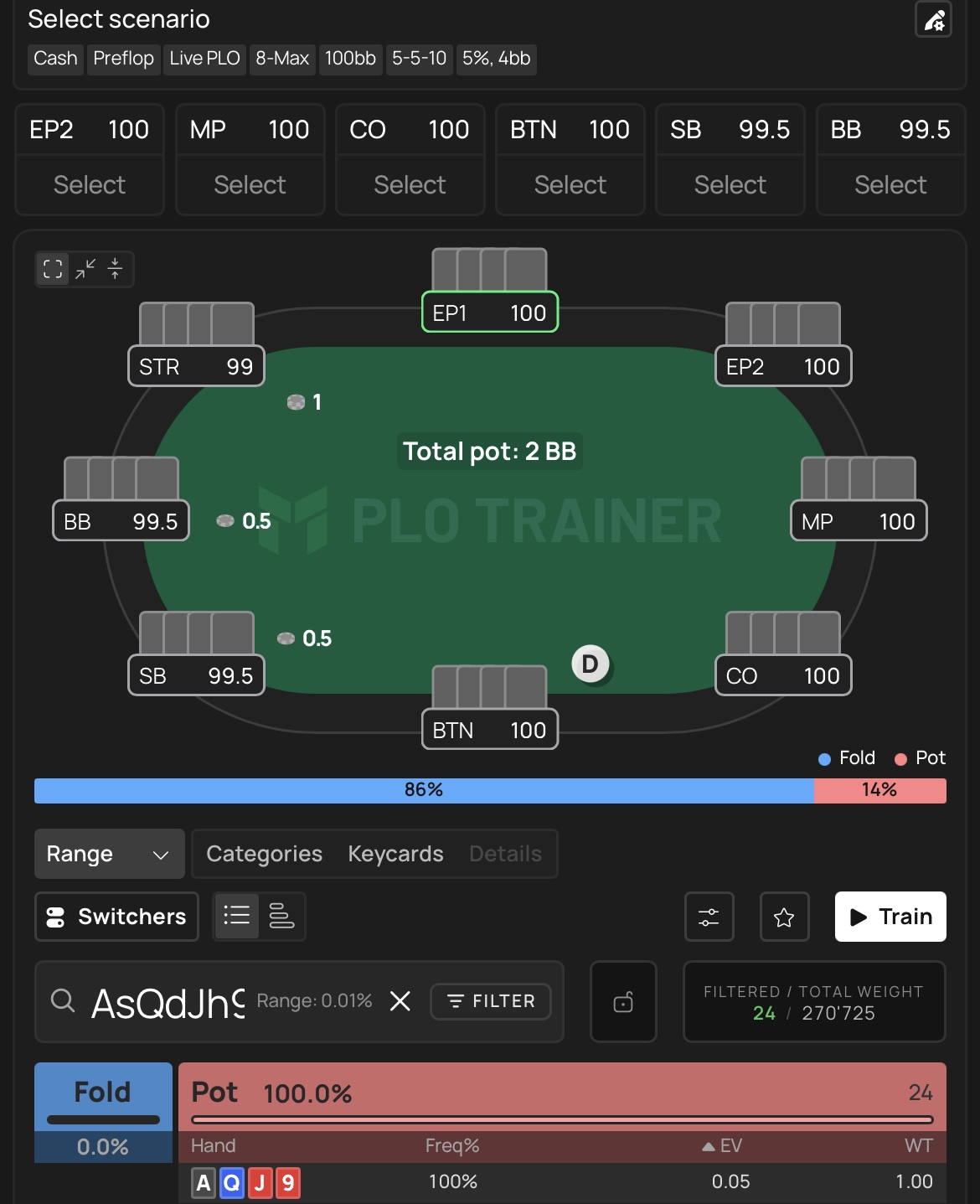 )
This is especially plausible for hands near the bottom of an opening range. A premium hand generally likes action and suffers directly from rake. A marginal open can actually benefit disproportionately from everyone else being forced to play tighter.
There’s also an important PLO-specific point: A♠ Q♦ J♥ 9♥ has decent blocker/high-card properties for stealing. The ace and queen reduce some strong continuing combinations behind, while the hand still has enough connectivity and suitedness to function when called.
It’s interesting how rake changes the incentives of the entire tree rather than just mechanically making every individual range tighter.
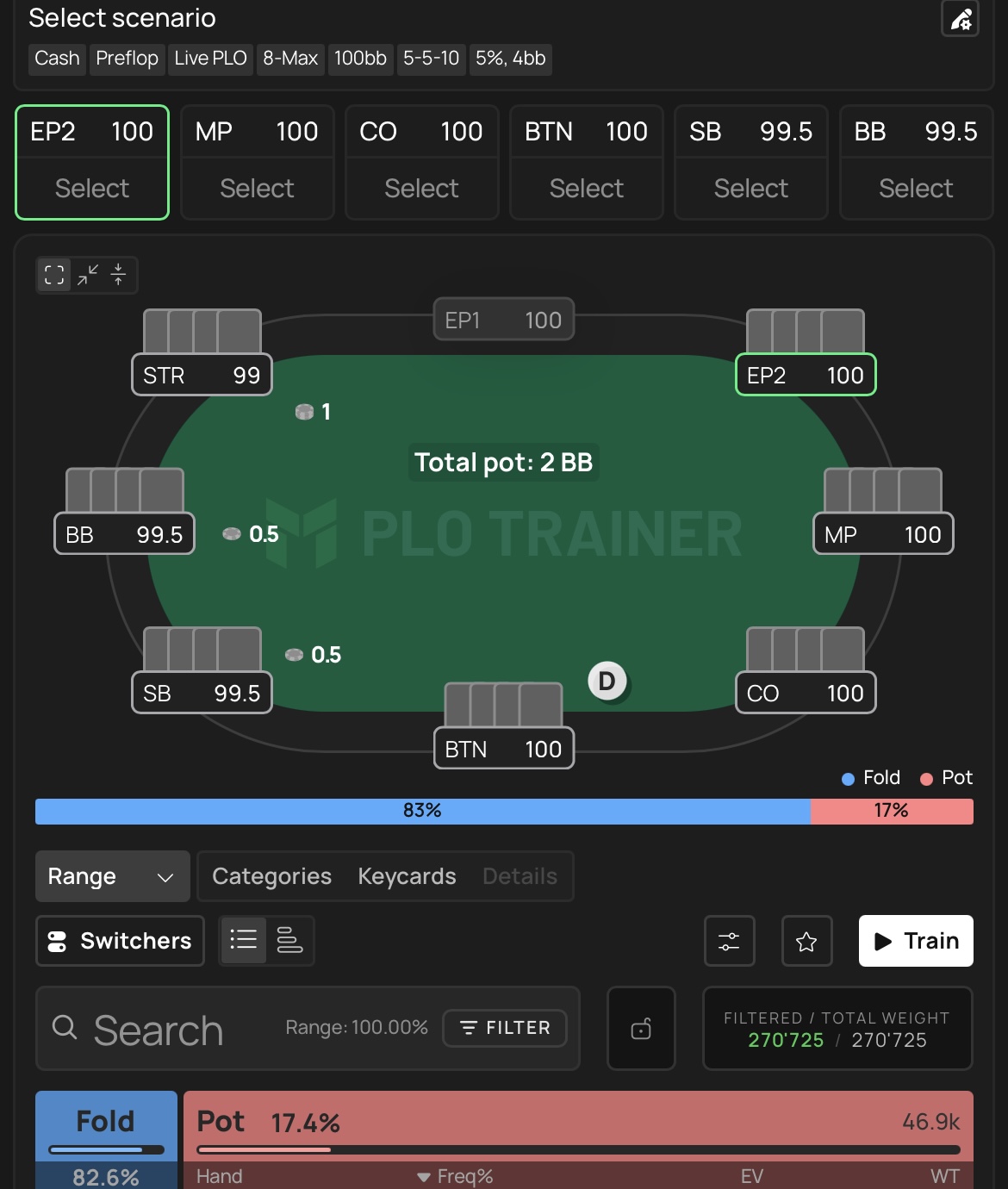
Continuing with EP2 RFI, we’re potting 17.4% of hands (~46.9k combos) and folding 82.6%. In the 25/25/50 rake-free sim, we’re potting 16.8% and folding 83.2%, so the trend of opening slightly more often in this 5/5/10 rake structure continues. Two 100% frequency opens I found interesting: J♦ 9♦ 8♥ 7♠ K♦ K♣ T♥ 8♠ The J♦ 9♦ 8♥ 7♠ is a nice example of how much the solver values connectivity and smooth equity distribution even without especially strong high-card structure. K♦ K♣ T♥ 8♠ stood out for a different reason. Despite the rainbow structure, this is a rare 100% open from the one-pair, non-AA rainbow hand class from MP2. The kings provide the raw pair strength, while the T8 side cards give the hand enough connectivity that this particular configuration still clears the threshold without any suitedness. On the other side, two 100% frequency folds that stood out to me: T♦ T♠ 5♥ 5♠ A♠ 6♥ 5♥ 2♠ T♦ T♠ 5♥ 5♠ is another good reminder that double-paired doesn’t automatically mean playable this early. The two pair components are poorly connected to one another, and the hand has limited ability to make strong straights or nutted flushes. A♠ 6♥ 5♥ 2♠ looks much more appealing aesthetically because it’s double-suited and contains an ace, but the gaps and low-card structure leave it without enough robust connectivity to clear the EP2 threshold.
Some Takeaways: EP2 continues the same pattern we saw in EP1: the raked 5/5/10 environment is actually opening slightly wider than the 25/25/50 rake-free sim. At the hand-selection level, connectivity and how well all four cards work together can matter more than appearance—enough that a connected rainbow KK hand can be a pure open while prettier-looking double-paired or double-suited holdings remain pure folds.
( )
Continuing with MP RFI, we’re potting 21.4% of hands (~57.9k combos) and folding 78.6%. In the 25/25/50 rake-free sim, we’re potting 20.8% and folding 79.2%, so the trend of opening slightly more often in this 5/5/10 rake structure continues through the first three positions.
(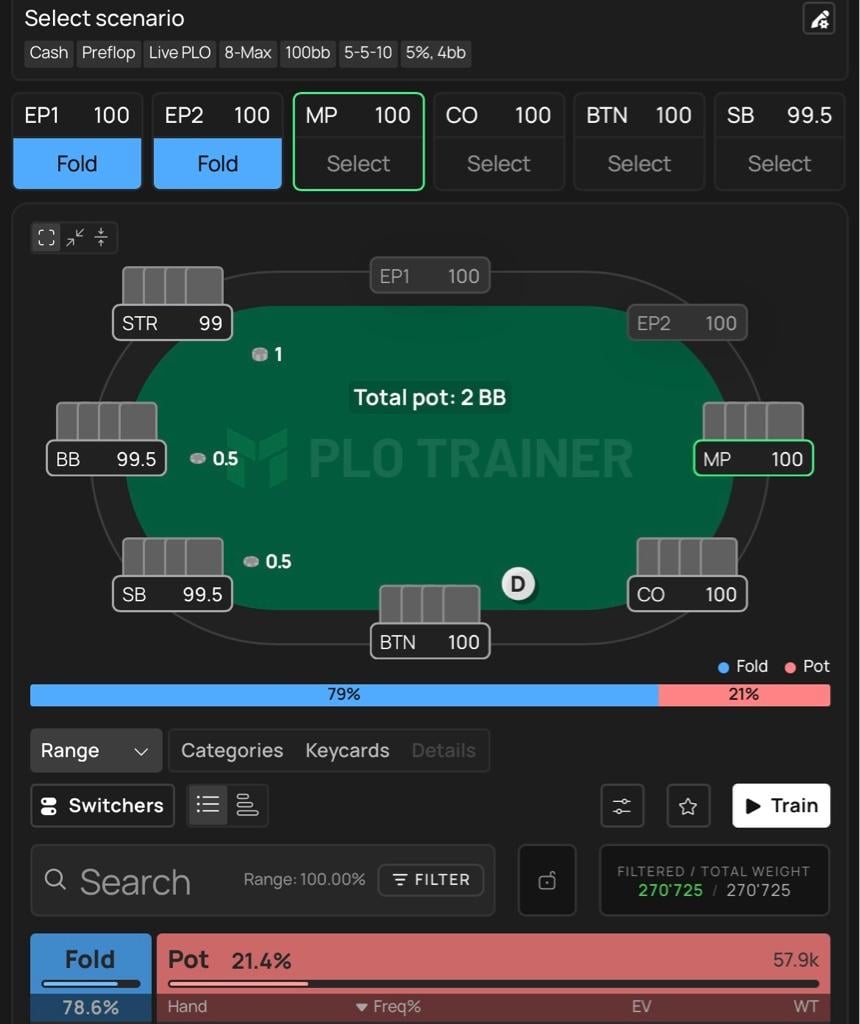 )
Two 100% frequency non zero EV opens I found interesting: A♠ T♣ 9♦ 8♥ This is an unpaired rainbow ace-high hand without two Broadway cards still clearing the opening threshold from MP. The A-high component gives us useful blocker and high-card properties, while T98 provides enough three-card connectivity that the hand can overcome having no suit. ————————— A♠ 9♦ 9♣ 8♥ Another interesting one: a one-pair, ace-high rainbow holding without two Broadway cards still making it in from MP. The 998 structure gives the hand considerably more internal coordination than a generic A-high + medium-pair holding, while the ace adds both nuttiness and blocker value.
On the other side, some 100% frequency folds that stood out to me: 7♠ 7♦ 4♣ 4♥ 6♠ 6♦ 3♣ 3♥ 8♠ 8♦ 5♣ 5♥ 5♠ 5♦ 2♣ 2♥ Even from MP, these middling and low double-paired rainbow hands still aren’t good enough, even with some loose connectivity between the two pair components. The bigger issues are the lack of suitedness and high-card/blocker value, along with the fact that their set-making equity is often non-nut and comes with relatively poor redraws. The raw double-pair structure still isn’t enough to compensate. —————- Another group of pure folds that stood out: A♠ K♠ 6♥ 2♥ A♠ T♥ 5♠ 2♥ A♠ Q♠ 3♥ 2♥ A♠ J♥ 6♠ 2♥ These are all double-suited A-high holdings with a nut suit and a Broadway card, yet they’re still pure folds from MP. The nut-suit potential and double-suited structure look attractive in isolation, but the underlying four-card structure is simply too disconnected. The low cards—particularly the recurring 2x—interact poorly with the Broadway portion of the hand, leaving us with too many weak straight configurations and too much reliance on flush equity.
Some Takeaways: MP continues the same pattern we saw in EP1 and EP2: the raked 5/5/10 environment is actually opening slightly wider than the 25/25/50 rake-free sim. At the hand-selection level, the optimal range is continuing to reward four-card coordination over superficial hand strength. A rainbow A-high hand can clear the threshold when its remaining cards work together, while double-paired or even double-suited A-high holdings with a nut suit can still be pure folds when too much of the hand is disconnected.
A♦J♦3♣ — LJ vs BTN SRP. LJ checks. This is a phone sim, so it’s not necessarily as refined as a full Pio sim. Take it for what it’s worth, but the core strategic concepts should still carry over. BTN responds with an 80% pot stab with roughly 33% of range, despite not having any AA or AKs in the preflop calling range. The “value” portion is built around hands like JJ, AJs, small portions of AKo/AJo, 33, etc. The bluff/equity-denial region starts pulling from hands like 22/55 with a diamond, 54s, and similar candidates. Once we arrive at this node, it’s worth remembering that the ranges are closer in strength than the raw preflop AA discrepancy might suggest. LJ has already checked and is not range-checking this board, so some of the strongest hands have been filtered out of the checking range. At the same time, BTN is calling fairly tight preflop, so its range enters the flop relatively condensed and strong. That combination is what allows BTN to support a fairly large stab size without needing the conventional preflop nut advantage.
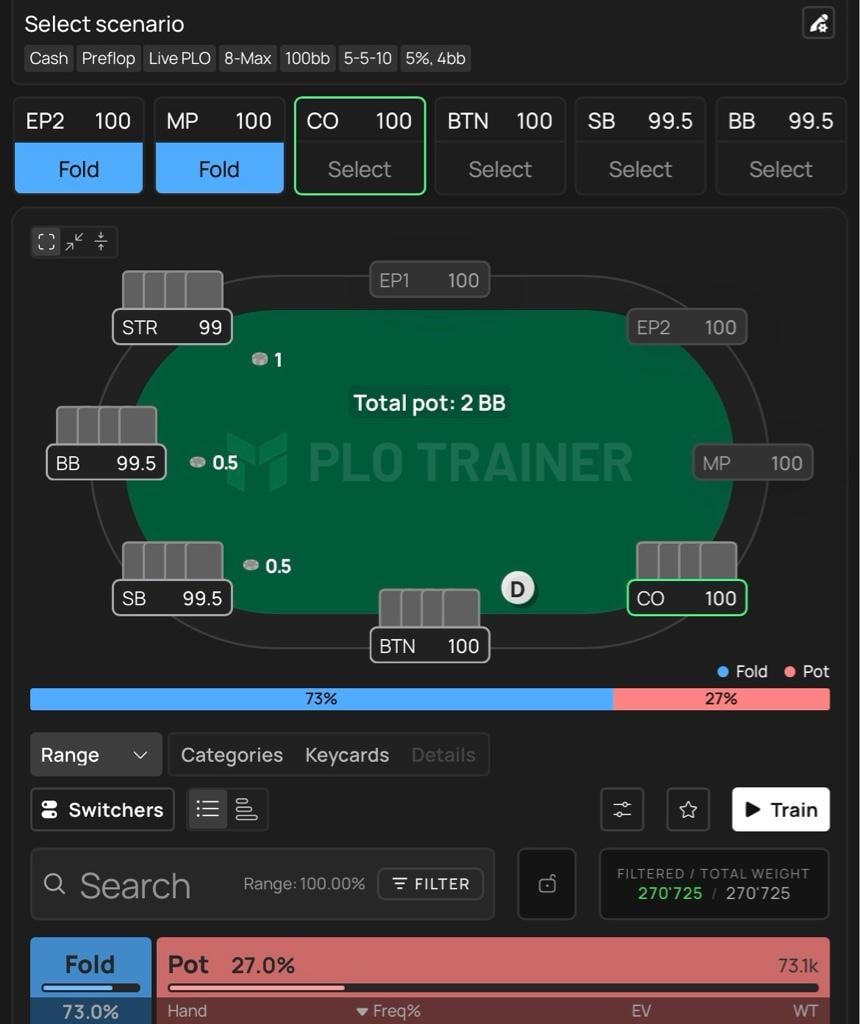
Continuing with CO RFI, we’re potting 27.0% of hands (~73.1k combos) and folding 73.0%. In the 25/25/50 rake-free sim, we’re potting 26.8% and folding 73.2%, so technically the trend of opening slightly more often in this 5/5/10 rake structure continues through the first four positions, although practically speaking the two ranges are now essentially the same width.
(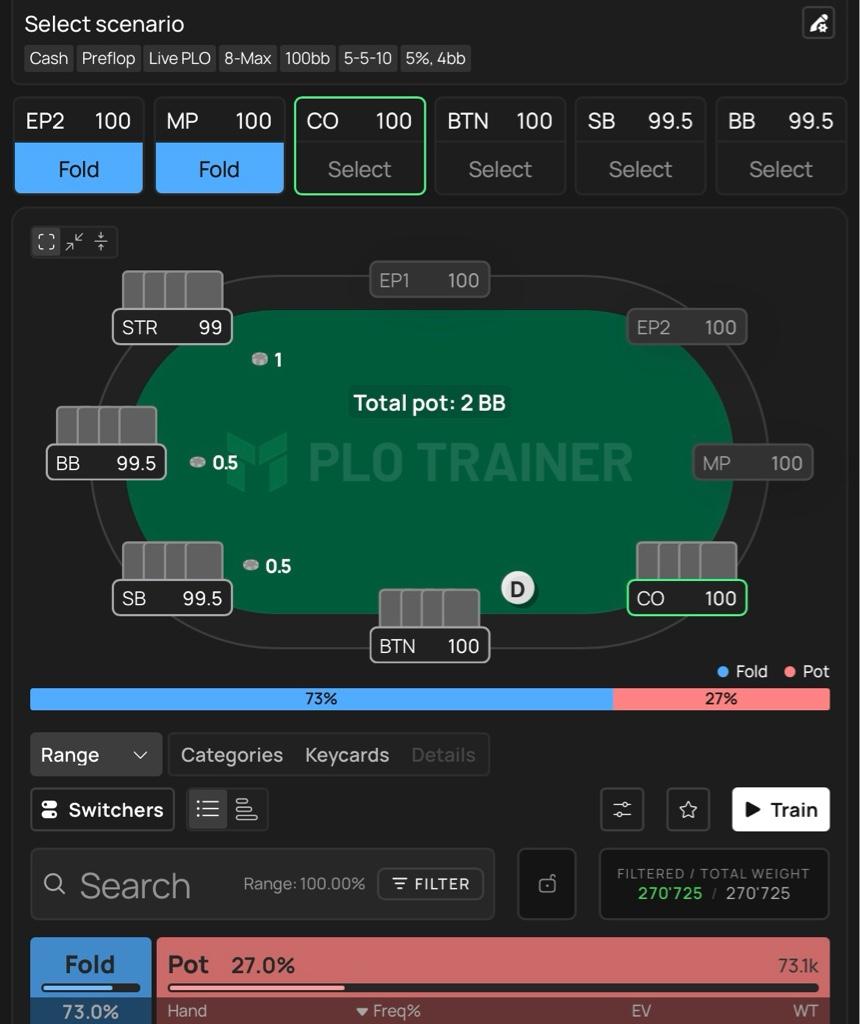 )
Some 100% frequency non zero EV opens I found interesting: T♠ T♥ 9♥ 4♠ T♠ T♥ 5♥ 4♠ J♠ J♥ 8♥ 4♠ J♠ J♥ 9♥ 4♠ Despite only containing JJ/TT, a clear dangler, and limited ability to make nutted hands, these still squeeze into the CO opening range. The important compensating factor is that they’re double-suited, so even though the fourth card contributes very little to straight construction, it still participates in a suit. Combined with a reasonably strong pair and the additional fold equity we gain from CO, that’s enough to push these configurations over the threshold. It’s another example of how a card can function as a dangler without being completely dead to the hand. Another group of pure opens that stood out: K♥ 9♦ 8♥ 7♠ K♦ 9♦ 8♥ 7♠ K♦ 8♦ 7♥ 6♠ K♠ 8♦ 7♥ 6♠ Despite being unpaired, only single-suited with a non-nut suit, and containing just one Broadway card, these still make it into the CO opening range. The reason is how efficiently the three lower cards work together: 987 and 876 provide compact three-card connectivity, while the king adds useful high-card and blocker value without disrupting that structure. From CO, that combination of position, connectivity, and some high-card equity is enough even without premium suitedness or pair strength.
On the other side, some 100% frequency folds that stood out to me: Q♠ Q♥ 7♥ 2♠ J♠ J♥ 6♥ 2♠ J♠ J♥ 8♥ 3♠ T♠ T♥ 8♥ 5♠ Despite being double-suited Broadway-pair holdings, these hands make it into the 10.7% (~338 combos) of this hand class that are folds at equilibrium. The contrast with the JJ/TT opens above is subtle but important: double-suitedness and pair strength aren’t enough by themselves. Once the side cards become sufficiently weak or poorly coordinated with the pair, too much of the hand’s postflop equity comes from making non-nut flushes, medium sets, or marginal straight structures. At the bottom of the CO range, those differences are enough to separate a pure open from a pure fold. Another group of folds: A♠ J♣ T♦ 6♥ A♠ Q♣ T♦ 4♥ A♠ Q♣ J♦ 2♥ A♠ Q♣ T♦ 2♥ Despite being ace-high connected Broadway holdings, these make up part of the 16.3% (~203 combos) of this hand class that still folds at equilibrium. The problem is that the Broadway structure is doing almost all of the work: these are rainbow, unpaired, and the fourth card contributes very little to the rest of the hand. Once we remove suitedness and meaningful four-card connectivity, even AQJx/AQTx/AJTx structures can fall below the CO threshold when the side card is sufficiently weak.
Some Takeaways: CO technically continues the pattern from EP1 through MP, with the 5/5/10 raked sim opening marginally wider than the 25/25/50 rake-free sim, although at 27.0% versus 26.8% the practical difference is negligible. More interestingly, the bottom of the CO range continues to show how small differences in four-card cohesion can outweigh much more obvious surface-level hand strength. JJ/TT with a dangler can still open when double-suited, and single-suited K-high hands can get there through compact three-card connectivity, while prettier-looking double-suited pairs and A-high Broadway holdings still fold when too much of the hand is structurally isolated.
( )
Continuing with BTN RFI, we’re potting 36.9% of hands (~99.8k combos) and folding 63.1%. In the 25/25/50 rake-free sim, we’re potting 37.9% and folding 62.1%, so the trend of opening slightly more often in the 5/5/10 raked structure through the first four positions has officially reversed. The most likely explanation is that BTN is where we begin reaching much deeper into the marginal portion of the opening range. Rake still forces the blinds to defend somewhat tighter, which helps our steal equity, but the hands being added at the bottom of a BTN range derive a large portion of their value from position and postflop realization. Once those marginal hands actually get called, rake directly taxes that positional edge. By this point, the extra fold equity created by tighter defenses is no longer enough to compensate for the rake paid when these weakest opens reach postflop, allowing the rake-free BTN range to expand slightly wider.
(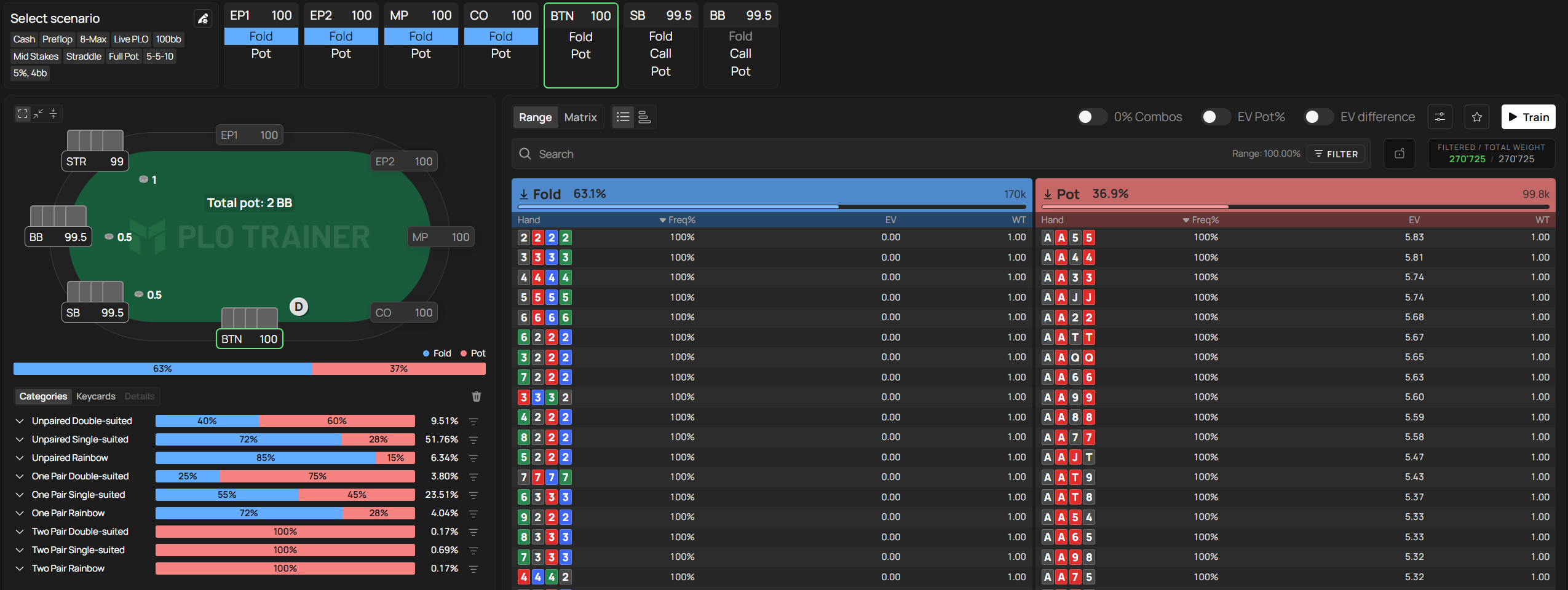 )
Some 100% frequency non-zero EV opens I found interesting: A♠ J♣ 7♦ 5♥ A♠ K♣ 8♦ 3♥ A♠ Q♣ 9♦ 5♥ A♠ T♣ 7♦ 5♥ Despite being unpaired rainbow A-high holdings with only two Broadway cards and limited connectivity, these squeeze into the BTN range. The ace is doing a lot of work through its high-card and blocker value, while the second Broadway card gives the hand enough additional top-end strength to avoid being completely dependent on the disconnected lower cards. The complete lack of suitedness makes these especially interesting. BTN position and immediate fold equity are strong enough that hands with very limited four-card cohesion can still become profitable opens, even when they have no flush potential whatsoever.
Another group of pure opens that stood out: 9♥ 7♥ 5♠ 3♠ 9♠ 7♥ 6♥ 3♠ 9♥ 6♠ 5♥ 3♠ 9♠ 6♥ 5♥ 3♠ Despite coming from a low-card, unpaired hand class with no Broadway cards, these still make it into the pure BTN opening range. They’re heavily carried by being double-suited, while the middle cards retain enough loose connectivity to give the hands multiple ways to develop equity postflop. This is a good example of BTN allowing suitedness and distributed equity to compensate for a complete lack of high-card strength. These would be far too weak earlier, but position plus two suits gives them enough realization to cross the threshold.
On the other side, some 100% frequency folds that stood out to me: T♠ T♥ 3♥ 2♠ T♠ T♥ 6♥ 2♠ J♠ J♥ 7♥ 2♠ J♠ J♥ 6♥ 2♠ Despite being double-suited with a Broadway pair, even with the much wider BTN RFI these hands make it into the 6.4% (~84 combos) of this hand class that remain folds at equilibrium. The pair and double-suited structure look strong superficially, but the low side cards interact poorly with the pair and leave the hand with limited ability to make nutted straights or dominate opposing continuing ranges. The recurring 2x is particularly restrictive. A lot of the hand’s equity becomes tied to medium sets, non-nut flushes, and weak low-card straight development, which still isn’t quite enough to justify opening the very bottom of this class.
Another group of pure folds that stood out: A♠ 6♠ 3♥ 2♥ A♠ 6♥ 3♠ 2♥ A♠ 6♥ 3♥ 2♠ Despite being double-suited A-high holdings with a nut suit, even these make it into the 2.6% (~36 combos) of this hand class that remain folds at equilibrium. The ace and two suits provide real value, but A632 is simply too compressed toward the bottom of the deck. The 6-3-2 structure has very limited interaction with the ace outside of narrow wheel development, and there’s only one genuinely strong high card in the hand.
Some Takeaways: The pattern from EP1 through CO, where the 5/5/10 raked sim opened marginally wider than the 25/25/50 rake-free sim, has now stopped. BTN is the first position where the rake-free range becomes wider, likely because we’re now reaching marginal hands whose profitability depends much more heavily on postflop realization and positional edge. Rake taxes exactly that portion of their EV enough to outweigh the extra steal equity generated by tighter blind defenses. The hand-selection rules also become noticeably less rigid on BTN. Position allows individual strengths to carry otherwise flawed holdings much further: A-high/blocker value can rescue rainbow disconnected hands, and double-suitedness can rescue extremely low-card structures. But there are still limits—double-suited Broadway pairs and nut-suited aces can remain pure folds when the remaining cards contribute too little nutted potential or meaningful four-card interaction.
Today’s notes from "This Is PLO" by Phil Galfond:
We want to put money in with our high-equity hands and build our strategy around that principle. We’re going to start from the river and work backwards, with a focus on equity and EV. Phil considers this Building Block #1.
River: Poker’s 80/20 rule: A useful heuristic is that if, when called, we’re ahead of roughly 80% of the hands our opponent can continue with and behind only about 20%, our hand is strong enough to support a pot-sized value bet. That does not mean pot is automatically the highest-EV size. As our value hand gets closer to that 80/20 threshold, smaller sizes can outperform pot because they get called by a wider range while still extracting value. The sizing we actually choose also depends on the sizings our overall range wants to use in that spot, whether we want to split between multiple sizes, and how the rest of our value and bluffing range is constructed. Sometimes, even if 50p or 33p is the higher-EV size in a vacuum, the way we’ve played the hand up to the river can make all-in the only practical size against any good opponent.
Turn:
Assuming our opponent defends half of their range on the turn versus our pot-sized bet, our hand needs to be good roughly 90% of the time to go for two streets of pot-sized value. The logic is straightforward: if we’re good 90% of the time, we’re beat by 10% of their current range. If they then call the turn with 50% of that range, the 10% that beats us remains inside a 50% continuing range. That means we’re ahead of 40 out of those 50 parts of the range: 40 / 50 = 80% That leaves us satisfying the 80/20 threshold on the river, making a pot-sized river value bet viable. Some factors that can move that threshold in either direction are how often the board changes, how often we get raised, and how many river cards actually allow us to continue betting for value. Phil notes that in PLO, most hands that are strong enough to value bet across two streets should usually start extracting that value on the turn. Conversely, hands that are not strong enough to support two streets will often perform better by checking the turn and waiting to capture their value on the river.
Flop: There are simply too many variables on the flop to cleanly calculate whether a hand is strong enough to start betting for value across multiple streets. Ranges are much more convoluted because our opponent can call, check-raise, and continue in several different ways. There are so many possible combinations of turn and river runouts. Implied odds become much more important. Board coverage and how our range interacts with future cards matter significantly.
Priority Chart for Flop / Turn / River in terms of weights: These are approximate weights: River: Value: 100p Turn: Value: 65p Board Coverage: 15p Implied Odds: 15p "Protection": 5p Flop: Value: 50p Board Coverage: 30p Implied Odds: 15p "Protection": 5p Board coverage is especially important on the flop because there are so many possible turn and river runouts. Leaving any part of our range too devoid of certain made-hand classes, draw classes, or future-runout coverage can become very dangerous. On the flop, Phil finds trying to think exactly like a solver less useful. Instead, he places more emphasis on making sure each of our ranges contains the necessary hand classes and draw classes so we remain well covered across future runouts.
Choosing a sizing strategy: Solver Logic: Starts with our value ranges. Position: IP and OOP. There will be spots where we check-raise a monotone flop representing the nut flush, and that nut-flush region only wants to pot. In those cases, we may pot even if that would not be the theoretically optimal size for the rest of our range. Another example: say both a straight and a flush are present on the board. We have the same number of flushes and the same number of nut flushes as our opponent, but they have no straights while we have a large number of them. In that case, we have a range advantage, but it exists within a very specific hand category: our second-tier value hands. We can leverage that advantage by using a smaller sizing. The solver may even choose to move all of our flushes into that smaller sizing if the range advantage created by those second-tier hands is important enough to the overall strategy.
Summary:
Continuing with SB RFI, we’re potting 9.4% of hands (~25.3k combos), calling 30.4% (~82.1k combos), and folding 60.3% (~163k combos). In the 25/25/50 rake-free sim, we were potting 5.4%, calling 45.4%, and folding 49.3%. The rake incentivizes us to call and continue significantly less from the SB because limping creates a large number of marginal, out-of-position pots where our equity realization is already poor and rake takes an additional bite once we reach postflop. At the same time, the hands strong enough to continue are pushed more often toward potting: raising can win the dead money immediately, avoids rake when BB folds, and forces BB to continue with a tighter range rather than allowing us to realize a marginal hand cheaply through a limp. The result is a much more polarized SB construction—far fewer calls and substantially more raises among the hands that do continue—rather than rake simply making every action uniformly tighter. 5/5/10 5% 4bb cap sim
(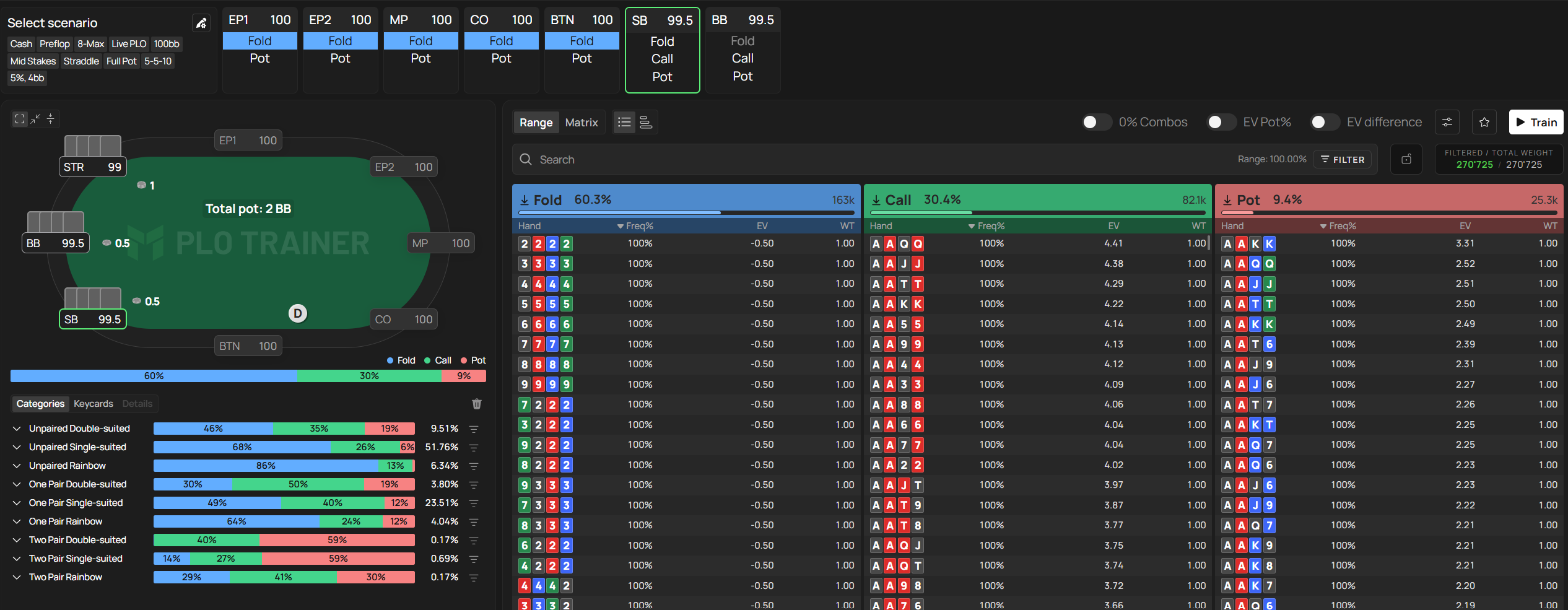 )
25/25/50 rake free sim
(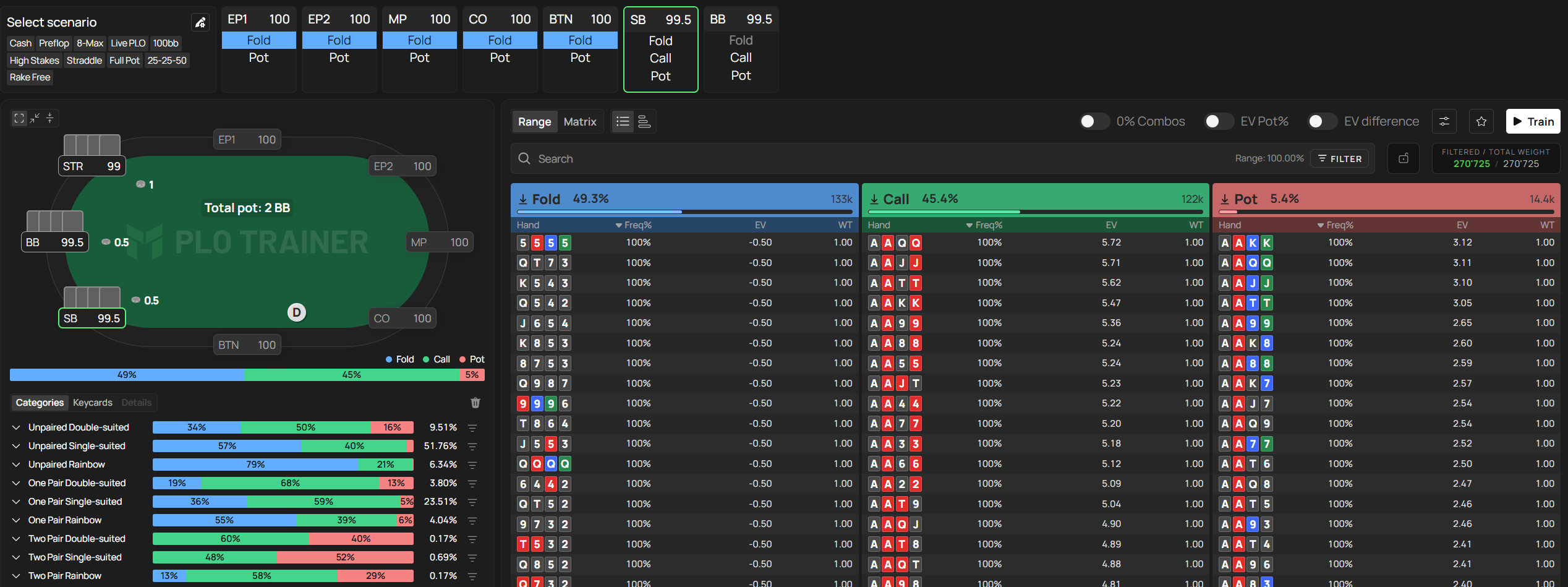 )
Some 100% frequency opens I found interesting: A♠T♠7♦4♥ A♠T♠9♦5♥ A♠T♦9♥5♠
A♠J♠9♥7♠ Note that when we fold, our EV is -0.50, so for an open to be profitable in equilibrium we do not actually need the hand to make money in absolute terms. We just need opening to lose less than folding. Despite being unpaired, only single-suited, and relatively loosely connected, these are all pure opens in optimal. The ace is doing a lot of work through both its high-card and blocker value, while the second Broadway card gives the hand enough additional top-end strength that we are not completely dependent on the disconnected lower cards. The nut suit matters quite a bit as well, since it gives us clean nutted potential and improves how comfortably the hand can continue across a wide range of flops. I think these are useful examples of how easy it is to overvalue raw connectivity when looking at a hand in isolation. Something like A-T-7-4 can look fairly ugly structurally, but nut-suit quality, ace/blocker value, and two-card high-card strength can compensate for a surprising amount of disconnect. We do not need all four cards cooperating perfectly when the strongest components of the hand already interact well with the ranges behind us.
Another group of pure opens that stood out: K♠7♥6♥4♠ 8♥7♠6♥4♠ J♥8♥7♠5♠ Q♥9♥7♠6♠ These hands are all double-suited with solid three-card connectivity, which gives them enough equity realization and board coverage to clear the opening threshold even without premium high-card structure. They can make strong wraps, straights, and flushes across a wide range of boards, while the second suit materially improves how often that connectivity converts into robust postflop equity. What stands out is that the high card does not need to be especially strong when the rest of the hand is this coordinated. Connectivity + double-suitedness is doing enough of the work that even hands like 8-7-6-4 and K-7-6-4 retain sufficiently high EV to become pure opens rather than mixes.
On the other side, some 100% frequency folds that stood out to me: 6♠6♦3♠3♥ 8♠8♦3♠3♥ 4♠4♦2♠2♥ 3♠3♦2♠2♥ These hands can look deceptively playable because they are double-paired and single-suited, but the pairs are simply too low and too poorly connected to generate enough robust equity. We are frequently dominated when we make sets, have very little straight potential, and the suit does not compensate enough for how weak the underlying rank structure is. The bigger issue is that low double-paired hands realize their equity poorly against continuing ranges because so many favorable-looking flops still leave us vulnerable to higher sets, straights, and stronger redraws. Even 8-8-3-3 does not gain enough from the higher pair to escape that structural problem, so all four remain pure folds.
Another group of pure folds that stood out: A♠Q♠7♠3♥ A♠J♠7♠3♥ A♠K♠9♠3♠ A♠6♠5♠4♥ These are a good reminder that simply having a suited ace does not automatically give us a strong suit component. Three or four cards in the same suit actually cannibalize our own flush equity, since the extra spades are cards we would rather have available in the deck, while the rest of these hands lack enough connectivity or pairing to compensate. Even the A-K and A-Q versions have surprisingly weak overall structure once we look beyond the high cards. A♠6♠5♠4♥ has better connectivity, but the trip-suited construction combined with relatively low rank strength still leaves it short of the EV required to open.
Some Takeaways: One thing worth emphasizing is that this is not really a standard blind-versus-blind environment. With 5/5/10, the SB and BB are the same size and the straddle is twice either blind, so our positional incentives are being shaped by a three-blind structure with substantially more money already in the pot. That changes the threshold for entering compared with thinking about the spot through normal SB/BB heuristics. The same structural point applies to the 25/25/50 rake-free game: the relative blind configuration is still 1:1:2. So some of the wider or more unusual-looking opens are not simply a product of “loose PLO strategy,” but of the incentives created by the straddle and the amount of dead money available before we act. Where the two environments really begin to separate is rake. In the 25/25/50 rake-free game, we can retain a lot more of the thin EV generated by marginal opens, whereas in the 5/5/10 game the 5% rake capped at 4bb eats into exactly those close decisions. As a result, hands near the bottom of the opening range need substantially more structural quality to survive. That makes the pure opens particularly informative. If something like a loosely connected suited ace or a modest double-suited hand is still opening 100% in the raked structure, then its positional EV is clearly strong enough to clear both the opening threshold created by the blind configuration and the additional drag from rake. The pure folds tell us the opposite side of that boundary. Some hands have recognizable components of strength, but from this position they do not realize enough value to justify entering once rake is applied. In the rake-free sim, many of those marginal regions can naturally expand because we are no longer surrendering part of our postflop EV to the house. So the useful comparison is really two-layered: the 1:1:2 SB/BB/straddle structure explains a lot about the positional incentives in both games, while rake explains much of the frequency compression in 5/5/10 relative to 25/25/50. That distinction is important when trying to transfer conclusions from one sim to the other.
Today’s notes from “This Is PLO” by Phil Galfond: Building Block #2: Range Construction Why does range construction matter so much?
How do we do that?
“Only two cards play” Take a J♥8♥2♠ flop in a HU SRP where we’re IP, looking at the various JT98-type combinations and playing a 70p/check strategy. A hand like JT98 primarily wants to bet 70p. We do want some J8 in our checking range, and we also want some T9 in our checking range, but we don’t need to check both components together. When a hand contains multiple strong components, it’s generally too strong to slow down just for the sake of coverage. Instead, the J8 hands we check and the T9 hands we check can typically come from the weaker portions of those classes. For example, something like KJ84 with no suits can provide J8 coverage, while T934 with no suits can provide T9 coverage. We don’t need the premium combo hands themselves to accomplish both jobs simultaneously. There are exceptions. Something like JJ + NFD can occasionally have the board so thoroughly covered that checking becomes attractive, particularly because keeping all of that future-street coverage in our range can generate substantial implied odds later. Practical summary: We don’t need to start slow-playing our strong combo hands in PLO4 simply to maintain balance. This contrasts with NLHE, where if we have top two pair like J8, those are our only two hole cards, so some specific J8 combinations may need to appear in our check-back range. PLO gives us far more ways to achieve that same two-card coverage through weaker four-card combinations. As a result, there is generally less need to mix the strongest specific combo hands purely for balance. We can deviate from exact solver frequencies while still maintaining strong two-card representation across our ranges.
Example of Simplifying HU, K♠T♥3♣7♥. We’re OOP in a turn probe spot with 33. The solver uses two bet sizes here, but for practical purposes we can simplify the strategy to big bet or check. If we go through the 33 combinations the solver bets versus checks, there’s a lot of noise. There are patterns, of course, but at the combo level much of the mixing can look fairly random. If we tried to replicate those exact frequencies in-game, we’d almost inevitably get them wrong. So instead, we simplify around the additional equity attached to our set:
Messing Up Range Construction: Part 1 K♠T♥3♣ We’re going to look specifically at the QJ hand class in a 100bb HU SRP with IP facing a check. In the solver, QJ splits approximately 35% check / 65% big bet. In practice, though, players tend to bet this hand class too frequently. Let’s say instead of checking QJ 35% of the time, they only check it 15%. That may not seem like a huge difference, but it dramatically changes the composition of the checking range. If QJ is dealt around 8.5% of the time, and IP’s overall checking frequency is around 58%, then: 35% × 8.5% / 58% ≈ 5% So in the solver strategy, QJ makes up roughly 5% of IP’s checking range. If we instead only check QJ 15% of the time: 15% × 8.5% / 58% ≈ 2% Now QJ represents only around 2% of the checking range. That 5% → 2% drop is strategically significant. Think about how much more thinly OOP can value bet across later streets, including with large sizings, when one of IP’s important nutted runout classes is so underrepresented. A hand class players tend to check at a more appropriate frequency, or sometimes even over-check, is QQ/JJ. Depending on the side cards, these hands are supposed to check around 70% of the time and can make up roughly 7% of the overall checking range.
Let’s say IP checks back under the above circumstances/assumptions. K♠T♥3♣ The turn is the 9, we pot as OOP and IP calls. The river is a brick, say a 2, no flushes available, we pot as OOP again, and IP raises all-in. IP may reason that because QJ exists in the flop check-back range, they’re allowed to bluff-raise the river at the theoretically appropriate frequency—or perhaps even more aggressively if they believe oop will overfold this spots in practice. But in our hypothetical, QJ is only 2% of that flop check back range instead of roughly 5%. If IP fails to reduce the bluff-raising frequency accordingly, OOP can have a massive exploit in what has now become a very large pot (200bb) considering this was an SRP. A mistake in range construction on the flop can therefore compound across streets into something like a 15bb river mistake in this hypothetical. A practical range-construction read might be: “We know our opponent isn’t checking back enough QJ on the clop to balance the times they arrive to the river with bluff-raising AI candidates. If they also fail to adjust their bluff-raising frequency to account for that deficiency, we have a very easy call.”
Simplifying Our Sizings Learn which sizings are preferred on different board textures and after different action lines, but more importantly, understand why. That understanding helps us arrive at the sizing we want—or at least the sizing that is most efficient to implement in practice. We can take spots where a bet is used at a very high frequency (80%+) or very low frequency (20%-) and simplify them into a pure bet or pure check. For example, suppose in a 3BP on a paired board we’re betting 60–90% of the time for 33p. We may be able to simplify that into betting 100% of the time for something like 16p. Overall, we’re putting roughly the same amount of money into the pot. Any small amount of theoretical EV we give up through that simplification can easily be offset by the mental bandwidth we preserve. We can also take a spot where the solver uses two or three sizes and simplify to only the largest size that is used at a meaningful frequency. The hand classes that fit into the larger sizing tend to be much more intuitive and require less mixing. With a small sizing, on the other hand, we often have to mix a huge number of different hand types for board coverage. We aren’t extracting that much value with the small bet itself, so all of the other underlying factors we’ve discussed—coverage, protection, implied odds, future-street construction—become more important. When we bet big, the strategy is often much easier to reason through in-game. We can lean on principles like the 90/10 and 80/20 rules discussed earlier: if we’re potting the turn, we generally want to be good around 90% of the time; if we’re potting the river, around 80%. From there, we can construct the appropriate number of bluffs around that value region. Example to follow.
Example: We’re IP in a SRP and check back the flop. The turn completes a flush, there is no straight available, and the board is unpaired. OOP checks again. Let’s say the solver splits between 33p and 100p. 100p: primarily designed around flushes. 33p: includes some flushes, but also a lot of two pair and sets. If we simplify to full pot only, we’ll still bet some sets and two-pair hands for board coverage, value, and some protection, but the range will be built primarily around flushes. We’ll also check back some flushes, a lot of two pair, and some sets. That makes the range much easier to construct correctly. If instead we use only 33p—or try to implement both 33p and 100p—it becomes very easy to bet too many flushes, too many two-pair hands, and too many sets as we are trying to fit all of those combos into two sizes instead of one. Suddenly our check-back range is stripped of all of those classes. Now when we check back we arrive at the river with a range that is overwhelmingly one pair or worse.
Reminders: When deciding which hands to bet, prioritize the strongest versions of important two-card hand classes—especially those that can frequently improve to the nuts or near-nuts on future streets. Before taking an aggressive line, check what that action leaves behind. Make sure we are not stripping our checking or calling ranges of entire strong hand classes and creating an exploitable range-construction problem later. Simplify around two-card coverage rather than exact four-card combos. We do not need every specific combo represented everywhere as long as the important made-hand and draw classes remain adequately covered. When the solver uses multiple sizes, look for opportunities to remove the smaller or less frequently used sizes and keep the largest meaningful size that preserves the core logic of the strategy. Favor simplifications that are easy to execute correctly in-game. A slightly less precise strategy that preserves balance and range coverage is often more useful than a theoretically exact strategy we cannot reproduce reliably.
NLHE. BB vs. EP, 3-bet pot, 100bb effective. We’re in the BB with A♦Q♠. Flop: Q♦ Q♣ 8♣ We bet 33% pot, and EP calls. Turn: T♣. We check, EP bets 75% pot, and we jam with no club. In this sim, EP is supposed to call the JJ combos containing a club that reach this node, along with any KQs, AQo, and AQs they arrive here with. In practice, they may not call wide enough, but if we’re constructing our check-jamming range with the appropriate bluffs, those bluffs gain EV from their overfolding. We shouldn’t assume too much about this node or get cute with adjustments. Until we have a better understanding of what their range construction looks like here, we’re better off sticking to the optimal strategy. Keep in mind that this is a phone sim, so i wouldn’t treat the output as 100% accurate, but i do try to leave any sim/result i don’t have confidence in unposted without cross checking or taking a deeper look with pio or in some other way.
Outside the Felt #2: A Quiet Problem Sports betting has become a meaningful part of my work, so I’ll occasionally share that side here alongside the poker theory and life updates. I take a quantitative approach across a wide range of sports. Most books no longer meaningfully accept my action on their app or online, either cutting me off entirely or restricting me to small amounts—even on NFL moneylines where unrestricted accounts can get down substantially more. This snapshot is from Bet105: 7 of 10 wagers beating the close, with average CLV of +4.5%. It’s only a small percentage of my overall action. I have to be conservative against a book this sharp, but it’s encouraging to find a healthy estimated edge even with limited volume. I’m proud of the processes I’ve built. During harder stretches, seeing the work translate into something measurable gives me a little personal validation. Heading into Week 3 NFL Sunday.
(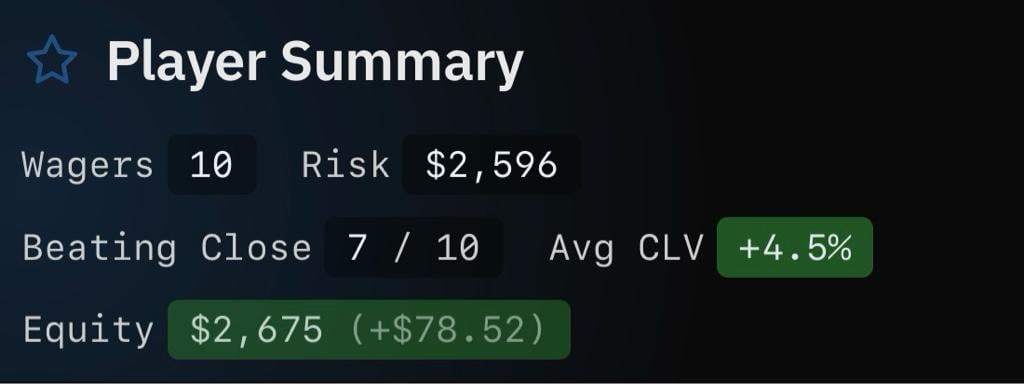Spoiler) Show
Leaving part 1 below: https://forumserver.twoplustwo.com/showp... (https://forumserver.twoplustwo.com/showpost.php?p=59401559&postcount=3050)
Continuing with BB RFI, we’re potting 22.2% of hands (~59.9k combos), calling 34.1% (~92.4k combos), and folding 43.7% (~118k combos). In the 25/25/50 rake-free sim, we were potting 15.6%, calling 55.2%, and folding 29.2%. The rake effect is especially visible here in how much of the strategy gets pulled out of the calling region. Relative to rake-free, we are calling 21.1 percentage points less, folding 14.5 points more, and potting 6.6 points more. From the BB, a lot of hands that can profitably realize thin equity by calling in a rake-free environment no longer clear that threshold once 5% rake capped at 4bb is applied, particularly when we will be OOP at high SPR. At the same time, the response is not simply to tighten by folding everything marginal. The potting range actually expands, which is an important distinction: rake encourages us to polarize the decision more toward raising or folding rather than retaining such a large passive entry range. Hands with enough equity, nuttiness, blocker value, or realization can justify building the pot immediately, while much of the weaker middle that could call rake-free gets pushed out. 5/5/10 5% 4bb cap sim
(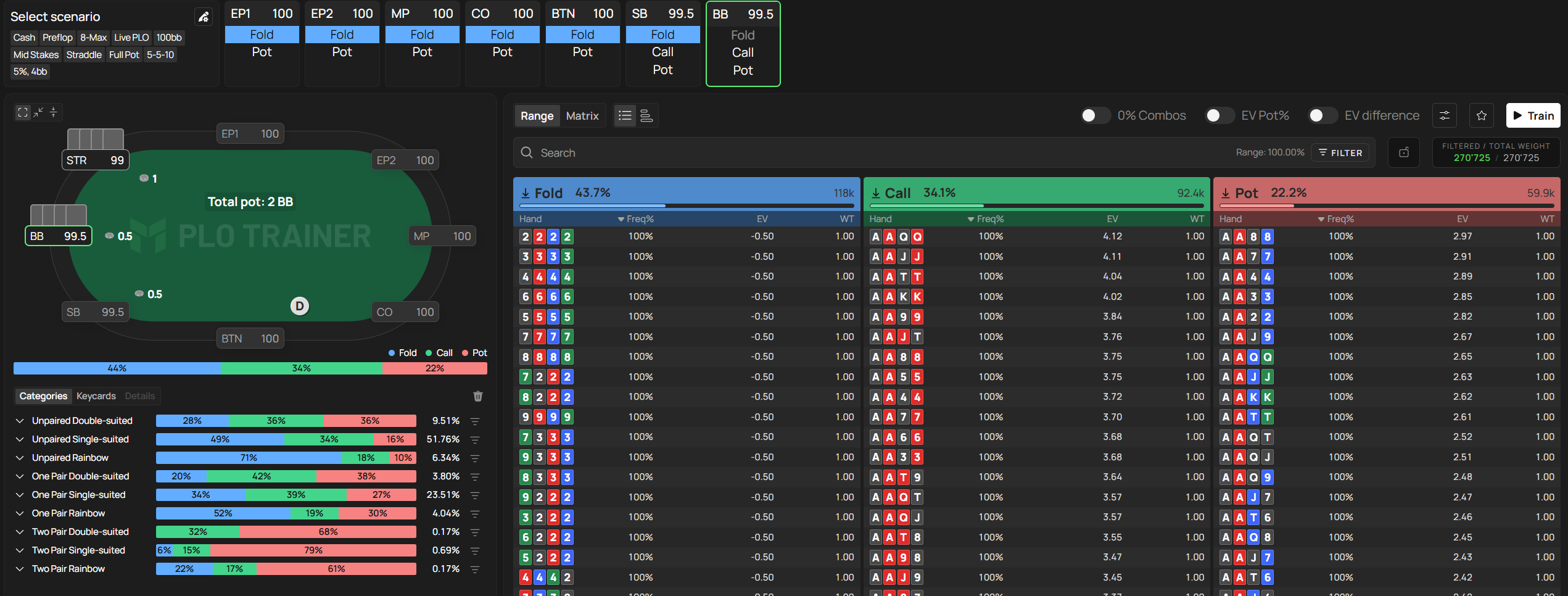 )
25/25/50 rake free sim
(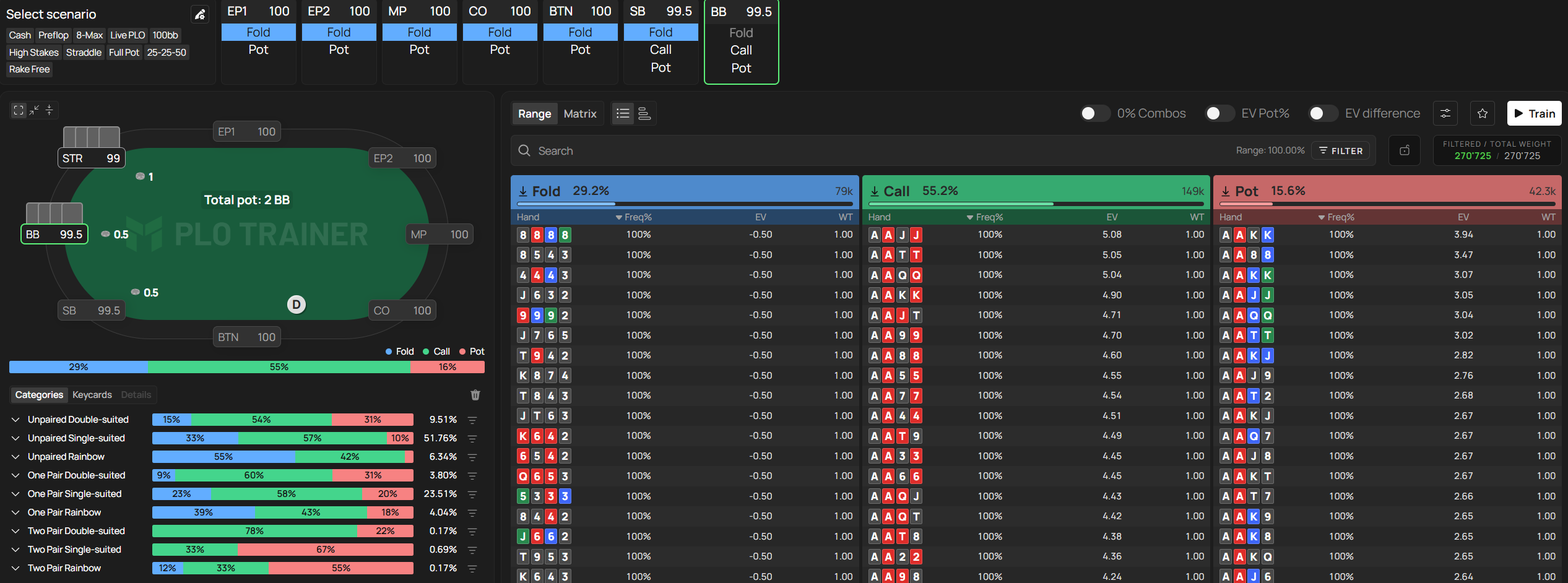 )
Some 100% frequency opens I found interesting: AQ87r AK54r A987r KQT7r All four are unpaired rainbow hands, which makes their pure-open status fairly instructive given that we are OOP, paying meaningful rake, and playing a high-SPR pot. None has suit equity to lean on, so the EV has to come primarily from rank quality, connectivity, high-card strength, and the ability to make strong/nutted straight structures. The ace-heavy hands also benefit from blocker and high-card value, while KQT7 retains enough Broadway density and connectivity to interact well with a broad range of flops. These are reminders of rainbow + unpaired not automatically meaning low EV: when the ranks themselves generate enough robust equity and useful future blockers, the hand can still comfortably clear the BB opening threshold even in this structure.
Another group of pure opens that stood out: J♥T♥6♠4♠ K♠J♥8♥4♠ Q♥T♥6♠4♠ J♠T♥5♥3♠ These are all unpaired and somewhat disconnected, but double-suitedness is doing a significant amount of work. Even when all four ranks do not cooperate naturally, the hands retain two suit avenues, useful two- and three-card straight interaction, and enough high-card strength to generate playable equity across a much wider set of boards than the raw rank structure might suggest. That matters particularly OOP at high SPR, where hands need ways to continue beyond simply flopping one medium-strength made hand. These constructions can develop strong draws, redraws, and nutted or near-nutted turns and rivers, giving them enough realization to remain pure entries despite looking fairly loose at first glance.
On the other side, some 100% frequency folds that stood out to me: 5♠ 5♥ 2♦ 2♥ 4♠ 4♥ 2♦ 2♥ 3♠ 3♥ 2♦ 2♥ These are another useful reminder that “double-paired” is not a sufficient hand-quality classification in PLO. Unlike Hold’em, simply starting with two pocket pairs does not inherently create a strong hand: when both pairs are low, one of them is deuces, and the hand is only single-suited, our set-making value comes with substantial domination and redraw problems. When we hit a set, it is frequently a low set in a game where higher sets, straights, wraps, and strong redraws matter enormously. The 22 component in particular contributes very little connectivity or high-card value, so these hands are carrying a lot of apparent structure without generating enough nutted equity or robust realization to justify entering from the BB in the raked configuration.
Another group of pure folds that stood out: A♠T♥3♥2♥ A♠J♦3♥2♥ A♠T♦3♦2♥ A♠T♥3♦2♥ These are particularly interesting because they still contain an ace and an additional Broadway card, yet make it into the roughly 2.9% of this hand class that folds in this configuration. The problem is that the bottom half of the hand contributes very little: 3-2 creates weak low-end connectivity, and the overall constructions lack enough suit quality and four-card interaction to compensate. The ace and Broadway card provide some high-card and blocker value, but they are doing too much of the work by themselves. OOP and under rake, that is not enough when the rest of the hand produces weak straight coverage, limited nutted development, and poor realization on many board textures, pushing even these superficially respectable A-Broadway holdings into the pure-fold region.
Some Takeaways: The most striking feature of BB strategy here is not simply that rake makes us tighter; it is where the lost frequency goes. Compared with the 25/25/50 rake-free sim, the calling range collapses from 55.2% to 34.1%, while both folding and potting increase. In practice, that means we should be particularly skeptical of importing marginal rake-free calls directly into the 5/5/10 game. The BB also deserves to be thought about separately from the SB despite the same 5/5 blind sizes. We have already invested a blind, but we are still responding to a straddle twice that size and will be OOP after entering, so equity realization matters enormously. The result is a strategy that rewards hands capable of either supporting an aggressive pot or realizing cleanly enough to call, while aggressively removing the weaker middle. That helps explain why some visually modest hands remain pure entries while seemingly respectable hand classes disappear entirely. Rainbow A-high constructions can survive through rank strength and connectivity; disconnected double-suited hands can survive through suit equity and redraw potential; but low double pairs and weak A-Broadway-low-low structures often lack enough robust postflop development. So for BB specifically, the practical lesson is less “rake makes us play fewer hands” and more that rake changes the shape of the entire entry strategy. The rake-free sim permits a very broad calling region, whereas the 5/5/10 structure forces us to be much more decisive about which hands deserve to enter passively, which should take the aggressive route, and which no longer generate enough EV to participate at all.
Moving on to 8-max, 100bb, with a two-blind structure. We’ll start with 25/25 rake-free, then work through 5/5 with 5% rake capped at 4bb as supplemental training and review. I like starting rake-free because it gives us a consistent baseline for understanding how position, hand structure, and equity realization shape our ranges before adding a particular rake structure. Every game can have different rake rules, so understanding that foundation should make our study more adaptable and efficient than memorizing ranges for one specific setup. The second pass will give us extra reps, reinforce the concepts, and let us compare where the rake changes our decisions. It’s a marathon, not a sprint! Starting in EP, we’re potting 12.2% of hands (~33k combos) and folding 87.8% (~237k combos). I’m not sure how the images display across different browsers and devices, but at least on pc when logged in and using google chrome, clicking the image should open it in a separate window where it’s easier to view at full size. However, that may not work as well on a phone or other devices, so I will try to include a Gyazo link to view the image at full size that way too when I can. You can click it directly if you’re comfortable, or copy and paste it into your browser so you can inspect the URL first if you prefer. https://gyazo.com/b39e0eae7536881d659dbf... (https://gyazo.com/b39e0eae7536881d659dbfdfa90aeebf)
(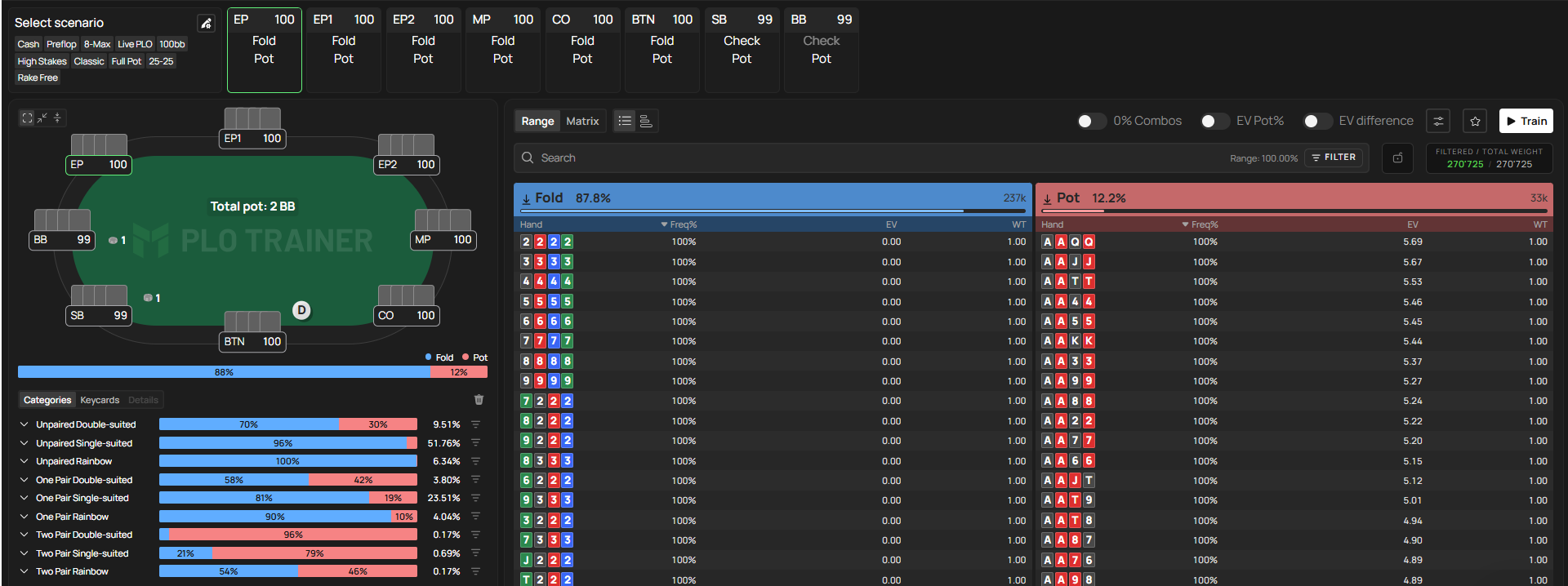 )
Some 100% frequency non-zero EV opens from EP1 I found interesting: Hand class: unpaired, single-suited hands with an offsuit ace (i.e. non-nut suit). A♠K♥T♦8♥ A♠J♥T♦8♥ A♠K♦J♦9♥ A♠J♥T♥9♥ Across this entire hand class, only 3.8% of combos—707 total—are opened from EP1. These four hands are part of that very small opening subset. They’re all unpaired, only single-suited, and the ace itself is offsuit from the suit, so none gets the obvious boost of a nut suit. What pushes these specific constructions over the line is the strength of the remaining three cards: they’re high, connected, and Broadway-dense. That gives us multiple ways to make strong straights, wraps, two pair, and high pairs while retaining good equity across a wide range of boards. The offsuit ace still contributes useful high-card strength and some AA removal, but it isn’t the main reason these hands open. The bigger driver is how efficiently the other three ranks work together, with very little wasted structure. The secondary suit also adds enough equity to matter even without being nut-suited. Combined with the strong rank connectivity, that is enough for these specific hands to separate themselves from most of the class and become pure EP1 opens.
Some more 100% frequency non zero EV opens:
Hand class: Rainbow non AA broadway pairs: K♦K♣T♥9♠ A♠Q♣T♥T♦ K♦K♣J♥T♠ A♠K♣T♥T♦ These hands make it into the 8.2% (274 combos) of this hand class that are opening here from EP. Despite being rainbow, non-AA paired hands, these examples sit near the top of the class because the pair is accompanied by unusually strong high-card structure. The KK hands already begin with a premium pair and add connected Broadway side cards, giving us strong set value while retaining meaningful straight coverage and the ability to make or block a lot of strong top-pair/two-pair holdings. The TT hands compensate for the weaker pair through A-high Broadway support. AQTT and AKTT contain two premium overcards, useful blockers, and much better domination properties than a typical rainbow TT hand. Even without a flush draw, enough of the deck interacts favorably with these holdings that their raw equity and nut-making potential remain strong enough to overcome the positional disadvantage of opening from EP.
Bottom Set, Six Ways… But We Have a Gutter (: 0.6bb ante. BTN is a passive whale. No real info on SB, but he seemed pretty nitty over a small sample. I open LJ pot with A♦4♣2♦2♣. Everyone calls. 6 ways. 25bb in the middle. Flop (25bb): K♦5♥2♥ SB checks, BB checks. I bet 6.5bb. HJ folds, CO calls, BTN calls, and SB x/r to 56.5bb. BB folds. I decide to jam for around 125bb total. CO and BTN fold. SB calls A♣K♣5♦4♦. We hold. Not really sure about this one. Five ways facing a pot-sized x/r with bottom set and no FD, against someone I thought was basically nut-peddling, feels pretty dicey. We’re also not shallow enough that we can just shrug and get it in. The other issue is that we still have CO and BTN behind us after they both called the flop. There are plenty of configurations where one of them wakes up with something that can continue, while the SB is already showing a ton of strength. I ended up stacking off mostly because of the gutter lol. Against the hands that have us crushed, at least having the wheel outs gives us a little extra equity, and obviously we’re doing much better when SB is showing up with two pair or a big draw instead. Still, when SB is actually willing to stack off here, we’re going to be basically dead against higher sets a decent amount and probably aren’t in fantastic shape against the stronger combo draws either. Somehow this particular hand felt pretty close to the best-case scenario for us. Interesting one, I thought. Or maybe it’s not interesting at all (:
On the other side, some 100% frequency folds that stood out to me from EP: 8♠8♥3♠3♥ 7♠7♥2♠2♥ 9♠9♥4♠4♥ The first structural weakness is zero straight potential: 8–3, 7–2, and 9–4 cannot fit within any five-card straight, and we must use exactly two hole cards. Consequently, these hands cannot flop straight draws, develop backdoor straights, or pick up straight redraws alongside a made hand. The second pair adds another set target, but the separation between the ranks leaves an entire source of postflop equity unavailable. Having two pocket pairs increases our chances of flopping a set, but the quality of those sets matters. The smaller pair frequently produces bottom set, while even the higher pair can produce middle or bottom set on boards containing overcards. We can certainly flop top set and win a substantial pot, but we cannot assign the same implied value to every set we make. Lower sets carry greater exposure to higher sets and inferior full houses, especially when multiple players continue. Those occasional expensive collisions reduce the value of entering pots primarily to hit either pair. Double suitedness adds meaningful equity, but both suits are headed by only a seven, eight, or nine. That creates flush potential with substantial domination risk: against a higher flush draw, cards that appear to improve us can instead make an expensive second-best hand. A small flush draw can provide useful additional equity alongside a set, but a bare small flush draw is much less reliable as a reason to continue against pressure. The suits therefore improve these hands without giving them the same ability to build pots and withstand aggression as stronger suited structures. My interpretation of these folds is that those weaknesses compound particularly badly from EP. With seven players behind, we must account for calls, multiway pots, and 3-bets, often followed by playing out of position. When we miss our sets, we frequently have an unimproved medium or small pair, sometimes supported by a vulnerable flush draw, with limited opportunities to improve into a strong continuing hand. The opening decision depends on how much equity we can realize across that entire game tree. In this solution, the combination of modest pair strength, weak suits, and completely disconnected ranks leaves these hands below the opening threshold despite their attractive double-paired, double-suited appearance.
Some more 100% frequency folds from EP in this 25/25 Rake free sim that stood out to me from an assortment of hand classes: A♠J♥7♠4♥ K♠Q♥7♥6♠ A♠K♠7♥4♥ J♠J♦4♠4♥ AJ74 double suited has a nut suit, a second suit, and two Broadway cards, but its strength is spread across components that offer limited support to one another. AJ can make the nut Broadway straight, while 74 provides some low straight potential, yet the hand lacks the concentrated connectivity needed to produce frequent strong straight draws or layered combinations of made hands and draws. The jack-high heart suit adds equity but remains vulnerable to higher flushes, and pairing the ace often leaves us with a relatively fragile holding when substantial money goes in. The nut spades are the strongest feature, but we frequently miss that draw and must navigate with weak pairs, limited straight draws, or backdoors. My reading of the pure fold is that one nut suit does not generate enough realizable equity to carry the fragmented rank structure through an EP opening tree. KQ76 double suited looks coordinated because KQ and 76 are each connected, but the two connected groups do not interact: K7, K6, Q7, and Q6 cannot contribute to a straight. That sharply limits the combinations available compared with a hand whose four ranks work together, reducing our opportunities to flop substantial straight draws and improve them across later streets. KQ can make strong high straights and 76 can make nut straights on suitable low boards, but hitting one part often leaves the other contributing little beyond its suit. Both suits have useful height, although neither contains an ace, so flush domination remains relevant—particularly when pots become multiway. From EP, the combination of disconnected rank groups and non-nut suits helps explain why its attractive individual features still fall short of an opening hand in this solution. AK74 double suited retains nut spades and improves the Broadway component to AK, but its second suit is only seven-high, and the rank structure remains divided. AK contributes top-pair strength and nut Broadway potential, while 74 supplies a separate low straight component; neither K7 nor K4 can form a straight, and A7 cannot either. A4 adds wheel potential, but that does little to create strong, overlapping draws on the high boards where AK connects. We therefore often flop a hand with one useful feature and limited backup: top pair without a substantial redraw, a small heart draw, or a low straight draw exposed to stronger combinations. The improvement from AJ to AK does not repair the weak supporting structure, and here it also comes with a considerably weaker second suit. The fold illustrates how premium-looking top cards can still leave the complete four-card hand below the EP threshold. JJ44 single suited offers two set targets, a medium-high pair, and a jack-high spade suit, but it has no straight potential and only one flush route. The jacks can flop valuable top sets, yet on many other boards they become an unimproved pair facing overcards or coordinated opposition. The fours add opportunities to make a set, but these are overwhelmingly bottom-set outcomes whenever the flop contains a four and two distinct higher ranks. They also occupy two card slots that could otherwise provide connectivity or stronger suited support around JJ. Consequently, the hand depends heavily on relatively specific favourable flops, with limited ways to develop strong draws when it misses. From EP, that narrow distribution of profitable continuations helps explain why the extra pair and single suit are insufficient to justify opening in this solution.
Some Takeaways: Within this 12.2% EP opening range, the unpaired, single-suited hands with an offsuit ace are particularly selective: only 3.8% of that class opens. The featured AKT8, AJT8, and AKJ9 combinations show how high-card connectivity can support an opening hand even without a nut suit. Their supporting ranks create overlapping straight possibilities and opportunities to combine a pair with additional drawing equity. Compare that with AJ74ds and AK74ds: adding a nut suit and a second suit still leaves the high and low components poorly integrated. The distinction becomes especially relevant on flops where we connect only partially, because the stronger supporting ranks give us more ways to continue and improve through subsequent streets. The rainbow paired examples reveal a similar selection process: only 8.2% of the rainbow non-AA Broadway-pair class opens, with KKT9, KKJT, AQTT, and AKTT among the pure opens examined. The kings provide strong set potential alongside useful straight-making side cards, while the tens receive substantial support from two high cards that also interact with the pair’s rank. JJ44ss illustrates why adding another pocket pair does not necessarily improve the complete hand enough: the fours add set opportunities but eliminate straight potential, leaving fewer productive continuations when neither pair improves. We should therefore examine what the supporting cards contribute both when we hit our pair and when we miss it. The double-suited folds identify two distinct connectivity problems. In 8833ds, 7722ds, and 9944ds, straight potential is completely absent, concentrating their value in sets and low flushes that can encounter substantial domination. KQ76ds can make straights, but its connectivity is confined to KQ and 76; none of the four high–low combinations can form one. That limits how often several parts of the hand contribute to the same board. At 100bb from EP, these limitations affect both our ability to withstand pressure and the quality of the hands with which we build larger pots. The examples suggest that the cost of missing useful supporting equity—and sometimes paying to improve into second best—is enough to outweigh the extra suits in these specific constructions. Another useful distinction is how well a hand can improve while already holding something worth continuing with. The featured AKJ9 and KKJT combinations can connect through a pair plus a straight draw, or a set with additional straight possibilities, giving us several reasons to invest in the same pot. With disconnected double pairs, much of our improvement depends on hitting a set; with AK74ds, the low cards often contribute little when AK connects. These differences matter on the turn: useful supporting cards increase our opportunities to strengthen a flop continuation, while weak support leaves more runouts where further pressure forces us to surrender our remaining equity.
Continuing with EP1 in this 25/25 8-max. EP1 potting 14.2% (38.5k combos) and folding 85.8% (232k combos). I’m not sure how the images display across different browsers and devices, but at least on pc when logged in and using google chrome, clicking the image should open it in a separate window where it’s easier to view at full size. However, that may not work as well on a phone or other devices, so I will try to include a Gyazo link to view the image at full size that way too when I can. You can click it directly if you’re comfortable, or copy and paste it into your browser so you can inspect the URL first if you prefer. https://gyazo.com/7ef5ae26285a2dada2a083... (https://gyazo.com/7ef5ae26285a2dada2a083f2920caf84)
(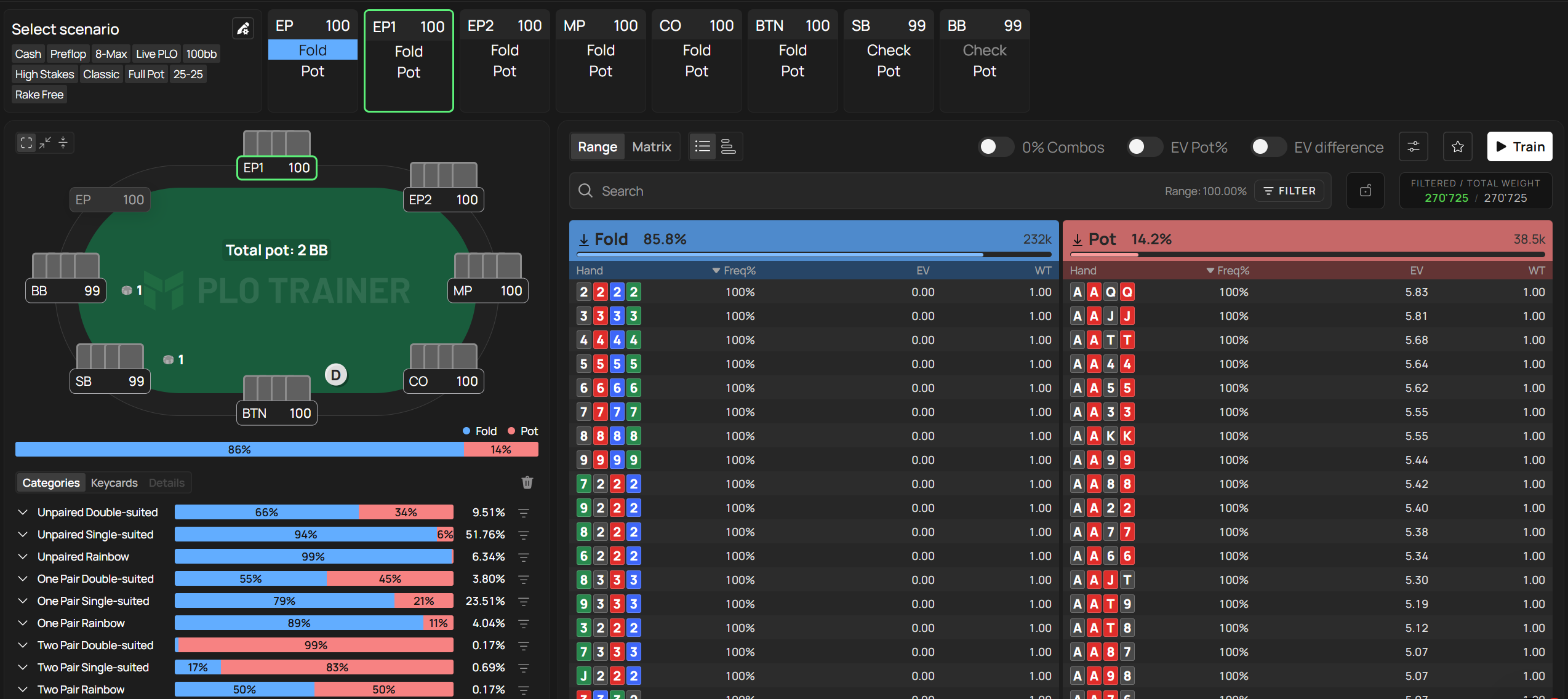 )
EP1 25/25 8-max rake-free Some 100% frequency non-zero EV opens from EP1 I found interesting: Hand class: Unpaired hands with an offsuit ace and one non-nut flush suit. A♠T♦9♦8♥ A♠Q♦J♥9♥ A♠K♦Q♦9♥ A♠Q♥T♥9♥ These hands fall within the 5.4% (~1k combos) opening from the selected hand class. With AT98ss, the T98 component provides three usable straight-making combinations—T9, T8, and 98—giving the hand substantial interaction with middle boards despite the separation between the ace and the lower cards. AT also preserves a route to nut Broadway on KQJ, so the ace contributes beyond its removal effects. The diamond suit connects T9, allowing flush equity to accompany some of those straight draws. Its ten-high ceiling introduces domination risk, but the connected three-card component gives us additional ways to continue when the flush draw is absent or insufficient on its own. AQJ9ss shifts more of that connectivity toward the upper end of the deck. On a T82 flop, QJ, Q9, and J9 give us several routes to a straight through different turn ranks; meanwhile, AQ, AJ, and QJ all participate in Broadway constructions. That combination lets the hand interact with both high and upper-middle boards, with the ace contributing directly to the high straight structure. Pairing a queen or jack can also leave relevant straight possibilities alongside our made hand, rather than forcing us to rely entirely on its immediate showdown value. The J9 heart suit provides additional drawing equity, while the overlapping rank connections help explain why this particular non-nut-suited construction clears the EP1 threshold. AKQ9ss has the strongest concentration of high cards in this group, with AK, AQ, and KQ all contributing to nut Broadway possibilities. A JT2 flop demonstrates how effectively those ranks cooperate: several different turns complete straights, and the nine extends our coverage below Broadway as well. This gives the hand substantial drawing potential without requiring a flush draw to justify continuing. The king-high diamond suit then adds another useful component, including opportunities to combine a strong straight draw with flush equity. Although the nine is separated from the king and ace, its connection to the queen gives it a concrete supporting role within a hand already anchored by three premium ranks. AQT9ss combines the QT9 straight structure with three Broadway ranks. On a J82 flop, QT, Q9, and T9 create overlapping straight possibilities, while AQ, AT, and QT preserve additional interaction with higher boards. This exact example contains three hearts, so it is technically three-suited: the extra heart reduces our available flush outs without creating another flush route. However, the nine still contributes meaningful straight connectivity, including ways to strengthen a hand that has already connected through a queen or ten. We can read this pure open as an example of sufficiently useful rank structure overcoming a suit-related penalty, with the queen-high heart suit still providing additional equity despite that penalty.
EP1 25/25 8-max rake-free Some more 100% frequency non-zero EV opens that stood out to me. These are from an assortment of hand classes: 8♥ 6♦ 5♥ 4♠ A♠ Q♦ 5♠ 4♥ Q♠ J♠ T♥ 9♠ 9♥ 8♦ 7♥ 6♠ 8654 single suited opens despite its low ranks, eight-high suit, and missing seven because all six two-card rank combinations can participate in straights: the compact 654 component supplies overlapping low-board connections, while the eight extends that coverage upward, giving us opportunities to combine pairs and straight draws even though the upper gap reduces the quality of some draws compared with a fully connected rundown. AQ54 with nut spades opens despite the separation between AQ and 54 because its components retain specific nut-making roles—AQ makes Broadway, A4 and A5 contribute wheel possibilities, and 54 connects with low boards—while the nut suit can support either end of that rank structure, providing stronger flush-draw continuations than the non-nut suits carried by many otherwise comparable disconnected hands. QJT9 tri-suited opens despite blocking one of its own potential flush outs because its four consecutive high ranks provide overlapping straight combinations and strong pair-plus-draw possibilities, with JT connecting both ends of the rundown; this gives the hand substantial value on boards where it does not flop spades and helps compensate for the suit penalty and the queen-high flush’s exposure to domination. 9876 single suited opens despite having no Broadway cards and only a nine-high suit because its gapless structure lets all four ranks contribute across neighbouring board textures, supporting wraps and combinations of made hands with straight draws; compared with 8654, the uninterrupted upper end adds useful straight coverage, although we still need to distinguish nut-making improvements from lower-end straights and vulnerable flush completions.
EP1 25/25 8-max rake-free On the other side, some 100% frequency folds that stood out to me: Hand class: Single-suited, disconnected double-paired hands. T♠ T♦ 5♠ 5♥ T♠ T♦ 4♠ 4♥ T♠ T♦ 3♠ 3♥ These hands fall within the 7.9% (72 combos) shown as pure folds within this hand class from EP1. Their most restrictive shared feature is zero straight potential: T5, T4, and T3 are all too widely separated to fit within a straight. Consequently, when the tens flop an overpair or middle pair, the smaller pocket pair cannot provide the straight draws that connected side cards could add. We are often left trying to continue with TT supported only by occasional spade equity, and many turns introduce an overcard or strengthen the connected hands that called our open. The second pair gives us another set target, but its contribution depends heavily on which rank hits. A ten can produce a valuable top set, whereas a three, four, or five frequently produces bottom set, with greater exposure to higher sets and inferior full houses when substantial action develops. Moving from TT55 to TT44 or TT33 does not change the number of remaining cards matching our paired ranks; it changes the rank of the additional sets we can make. More opportunities to flop a set do not translate directly into equally valuable opportunities to build a large pot, particularly when neither pair has straight-making support. All three hands also have exactly one ten-high spade suit, so their flush potential has the same ceiling despite the changing lower card. A set accompanied by a spade draw can have useful additional equity, but when we miss both sets, a bare ten-high flush draw is vulnerable to domination and may be difficult to continue with against strong pressure. Completing that draw can also create an expensive second-best flush. The structural explanation for these folds is therefore quite specific: the tens supply the strongest made-hand potential, while the smaller pair and low suit provide insufficient reliable support across the many boards where TT alone cannot sustain further investment.
EP1 25/25 8-max rake-free Some more 100% frequency folds that stood out to me from an assortment of hand classes: T♠ 8♦ 7♥ 6♠ 9♠ 8♦ 7♥ 6♠ K♥ Q♠ J♥ 7♠ Q♦ J♠ J♥ 9♠ T876 single suited retains a connected 876 component and a ten-high suit, but the missing nine interrupts its upper straight structure, increasing its exposure to stronger connected holdings on high boards—for example, on J98 our T7 makes a jack-high straight that loses to QT—while the non-nut spades provide limited protection against that domination when we also encounter a higher flush draw. 9876 single suited has gapless connectivity, but its nine-high ceiling leaves some apparently strong connections exposed to higher rundowns: on T98, our 76 makes the lowest available straight, beneath both J7 and QJ, illustrating why the quality of our straight completions matters alongside their frequency; this particular combination also has only the 96 spade suit, so its flush equity remains vulnerable when opponents continue with stronger suited hands. KQJ7 double suited combines three Broadway cards with king-high hearts and queen-high spades, but the seven contributes very little additional straight coverage: its only straight-making partner is the jack, and the resulting J7 straight on T98 is already surpassed by our own QJ, meaning the fourth rank adds little to the hand’s strongest straight outcomes while both suits remain exposed to ace-high flushes. QJJ9 single suited offers a meaningful QJ9 straight structure and two remaining jacks with which to make a set, but the duplicated jack limits us to three distinct ranks and removes one potential jack completion from Q9-based straight draws; with no ace or king, the pair also faces frequent overcards, and its jack-high spade suit leaves further domination risk when our straight and set possibilities receive substantial action.
EP1 25/25 8-max rake-free Some Takeaways: Within this 14.2% EP1 opening range, only 5.4% of the selected offsuit-ace/non-nut-suit class opens. AT98, AQJ9, and AKQ9 qualify with supporting ranks that generate overlapping straight possibilities while retaining access to Broadway; their value extends beyond pairing the ace or finding their suit. AQ54 with nut spades takes a different route: AQ supplies high-card strength, A4/A5/54 connect with wheel boards, and the nut flush draw provides a stronger continuation when those separated rank groups offer limited immediate support. The contrast between QJT9 tri-suited and KQJ7 double suited highlights the contribution of the fourth rank. QJT9 retains a complete high rundown despite losing a potential flush out, whereas KQJ7’s seven adds only the J7 straight route on T98, where QJ already makes a higher straight. The TT55/TT44/TT33 folds expose a more severe limitation: the second pair adds set targets but no straight possibilities whatsoever. Their extra opportunities to hit a set come with low-set exposure and little drawing support when the tens remain unimproved. The two 9876 examples require their exact suit pairings: the 97-heart-suited version opens, while the 96-spade-suited version folds in the posted results. Both have identical rank connectivity and a nine-high flush ceiling, so general explanations about low straights or flush domination cannot explain that split by themselves. Suit placement changes which boards combine flush equity with particular made hands and straight draws; comparing the actual opening EVs would establish how substantial the difference is, since opposite pure actions can still sit very close to the opening threshold.
Continuing with EP2 in this 25/25 8-max rake free. EP2 potting 17.1% (46.2k combos) and folding 82.9% (224k combos). I’m not sure how the images display across different browsers and devices, but at least on pc when logged in and using google chrome, clicking the image should open it in a separate window where it’s easier to view at full size. However, that may not work as well on a phone or other devices, so I will try to include a Gyazo link to view the image at full size that way too when I can. You can click it directly if you’re comfortable, or copy and paste it into your browser so you can inspect the URL first if you prefer. https://gyazo.com/cb036a5b9868ae9838b41c... (https://gyazo.com/cb036a5b9868ae9838b41c52e520ac91)
(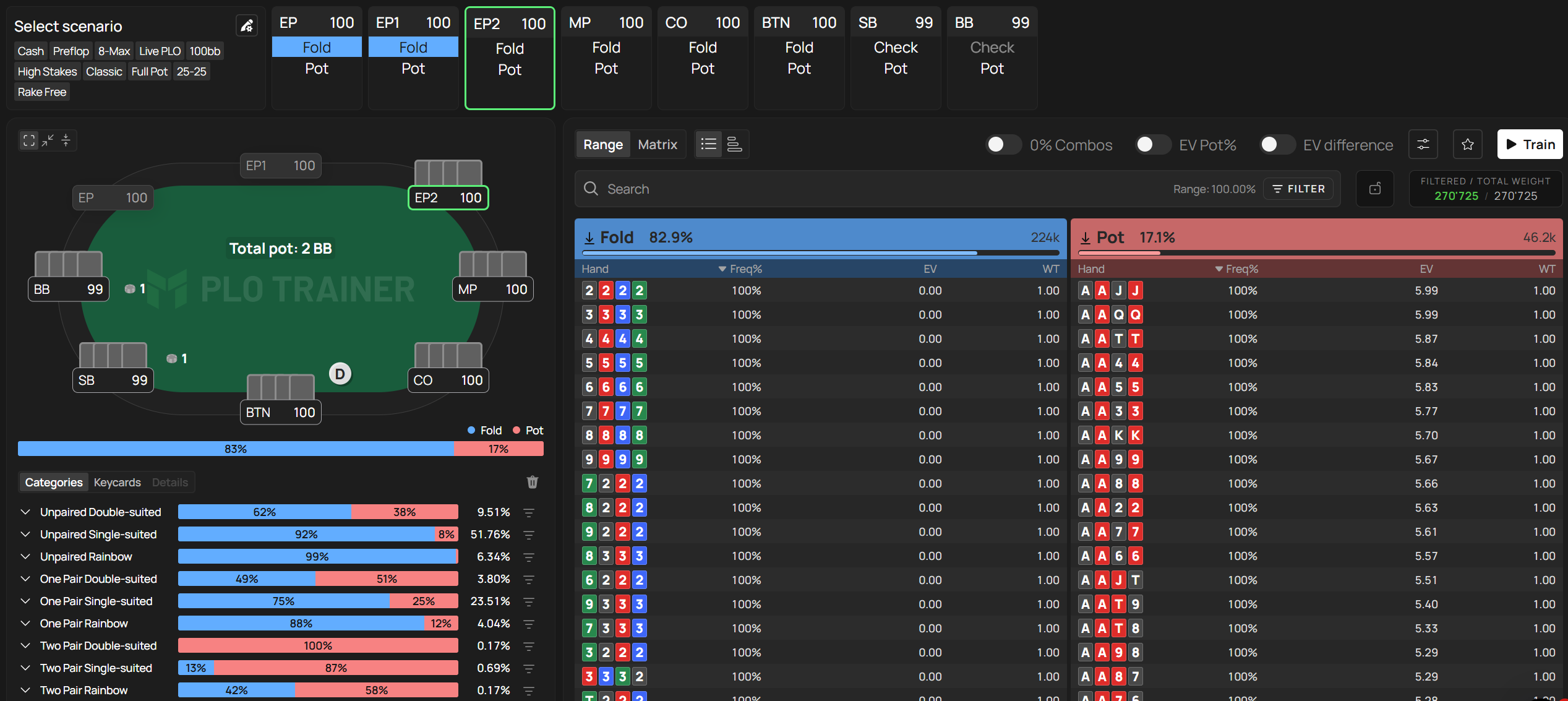 )
EP2 25/25 8-max rake-free
Some 100% frequency non-zero EV opens from EP2 I found interesting: Hand class: One pair, non-AA, rainbow hands. KKJ8r KK87r KK98r QQJTr These hands belong to the 11.9% (168 combos) of this hand class opening from EP2, with 88.1% (~1.2k combos) folding. KKJ8r combines the kings’ strong set potential with two distinct straight-making connections: KJ supplies nut Broadway on AQT, while J8 can make the nut straight on T97. The eight cannot connect directly with a king, but the jack gives it a useful role on lower boards. Consequently, the hand has ways to connect strongly beyond hitting a king, helping compensate for its lack of flush potential. KK87r is more clearly divided: neither king connects with either side card, leaving 87 as its only straight-making rank combination. However, that connector can make the nuts on boards such as 965, giving us valuable coverage on textures where unimproved kings would otherwise struggle. We can also flop a set of kings with a supporting straight draw when the remaining board cards interact with 87. Its inclusion suggests that the premium pair, supported by two consecutive side cards, supplies enough value in this particular EP2 solution despite the separation and absence of suits. KK98r moves the connected side cards upward and adds K9 as another usable straight combination, although that extra route needs careful valuation: on QJT, K9 makes a king-high straight that still loses to AK. The cleaner contribution comes from 98 making nut straights on suitable middle boards, such as T76, while the kings preserve strong top-set potential elsewhere. Relative to KK87r, the nine interacts with the pair’s rank, but additional straight coverage does not automatically mean additional nut coverage; the hand’s strength comes from the combined package. QQJTr has the most integrated rank structure of these examples, with QJ, QT, and JT all contributing to straight possibilities around the pair. On a rainbow Q98 flop, we already have the nut straight through JT, while QQ supplies full-house and quads redraws—a concrete example of the side cards strengthening the same board that hits our pair. When no queen arrives, JT and its connections to Q still provide substantial drawing potential. That cooperation helps compensate for the lower pair rank and rainbow suits, reducing dependence on flopping a set.
EP2 25/25 8-max rake-free Some more pure opens that stood out to me from an assortment of hand classes: A♠ T♦ 4♠ 4♥ K♠ Q♥ Q♦ 4♠ K♥ K♦ 8♥ 4♠ 8♦ 6♥ 5♠ 4♠ AT44 with nut spades has a vulnerable small pair, but the ace gives it two useful forms of support: nut-flush potential through A4 and wheel possibilities using either four. AT adds a separate route to Broadway, so the hand can connect strongly without hitting its pair. When we do flop a set, those additional features can materially improve its quality—for example, on 4♣ 3♠ 2♠, we have a set, the nut flush draw, and a gutshot. That combination helps explain how this particular construction overcomes the limitations of bottom-set potential. KQQ4 single suited gets most of its strength from QQ, the accompanying king, and the king-high spade suit; the four contributes to the flush but cannot form a straight with either high rank. KQ supplies nut Broadway on AJT and useful straight draws on neighbouring high boards, giving the queens support beyond their set value. Pairing the king also gives us a higher pair on some boards where QQ alone would be under pressure. The suit remains vulnerable to ace-high spades, but it adds meaningful drawing equity to a hand already carrying a high pocket pair. KK84 single suited is especially revealing because its straight potential is extremely limited: neither king connects with the side cards, and 84 can make a straight only using 567, where 98 makes a higher one. The opening therefore rests primarily on the kings and their king-high heart suit. On K♣ 7♥ 2♥, for example, we have top set with a flush redraw; on other textures, the hearts can support an unimproved overpair. Compared with the earlier rainbow kings, suitedness supplies additional continuations despite much weaker straight-making side cards. 8654 with the 54 spade suit has the weakest flush component here, making its compact rank structure particularly important. The 654 group offers overlapping low-board connections, including the nut straight through 64 on a rainbow 753 flop, while the eight extends our possibilities into higher sequences. Missing the seven weakens the upper end of the rundown, and a five-high flush draw requires caution when facing stronger suited ranges. Its inclusion suggests that the straight-making combinations and opportunities to combine a pair with a draw provide enough value here, with the small suit contributing supplementary equity.
EP2 25/25 8-max rake-free On the other side, some pure folds that stood out to me. Hand class: Rainbow → Ace High → Broadway Pairs AQQ4r ATT8r AJJ8r AKKKr These hands make it into the 42.8% (232 combos) of this hand class that are pure folding here from EP2.
EP2 25/25 8-max rake-free Some more 100% frequency folds that stood out to me from an assortment of hand classes: J♥ 9♠ 7♥ 5♠ J♥ 9♦ 8♥ 7♠ K♠ Q♠ J♠ T♠ K♥ 9♥ 6♠ 5♠
Some Takeaways — 25/25 Rake-Free EP2 RFI The rainbow pairs highlight two different ways to qualify for an open. KK87r relies heavily on its premium pair, with 87 supplying separate straight potential; QQJTr compensates for its lower pair through tightly connected side cards that can deliver a straight alongside a set. AQQ4r and AJJ8r show why adding an ace does not automatically provide comparable support. AKKKr takes the opposite problem further: the third king removes a set out while replacing a potentially useful side card, leaving an impressive-looking hand with very few distinct ways to connect. The suited paired opens show how the suit and side cards change what supports the pair. AT44 with nut spades can combine a small set with the nut flush draw and wheel equity, while KQQ4 adds KQ Broadway potential and king-high spades to its queens. KK84 has much less straight potential, yet its kings and heart suit still support an open. These examples help distinguish useful secondary features from disconnected additions: AT44’s ace participates in both its strongest suit and low straight possibilities, whereas rainbow AQQ4 receives much less overlapping support from its ace and four. Connectivity and suit distribution explain why visually attractive unpaired hands can still miss the range. The 8654 single-suited open has six distinct rank pairs capable of making straights, while K965 double suited has no K5 or K6 connection and only a vulnerable K9 straight route. J975 spreads its ranks across repeated gaps, and J987 lacks the ten that would strengthen its upper connections. KQJT all spades illustrates a different limitation: excellent ranks cannot fully offset holding four cards of one suit, which leaves only seven possible flush-completing cards on a two-spade flop. The reported folds identify the boundary here; their frequencies alone do not establish how far below it each hand sits.
Continuing with MP in this 25/25 8-max rake free. EP2 potting 21.5% (58.3k combos) and folding 78.9% (212k combos). I’m not sure how the images display across different browsers and devices, but at least on pc when logged in and using google chrome, clicking the image should open it in a separate window where it’s easier to view at full size. However, that may not work as well on a phone or other devices, so I will try to include a Gyazo link to view the image at full size that way too when I can. You can click it directly if you’re comfortable, or copy and paste it into your browser so you can inspect the URL first if you prefer. https://gyazo.com/cb036a5b9868ae9838b41c... (https://gyazo.com/cb036a5b9868ae9838b41c52e520ac91)
(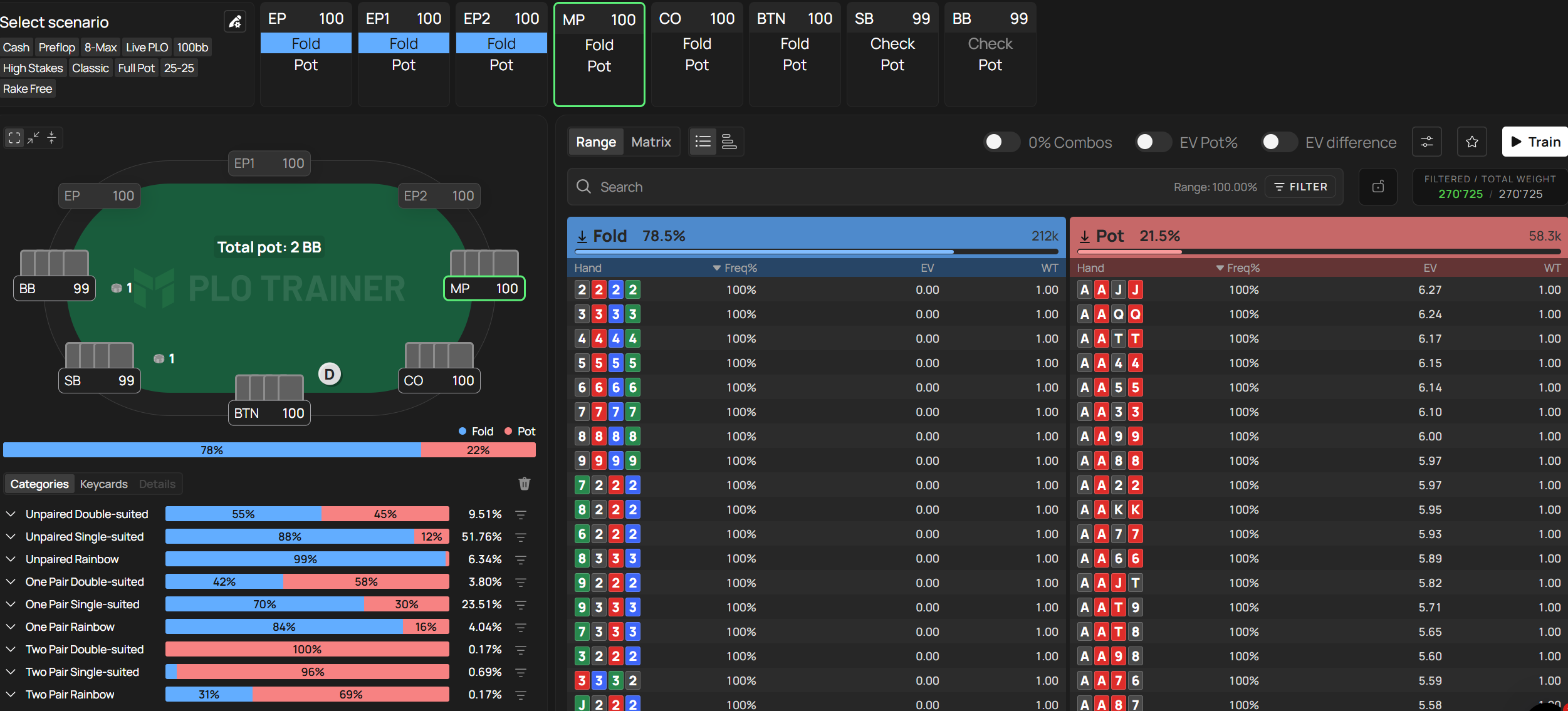 )
25/25 8-Max Rake-Free — MP RFI Across this entire hand class, only 7.5% of combos—858 total—are opened from MP. The other 10.5k combos fold in optimal. These four hands are part of that very small opening subset. Category: unpaired, single-suited, no ace. KdJsTh7s is getting opened because the K-J-T core carries enough high-card density and straight coverage to offset the weak 7. The important detail is that J-T already gives us strong interaction with Q-9-x, 9-8-x, A-Q-x, and K-Q-x structures, while the king improves both pair quality and the upper end of several straight formations. The 7 is not a true blank either: on 9-8-x and 8-6-x textures it extends our straight coverage enough to create additional wraps and pair-plus-draw combinations. The J-high spade suit contributes only modestly, so this is primarily a connectivity open rather than a suitedness open—the hand survives because three strong cards plus a semi-connected fourth produce enough realizable equity across a wide board set. QdTd8h7s is much more dependent on its lower-card geometry. Q-T-8-7 creates a surprisingly dense set of straight interactions, particularly on J-9-x, 9-6-x, T-9-x, and 8-6-x boards, where we can arrive with wraps, pair-plus-wraps, or multiple backdoor extensions. The Q-T diamond suit is also structurally useful because the suited cards participate directly in the straight matrix rather than sitting disconnected from it. What keeps this from being an easy fold despite lacking both an ace and king is that its equity is not concentrated in fragile Qx one-pair outcomes; a meaningful portion comes from boards where three or even all four cards cooperate. That produces substantially better postflop realization than many superficially stronger Q-high hands with worse internal connectivity. KdTh9s8s has one of the strongest raw connectivity profiles in this subset because T-9-8 forms a compact three-card rundown with very little internal gap cost. That creates substantial wrap density across J-x-x, Q-J-x, 7-6-x, T-7-x, and 9-7-x textures, and the king adds valuable upper connectivity on Q-J-T and K-Q-J structures while also improving top-pair quality when we do not flop a major draw. The T-9 spade suit is non-nut, but its placement matters: because those suited cards are already the center of the hand’s straight structure, flush draws frequently appear alongside pair, straight, or wrap equity. That multi-axis equity is what makes the hand robust enough to open even though no individual component—king-high, a ten-high suit, or T-9-8 by itself—would necessarily be sufficient. KdJd9h8s is slightly less linear than K-T-9-8, but it compensates with better suited high-card structure. K-J suited gives us a materially stronger flush branch, while J-9-8 still provides a legitimate connected lower block that interacts well with Q-T-x, T-7-x, T-9-x, and 7-6-x boards. The key distinction is that the hand does not rely on making naked king-pair or jack-pair holdings: when one of those high cards connects, we often retain straight equity, backdoor extensions, or a king-high flush draw alongside it. That combination of stronger suit quality and enough three-card connectivity pushes the hand into the thin opening region despite the gap between J and 9. In a hand class where only 7.5% of combinations survive, that extra overlap between top-end suitedness and lower straight coverage is enough to separate it from the bulk of the 10.5k folds.
25/25, 8-max, rake-free — MP RFI. Some more pure opens I found interesting from an assortment of hand classes: 7s7d6h5s is a good example of how much the solver can value compactness even when the absolute card strength is mediocre. The sevens give us legitimate set potential, but 76/65 also means the side cards are doing real work rather than functioning as disconnected kickers. We can flop pair + straight draw, set + straight draw, wraps around 843/854/864 textures, and the 7s5s suit gives the hand another usable equity channel. It is still a vulnerable medium pair, but unusually many flops give the entire four-card structure something to continue with, which appears to be enough to make it a pure MP open. KhKd8s4s looks much uglier structurally. We have premium raw pair strength with KK, but 8-4 is about as disconnected as side cards can get and the only suit belongs to those side cards rather than the kings. What carries the hand is simply how strong KK remains in an unopened pot: we dominate a large amount of the one-pair region behind us, retain strong set-over-set potential, and frequently reach flops with the best overpair. The 8s4s suit is weak but still contributes some backdoor and flush equity, so apparently the combination of KK + any additional suitedness is enough here despite almost no connectivity. AsTs9d5h gets there for almost the opposite reason. There is no pair at all, but the ace-high spade suit immediately gives us nut-flush potential, while T9 creates a connected core that can interact with a meaningful number of middling boards. The 5 is clearly the weak card, yet it is not completely dead: it occasionally extends wheel interaction with the ace and can participate in two-pair/trip runouts. The distinction from weaker ace-high holdings is that AsTs is not merely “an ace with a suit” — we have nut-suit coverage plus adjacent T9 connectivity, giving the hand enough nut potential and postflop maneuverability to open every time. TdTc6s6h is particularly interesting because double-paired hands can look deceptively rigid. TT66 has no suit and almost no conventional straight connectivity, but it gets two independent chances to flop a set while starting with a pair strong enough that many low and middling boards remain favorable. On Txx we frequently have an extremely strong made hand, while 6xx textures give us a lower set that can still extract heavily against one-pair and draw-heavy ranges. The hand will struggle on broadway-heavy and highly connected boards, but two set-producing pairs with TT on top create enough concentrated value that MP still prefers opening it at full frequency.
25/25, 8-max, rake-free — MP RFI On the other side, some pure folds from MP that stood out: Category: Two Pair ——->; Single Suited ——->; Disconnected 7♠ 7♦ 2♠ 2♥ is the most intuitive fold of the three. The 77 gives us reasonable set value, but 22 contributes very little outside of flopping bottom set, and the two ranks provide essentially no straight cooperation. Even the 7♠ 2♠ suit is weak and frequently dominated. When we miss a set, we are usually left with two medium/low pairs with almost no path toward a nutted hand. 8♠ 8♦ 3♠ 3♥ improves the top pair slightly, but not the underlying structure. 88 has more showdown value and can function as an overpair on low boards, yet 33 is still mostly a set-mining component. The 8♠ 3♠ suit is non-nut, and the 8-3 gap gives us essentially no straight interaction. Even when we connect, our value is concentrated heavily around flopping a set. 9♠ 9♦ 4♠ 4♥ is the most interesting because 99 looks materially stronger, yet still does not cross the MP threshold. We overpair more low boards and top set is obviously excellent, but 44 remains weak, 9-4 is disconnected, and the 9♠ 4♠ suit carries reverse-implied-odds risk. Too many flops still leave us with an overpair, underpair, or weak flush draw and almost no supporting straight equity. Taken together, these folds show how little simply moving the pocket pairs upward changes things when the rest of the hand remains structurally poor. 77/22 becomes 88/33 and then 99/44, but the same issues persist: weak suitedness, no rank connectivity, and most of the hand’s upside tied to specifically flopping a set. The extra raw pair strength is not enough to compensate for how narrow the profitable postflop outcomes remain, even in a rake-free MP opening range.
25/25, 8-max, rake-free — MP RFI Some more pure folds from MP I found interesting from an assortment of hand classes:
A♠ J♠ 8♥ 7♠ initially looks stronger than a fold because we have the nut-spade suit and a connected 8-7 component. But holding three spades makes the suit structure less efficient, while A-J and 8-7 still operate mostly as separate pieces. We can flop the nut-flush draw or useful straight equity, but too few boards activate both parts of the hand at once. K♦ K♣ Q♥ 3♠ shows how far bare KK can fall when almost nothing supports it. The kings provide strong set and overpair value, and Q♥ is at least a useful high side card, but the 3♠ is nearly dead. Being rainbow removes flush equity, and K-Q alone offers limited straight development. There is no meaningful secondary equity channel to support the raw strength of KK. T♠ 9♥ 6♥ 5♠ is especially interesting because it is double-suited and superficially connected. The issue is that T9 and 65 are separated by a real gap, so many straight-heavy flops interact with only one half of the hand. Both suits are also non-nut and vulnerable to domination. The hand can make plenty of medium-strength equity, but fewer genuinely nutted combinations. Q♦ Q♣ J♥ 9♠ looks close to a standard open because QQ gives us strong pair value and J9 provides useful straight interaction. But being rainbow matters, and there is no fourth card extending the connectivity. Many flops leave us with an overpair plus only thin straight support. QQ is strong, but the J9 side structure is not quite enough to pull the hand above the MP threshold.
Some Takeaways: 25/25, 8-max, rake free - MP RFI One of the clearest things from MP is how narrow the margin becomes once a hand loses both an ace and a nut suit. K♦ J♠ T♥ 7♠, Q♦ T♦ 8♥ 7♠, K♦ T♥ 9♠ 8♠, and K♦ J♦ 9♥ 8♠ still make it through because their rank density and connectivity are unusually strong, but only 858 combos—7.5% of that entire category—open while 92.5% fold (10.5k combos). So “connected + single-suited” is nowhere near sufficient by itself; the exact ranks and how efficiently all four cards interact matter a ton. The assortment of pure opens is especially useful because the hands arrive at an open through very different constructions: 7♠ 7♦ 6♥ 5♠, K♥ K♦ 8♠ 4♠, A♠ T♠ 9♦ 5♥, T♦ T♣ 6♠ 6♥ 7765 leans on pair-plus-connectivity, KK84 gets carried much more heavily by raw pair strength, AT95 combines the nut suit with T9 interaction, and TT66 has enough two-pair strength to open despite lacking suitedness or meaningful straight connectivity. The two-pair folds are another useful calibration point. 7♠ 7♦ 2♠ 2♥, 8♠ 8♦ 3♠ 3♥, and 9♠ 9♦ 4♠ 4♥ look superficially robust because we start with two made pairs, but their lack of connectivity and poor future nuttiness leaves them as pure folds even in a rake-free environment. Moving from 77/22 to 99/44 improves raw pair strength, but apparently not enough to compensate for how isolated the ranks are or how awkwardly these hands realize equity after getting called. The assortment of pure folds is especially useful because the hands fail for very different reasons: A♠ J♠ 8♥ 7♠, K♦ K♣ Q♥ 3♠, T♠ 9♥ 6♥ 5♠, Q♦ Q♣ J♥ 9♠. AJ87 has the ace and meaningful suit concentration but not enough rank cohesion, KKQ3 has premium pair strength but a largely dead three, T965 is reasonably connected but too middling and non-nutty, and QQJ9 has a strong pair with decent side-card interaction but still lacks enough overall quality as a rainbow combo to clear the MP threshold.
Continuing with CO in this 25/25 8-max rake free. CO potting 29.2% (79k combos) and folding 70.8% (191k combos). I’m not sure how the images display across different browsers and devices, but at least on pc when logged in and using google chrome, clicking the image should open it in a separate window where it’s easier to view at full size. However, that may not work as well on a phone or other devices, so I will try to include a Gyazo link to view the image at full size that way too when I can. You can click it directly if you’re comfortable, or copy and paste it into your browser so you can inspect the URL first if you prefer. https://gyazo.com/5ff0cf104d53649f65de5c... (https://gyazo.com/5ff0cf104d53649f65de5cbb93c760a4)
(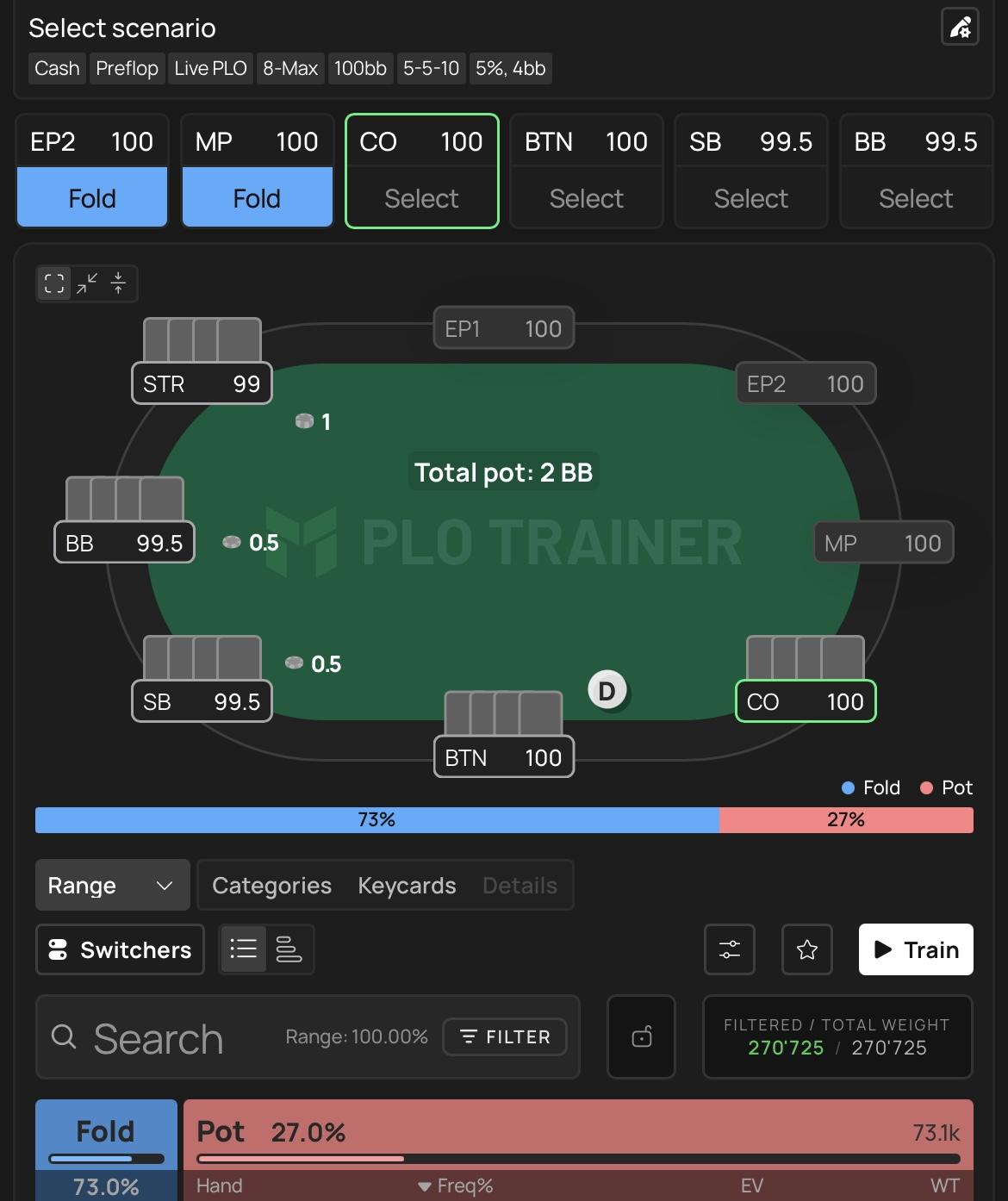 )
25/25, 8-max, rake-free — CO RFI Some pure opens from CO I found interesting: Category: Unpaired Rainbow ——- > Ace High AKJ7r AKQ7r AKQ5r AT98r Across this entire category, only 10.0% of combos—525 total—are opened from CO. 90.0% fold optimally in this structure (4.7k combos). AKJ7r gets there despite being rainbow because the A-K-J core carries substantial high-card and straight value. We can make broadway with a ten, pick up strong equity on Q-T-x textures, and frequently flop top pair with excellent kickers. The 7 is clearly weak, but three coordinated broadway ranks provide enough concentrated nut potential to compensate for having no flush route. AKQ7r is even more concentrated at the top of the deck. A-K-Q gives us three of the four highest ranks, so many broadway-heavy boards produce top pair plus redraws, two pair, or strong straight equity. The 7 contributes little, but the A-K-Q triangle creates unusually strong high-end flop interaction for a rainbow hand. AKQ5r keeps the same broadway engine while adding a small amount of low-end interaction. The 5 occasionally connects with the ace on wheel textures, while A-K-Q still drives almost all of the hand’s value. Those wheel possibilities are limited, but they keep the fourth card from being completely dead and help preserve the pure open. AT98r gets there through a different construction. Instead of three premium broadway cards, it uses T-9-8 as a compact connected block beneath the ace. That cluster interacts with many J-T-x, T-9-x, 9-8-x, and 7-6-x boards, producing wraps and pair-plus-draw combinations. The density of the T-9-8 connectivity is enough to overcome the complete absence of suitedness.
25/25, 8-max, rake-free — CO RFI Some more pure opens from CO that stood out from an assortment of categories and classes: 8♦ 7♦ 6♠ 6♥ benefits from how tightly the 8-7-6 structure wraps around the pair. The sixes give us set potential while also sitting directly inside the straight structure, creating pair-plus-draw and set-plus-draw combinations on many middling boards. The 8♦ 7♦ suit is modest, but the pair and connectivity reinforce each other unusually well. A♠ K♠ 6♦ 3♥ is much more top-heavy. The A♠ K♠ suit gives us the nut-flush draw with premium top-pair strength, while the 6 and 3 contribute little to the main structure. Even so, nut-suit quality plus elite high-card strength is enough to compensate for two weak side cards. K♥ T♦ 9♥ 6♠ gets much of its value from the T-9 core. It interacts well with Q-J-x, J-8-x, 8-7-x, and T-9-x textures, while the king improves top-pair and broadway outcomes. The 6 is somewhat detached, but T-9 creates enough connectivity to keep the entire hand functional. T♦ T♥ 6♥ 3♠ is far less coordinated, but TT supplies enough raw strength to carry it from CO. The T♥ 6♥ suit is vulnerable and the 3 contributes little, yet TT can overpair many low boards and retains strong set value. It is essentially a strong pair carrying a weak but still usable shell. These hands reach a pure open through very different equity sources: 8766 through pair-plus-connectivity synergy, AK63 through nut-suit and high-card strength, KT96 through middle-rank connectivity, and TT63 through concentrated pair value. Each core is strong enough to compensate for one or two structurally weak cards from CO.
25/25, 8-max, rake-free — CO RFI On the other side, some pure folds from a category here in the CO that stood out:
Category: One Pair Single Suited ——-> Broadway Pair ——-> Ace High, Nut Suit
A♠ Q♠ Q♥ Q♦ A♠ J♠ J♥ J♦ A♠ T♠ T♥ T♦ Across this entire category, 1.7% of combos—36 total—are folded from CO. 98.3% open optimally in this structure (2.1k combos). A♠ Q♠ Q♥ Q♦ looks powerful because we retain the nut-spade suit alongside QQ, but the third queen is a major structural cost. With three queens in hand, only one queen remains in the deck, sharply reducing our ability to improve to a set. The hand also has almost no straight development beyond A-Q interaction. What normally looks like premium pair strength is heavily diluted by self-blocking one of QQ’s most valuable improvement routes. A♠ J♠ J♥ J♦ has the same duplication problem with slightly weaker raw pair strength. A♠ J♠ still gives us nut-flush potential, but JJJ leaves only one jack available to hit and provides little useful connectivity with the ace. On many boards we are therefore working with JJ plus an ace-high flush draw rather than a hand capable of developing several strong equity components simultaneously. The third jack turns a normally attractive AJ-suited structure into something much more rigid. A ♠ T♠ T♥ T♦ pushes that rigidity even further. TT is less comfortable as an overpair than QQ or JJ, three tens again leave only one remaining set card, and A-T has limited direct straight cooperation. The nut suit still gives the hand a strong ceiling on spade boards, but outside of those textures there are many flops where the tens are vulnerable and the ace contributes little immediate support. The hand’s strongest components are individually useful but interact poorly with each other. In each case we retain the same nut-suited ace framework, and the lower pair becomes less valuable as a standalone made hand while the third copy continues to block set improvement. That leaves these hands unusually dependent on the flush component or on simply holding an overpair. For a category that opens 98.3% overall, these tripled broadway-pair constructions are a very narrow but highly specific folding pocket.
25/25, 8-max, rake-free — CO RFI Some more pure folds from CO that stood out from an assortment of hand classes: K♥ Q♠ 8♥ 5♠ A♠ Q♥ 5♦ 4♥ K♣ Q♥ Q♦ 2♠ A♠ 9♥ 7♠ 2♥ K♥ Q♠ 8♥ 5♠ looks playable because it is double-suited and starts with K-Q, but both suits are non-nut and 8-5 is badly disconnected. K-Q gives some broadway interaction, yet the lower cards rarely reinforce it. The hand makes plenty of medium-strength draws but very few nutted ones. A♠ Q♥ 5♦ 4♥ has the ace and some wheel interaction, but the suit structure is awkward because the ace is not part of the heart suit. Q♥ 4♥ produces only a queen-high flush draw, while A-5-4 creates low straight equity largely independent of the queen. Its strongest components operate too separately. K♣ Q♥ Q♦ 2♠ gets meaningful raw strength from QQ, but almost everything around the pair is inefficient. The hand is rainbow, the deuce contributes virtually nothing, and K-Q alone offers limited straight development. Too much of the hand’s equity is concentrated in QQ itself. A♠ 9♥ 7♠ 2♥ is double-suited, but only one suit is truly attractive. A♠ 7♠ gives us the nut suit, while 9♥ 2♥ is weak and the ranks are too spread out for reliable straight interaction. The nut suit is valuable, but the other three cards do not support it well enough. Taken together, these hands each have one obvious selling point—double suitedness, wheel potential, QQ, or the nut suit—but the supporting structure remains too weak. The attractive feature is never reinforced strongly enough by the other three cards, leaving too many flops with isolated or dominated equity.
Some Takeaways: 25/25, 8-max, rake-free —- CO RFI We still open a fairly selective 29.2% of the total range, so even with position improving relative to MP, raw card strength alone is not enough. The rainbow ace-high bucket makes that especially clear: only 10.0% opens, and the surviving hands are concentrated around very specific constructions such as AKQx, AKJx, or AT98. In other words, once suitedness disappears, the hand generally needs either multiple premium broadway ranks or unusually dense connectivity to compensate. The pure-open examples also show several different ways a hand can clear the threshold. 8♦ 7♦ 6♠ 6♥ gets there because the pair sits directly inside the straight structure, while A♠ K♠ 6♦ 3♥ survives almost entirely on the strength of the nut suit plus A-K. K♥ T♦ 9♥ 6♠ leans more on T-9 connectivity, whereas T♦ T♥ 6♥ 3♠ is basically being carried by TT. The solver is willing to tolerate one or even two weak cards when the core of the hand is sufficiently efficient. The tripled broadway-pair folds are a particularly sharp boundary case. A♠ Q♠ Q♥ Q♦, A♠ J♠ J♥ J♦, and A♠ T♠ T♥ T♦ all sit inside a category that opens 98.3% overall, yet these exact structures fold. The third copy of the paired rank does more harm than it first appears: it blocks one of the remaining set cards while contributing almost nothing new to connectivity or suitedness. That makes triplication meaningfully different from simply holding a strong pair plus two useful side cards. The assorted pure folds reinforce how much CO still punishes isolated equity. K♥ Q♠ 8♥ 5♠ is double-suited but makes too many dominated draws, A♠ Q♥ 5♦ 4♥ splits its wheel equity from its flush structure, K♣ Q♥ Q♦ 2♠ leaves QQ doing almost all the work, and A♠ 9♥ 7♠ 2♥ has the nut suit without enough rank cooperation. A hand can possess several individually attractive features and still fold if those features do not reinforce one another on the same flop textures.
Outside the Felt #3 Sports / Prediction Markets / Exchanges have become a meaningful part of my work, so I’ll occasionally share that side here alongside the poker theory and life updates. I take a quantitative approach across a wide range of markets. Most sports books no longer meaningfully accept my action on their app or online, either cutting me off entirely or restricting me to small amounts—even on NFL moneylines where unrestricted accounts can get down substantially more. This snapshot is from Bet105: 10 of 12 wagers beating the close, with average CLV of 3.5%. It’s only a small percentage of my overall action. I have to be conservative against a book this sharp, but it’s encouraging to find a healthy estimated edge even with limited volume. I’m proud of the processes I’ve built. During harder stretches, seeing the work translate into something measurable gives me a little personal validation. Heading into Week 4 NFL / CFB Week 5
(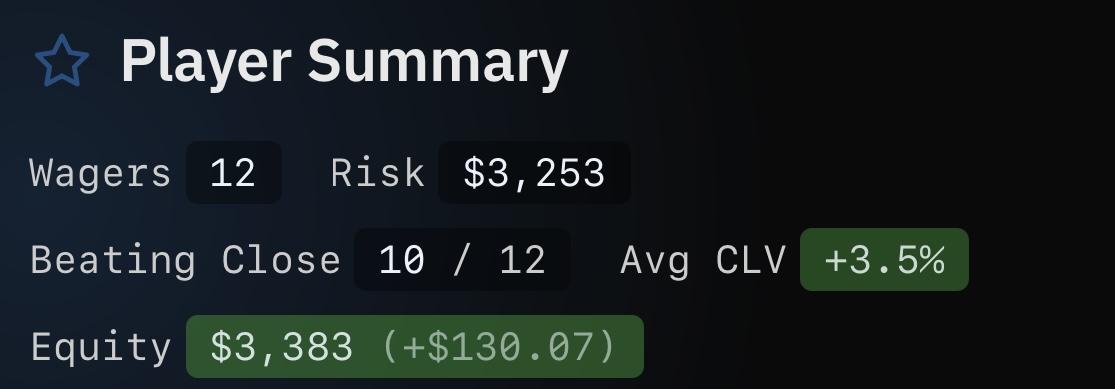Spoiler) Show
Leaving parts 1 and 2 below: https://forumserver.twoplustwo.com/showp... (https://forumserver.twoplustwo.com/showpost.php?p=59406218&postcount=3094) https://forumserver.twoplustwo.com/showp... (https://forumserver.twoplustwo.com/showpost.php?p=59401559&postcount=3050)
Continuing with BTN in this 25/25 8-max rake free. BTN potting 45.6% (123k combos) and folding 54.4% (147k combos) I’m not sure how the images display across different browsers and devices, but at least on pc when logged in and using google chrome, clicking the image should open it in a separate window where it’s easier to view at full size. However, that may not work as well on a phone or other devices, so I will try to include a Gyazo link to view the image at full size that way too when I can. You can click it directly if you’re comfortable, or copy and paste it into your browser so you can inspect the URL first if you prefer. https://gyazo.com/b1af44033892a098aca95b... (https://gyazo.com/b1af44033892a098aca95b242533f201)
(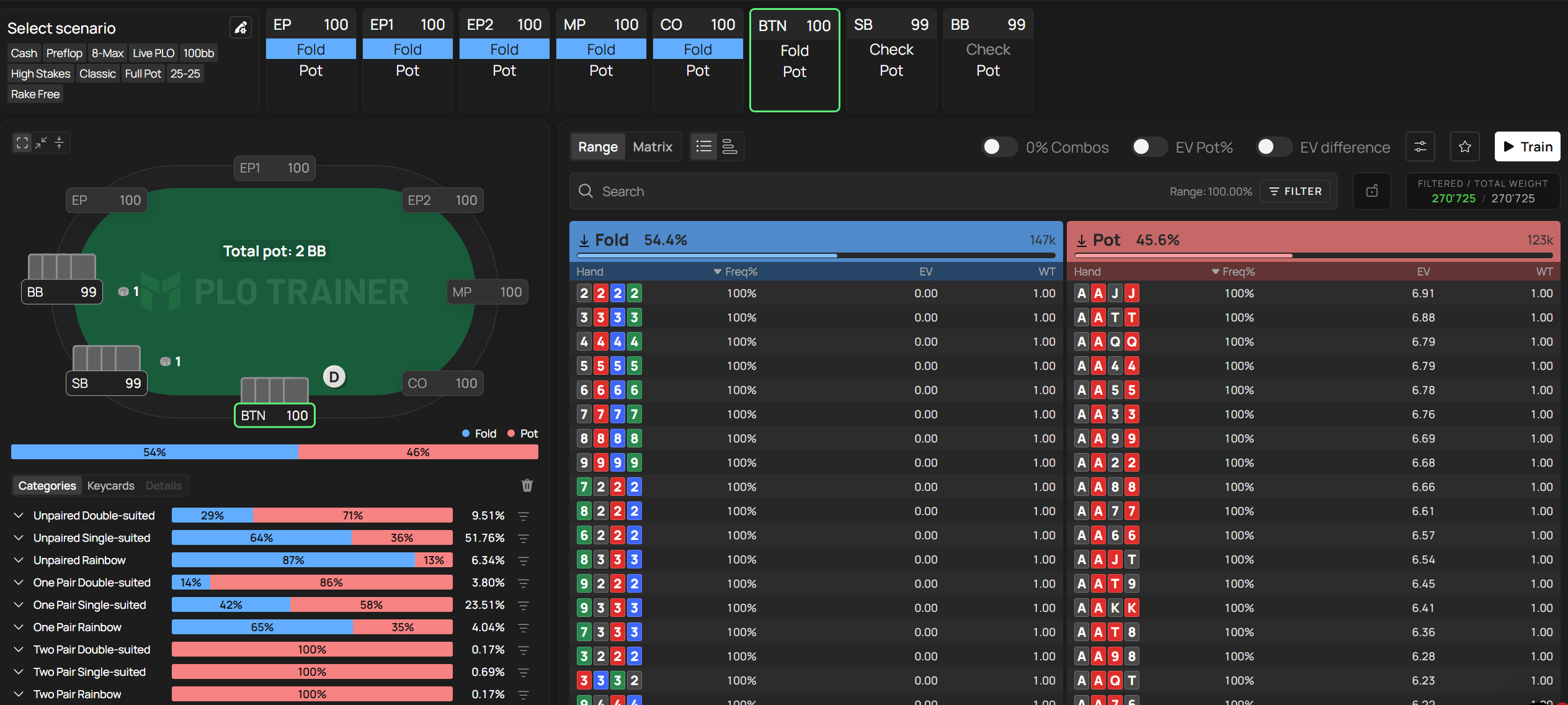 )
25/25, 8-max, rake-free —- BTN RFI Post 2 — Some pure opens from BTN that stood out: Category: One Pair Rainbow ——-> Mid/Low Pair J998r AK33r KQ88r T997r Across this entire category, only 6.8% of combos—454 total—are opened from BTN. 93.2% fold in optimal in this structure (6.2k combos). J998r gets a lot more out of the 99 pair than a generic rainbow paired hand because J-9-9-8 is unusually concentrated around one part of the deck. The J8 side cards give the hand immediate straight interaction with the pair rather than functioning as disconnected overcards. On T87, JT8, 876, QJT-type boards, the hand can develop wraps, pair-plus-draw combinations, or strong two-pair/trips structures. That connectivity appears important enough to overcome both the rainbowness and lack of high-card strength. AK33r reaches the pure-open region for almost the opposite reason. The 33 itself has very little connectivity, but A-K gives the hand the two strongest unpaired ranks available. That produces substantially better top-pair and two-pair potential than most low-pair rainbow holdings, while also blocking premium AA/KK combinations behind. The hand therefore does not need the pair to carry much of the equity burden: 33 supplies set potential while AK gives it enough high-card coverage to avoid being completely dependent on flopping a three. KQ88r sits between those two constructions. The 88 pair is considerably more valuable than 33 when it improves, while KQ supplies two connected Broadway ranks that interact with JTx boards and retain useful top-pair/two-pair equity on higher textures. KQ88 also has cleaner rank distribution than many hands in this class: neither side-card is especially weak, and the KQ component gives the hand legitimate ways to continue when the eights miss. That seems to be enough to push this particular rainbow 88 combination into the narrow 6.8% opening bucket. T997r is another example where the solver appears willing to tolerate weak high-card strength when the ranks surrounding the pair are exceptionally cohesive. T-9-9-7 connects across several adjacent straight regions, with the T7 side cards giving 99 meaningful support on boards containing 8s, 6s, Js, and combinations thereof. Compared with a hand such as K992r, T997r sacrifices raw overcard strength but gains far more interaction between all four cards. The pure open suggests that, within these lower paired rainbow holdings, that extra structural connectivity can be more valuable than simply attaching one disconnected high card to the pair.
25/25, 8-max, rake-free —- BTN RFI Post 3: Some more pure opens from BTN that stood out from an assortment of hand classes: A ♠ 8 ♥ 6 ♦ 5 ♥ T ♠ T ♦ 8 ♥ 3 ♠ 9 ♠ 7 ♠ 6 ♠ 6 ♥ 7 ♦ 7 ♣ 2 ♠ 2 ♥ These four pure opens all carry clear structural weaknesses, but each retains enough usable equity to stay at full frequency from BTN. A ♠ 8 ♥ 6 ♦ 5 ♥ gets a lot from the interaction between the ace and the 8-6-5 rundown underneath it. The suited ace is missing, but the connected lower three cards give it substantially more board coverage than a disconnected weak-ace holding. T ♠ T ♦ 8 ♥ 3 ♠ is much more pair-driven, with TT providing immediate showdown and set value while the 8 keeps the hand from being completely static. The T ♠ 3 ♠ suit is weak, but it still adds enough secondary equity to a hand already anchored by a respectable pair. 9 ♠ 7 ♠ 6 ♠ 6 ♥ has excellent internal coordination despite wasting a spade through the triple-suited construction. The 9-7-6 interaction produces strong straight-draw coverage, while the paired six adds set and full-house potential on many of the same boards. 7 ♦ 7 ♣ 2 ♠ 2 ♥ is almost the opposite profile: no suit value and essentially no straight connectivity, but two independent pairs create very clean set-improvement paths. On BTN, that concentrated pair equity is apparently enough to overcome just how poorly the four cards interact otherwise. The notable part is how little conventional prettiness is required on the button once a hand has one sufficiently strong structural feature. BTN can pure-open some very uneven constructions as long as the equity is concentrated in a way that realizes well enough in position.
25/25, 8-max, rake free —— BTN RFI Post #4: On the other side, some pure folds from BTN that stood out: Category: Unpaired Double Suited ———> Ace-high A ♠ 6 ♥ 3 ♥ 2 ♠ A ♠ 8 ♥ 3 ♠ 2 ♥ A ♠ 9 ♠ 3 ♥ 2 ♥ A ♠ 7 ♠ 3 ♥ 2 ♥ Across this entire category, only 1.5% of combos—120 total—are folded from BTN. 98.5% open (7.8k combos) . The 98.5% opening frequency shows how much BTN values the combination of an ace, two suits, and position. Even weak versions usually retain nut-flush access plus enough secondary equity to enter. These four sit near the absolute bottom because the supporting ranks contribute very little. Every hand contains a 3 and 2, creating poor high-board coverage and limited robust straight development. A ♠ 6 ♥ 3 ♥ 2 ♠ and A ♠ 8 ♥ 3 ♠ 2 ♥ have weak secondary suits and no real connected side structure. The rank gaps keep the low cards from functioning like a useful rundown. A ♠ 9 ♠ 3 ♥ 2 ♥ and A ♠ 7 ♠ 3 ♥ 2 ♥ concentrate most of their value in the nut suit. The 3 ♥ 2 ♥ suit is extremely weak, while the 9 or 7 remains largely isolated from the low cards. That explains how a category can open 98.5% yet still contain pure folds: only the least coordinated double-suited ace-high constructions fall out. These combine weak side suits, poor kickers, and very little backup beyond the suited ace.
25/25, 8-max, rake-free —- BTN RFI Post #5: Some more pure folds from BTN that stood out from an assortment of hand classes: 4 ♠ 4 ♥ 3 ♥ 2 ♠ A ♠ J ♠ 5 ♠ 4 ♠ T ♥ 9 ♥ 5 ♠ 4 ♠ T ♣ 8 ♥ 8 ♦ 7 ♠ What makes these interesting is that all four look like intuitive BTN opens at first glance. Each shows enough visible strength through pairing, suitedness, connectivity, or high-card value that the pure fold is not obvious. 4 ♠ 4 ♥ 3 ♥ 2 ♠ looks attractive because it is paired, double-suited, and tightly connected. Solver rejects it because nearly all of that structure sits in the weakest rank region, producing too many dominated sets, flushes, and straights. A ♠ J ♠ 5 ♠ 4 ♠ looks attractive because it combines an ace, a broadway card, and wheel-side connectivity. Solver rejects it because the four-spade construction collapses the suit value into one axis while J-5-4 provides too little coordinated backup. T ♥ 9 ♥ 5 ♠ 4 ♠ looks attractive because it is double-suited with two connected rank pairs. Solver rejects it because T-9 and 5-4 interact poorly, reducing wrap density and leaving too many flops where only half the hand contributes. T ♣ 8 ♥ 8 ♦ 7 ♠ looks attractive because it has a medium pair with adjacent straight support. Solver rejects it because the rainbow construction lowers realization and pushes much of its equity into middling, non-nut pair-and-straight regions. The useful takeaway is that these hands look stronger preflop (relative to a btn rfi range) than they function postflop. Their headline features are real, but the solver discounts them sharply when those features fail to reinforce each other.
25/25, 8-max, rake-free —- BTN RFI Post 6: Some Takeaways The BTN still folds 54.4% of its range and pots 45.6%, so the position is wide without becoming indiscriminate. Even rake-free, the solver maintains a meaningful floor for connectivity, nuttedness, and realization. The one-pair rainbow mid/low-pair class is especially selective: only 6.8% opens, with J998r and T997r getting there through dense local connectivity while AK33r and KQ88r compensate with much stronger high-card structure. The solver is finding very different ways for an otherwise weak rainbow pair to clear the BTN threshold. The assortment of pure opens reinforces how little “cleanliness” is required when enough equity components remain. A865 single-suited has useful wheel/mid-straight interaction, TT83[/B] single suited still carries pair strength, 9766[/B] tri suited concentrates around connected middling ranks, and 7722r[/B] gets unusual value from its double-paired construction.
Ace-high double-suited hands are almost universally opened—98.5% of the class—making A632ds, A832ds, A932ds, and A732ds notable exceptions. Their issue is not suitedness but the extremely weak side-card structure: too many dominated straight regions and too little high-card connectivity to complement the ace.
The miscellaneous folds show that superficially attractive features cannot rescue a badly assembled hand. 4432ds is simply too low, AJ54[/B] monotone wastes enormous suit value through redundancy, T954ds has two disconnected rank clusters, and T887r lacks enough suit/high-card support despite reasonable local connectivity.
The sharpest BTN lesson is how the solver evaluates the four cards as one integrated structure rather than rewarding individual features in isolation. A hand can survive rainbow texture or weak side cards, but once several deficiencies overlap—as in the rare ace-high double-suited folds—the BTN opening threshold is still very real.
Continuing with SB in this 25/25 8-max rake free. SB potting 4.5% (12.1k combos) and checking 95.5% (147k combos) I’m not sure how the images display across different browsers and devices, but at least on pc when logged in and using google chrome, clicking the image should open it in a separate window where it’s easier to view at full size. However, that may not work as well on a phone or other devices, so I will try to include a Gyazo link to view the image at full size that way too when I can. You can click it directly if you’re comfortable, or copy and paste it into your browser so you can inspect the URL first if you prefer. https://gyazo.com/a763687c4bb04d998b03bf... (https://gyazo.com/a763687c4bb04d998b03bfe9c239ccc6)
(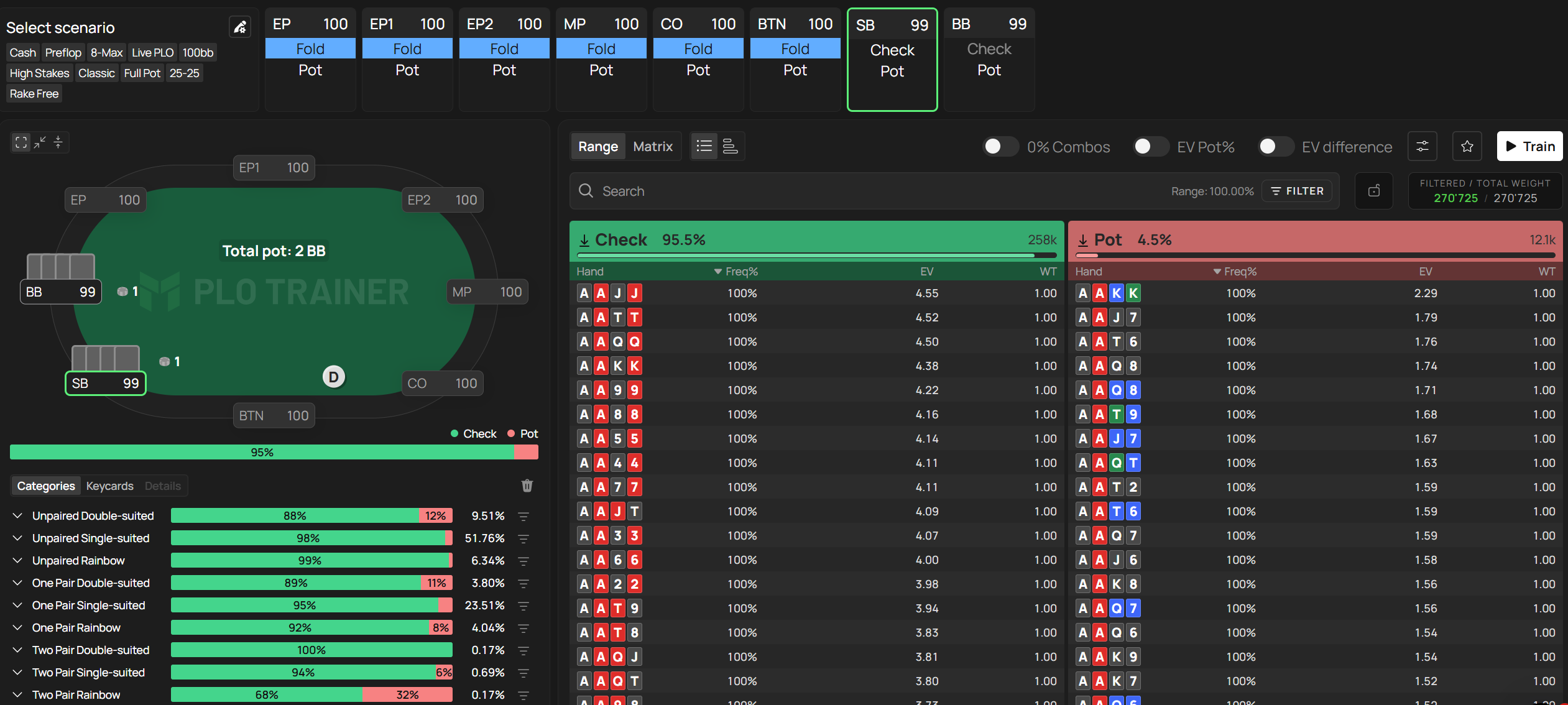 )
SB in this 25/25 8-max rake free. Post 2: A High-Level View of the SB Potting and Checking Ranges One quick structural note before getting into the hands: this isn’t a conventional SB/BB configuration, since both blinds are the same size. That materially changes the incentives compared with a standard blind structure, and I’ll most likely cover those implications separately—and in considerably more depth—over time, although I’m not sure exactly when yet. I’m also going to include the EV of every combo shown in this section, which I don’t normally do. That feels especially useful here because many hands the solver checks have substantially higher absolute EV than hands it chooses to pot. The important distinction is that the solver isn’t ranking hands by total EV and simply potting the top of the list. It is comparing the EV of each hand across its available actions: a very high-EV hand may preserve more value by checking, while a lower-EV hand can gain more specifically from potting through fold equity, equity denial, or cleaner realization.
SB in this 25/25 8-max rake free. Post #3: Some pure pots from SB that stood out: Category: One pair single suited ——-> Mid/Low pair Q♠ J♦ 7♠ 7♥ (-.30 EV)
A♠ 5♠ 4♥ 4♦ (-.20 EV)
K♦ J♠ 8♠ 8♥ (-.19 EV)
A♠ Q♦ 2♦ 2♥ (-.19 EV) Across this entire category, only 3.2% of combos—1.2k total—are potted from SB, while 96.8%—37.9k combos—are checked in this 5/5 structure. QJ77ss has a clear separation between its QJ straight component and its sevens: no straight can use a seven together with either broadway. Its inclusion suggests that four-card connectivity is not required for potting, with the QJ component, middle pair, and queen-high suit supplying separate sources of equity. A544ss has a more integrated structure, with A4, A5, and 54 contributing distinct straight possibilities. Holding two fours reduces the available fours for A5’s wheel runout, but alternative low-straight routes, the nut suit, and ace removal offer a plausible basis for preferring aggression. KJ88ss gains a connection that QJ77ss lacks: J8 can complete a straight, including the nuts on T97. The J♠ 8♠ suit also allows straight and flush draws to overlap on connected boards, concentrating more of the hand’s equity on the same runouts. AQ22ss supplies the strongest counterexample to a connectivity-based explanation: the deuces cannot form a straight with the queen, and the ace is outside the suit. Ace removal and AQ’s nut-straight potential plausibly support potting here, even though the low pair and non-nut suit make its postflop structure less convincing. The working interpretation is that these hands combine enough selective board coverage with removal or suited support to benefit from potting, despite weaknesses that make them look more natural as checks. The subsequent posts and the SB section as a whole should make that distinction clearer, particularly as we compare these exceptions with hands that prefer checking despite looking stronger, having higher EV, or both.
SB in this 25/25 8-max rake free. Post 4: Some more pure pots from SB that stood out from an assortment of hand classes: 4♦ 4♠ 3♣ 3♥ (-.68 EV)
5♦ 5♠ 3♣ 3♥ (-.58 EV)
Q♥ J♦ 7♥ 5♠ (-.55 EV)
Q♠ Q♥ Q♦ J♠ (-.55 EV)
4433r gives us two set ranks, but 43’s straight potential is limited by its low ranks: it makes the nut straight on A25 and 256, but on 567 its seven-high straight loses to 84 and 98. With no flush route and frequent bottom-set exposure, its pure opening plausibly depends heavily on immediate fold equity rather than comfortably playing large pots. 5533r retains two set ranks while shifting its straight coverage: 53 makes the nuts on A24 and 246, whereas 43 has only one nut-straight flop rank pattern. That provides a concrete structural distinction consistent with its higher displayed EV, although it does not isolate the cause of the difference. QJ75ss has two separate straight components, with QJ covering high boards and 75 supplying the nuts on 468. The Q♥ 7♥ suit connects those components through flush potential, but the limited interaction between all four ranks makes this a selective opening rather than an especially robust rundown. QQQJss sacrifices a substantial part of QQ’s set potential because only one queen remains available, while the third queen cannot contribute directly at showdown. Its compensating features are unusually concentrated removal of opposing QQ and Q-containing broadways, plus QJ straight potential and a queen-high suit; those are plausible reasons aggression survives the duplication. QQQJss and QJ75ss share the same displayed EV despite arriving there through very different structures, while the two low double-paired hands trade flush potential for additional set coverage. Comparing these opens with nearby checks in the subsequent posts should help distinguish which features actually change the preferred action, rather than treating their EV ordering as a complete explanation.
SB in this 25/25 8-max rake free. Post 5: On the other side some pure checks from SB that stood out: Category: Two pair rainbow ——-> KKxx–TTxx
K♠ K♥ J♦ J♣ (1.16 EV)
K♠ K♥ T♦ T♣ (1.12 EV)
J♠ J♥ T♦ T♣ (.83 EV)
T♠ T♥ 9♦ 9♣ (.47 EV)
Across this entire category, 67% of combos—152 total—are checked from SB, while 33%—75 combos—are potted in this structure. K♠ K♥ J♦ J♣ retains two high set ranks and KJ’s nut-straight coverage, giving us substantial value to preserve through checking even without a suit. Holding KK and JJ also removes opposing combinations containing those pairs, so its blockers do not exclusively target hands we would prefer to fold. K♠ K♥ T♦ T♣ shares the kings but shifts its straight coverage to KT, including the nuts on AQJ and QJ9. Its 1.12 EV sits close to the previous hand’s 1.16, suggesting that this change in connectivity leaves much of its checking value intact without creating a preference for potting. J♠ J♥ T♦ T♣ concentrates its straight potential in JT, which makes the nuts on AKQ, KQ9, and Q98, while retaining two substantial set ranks. That combination gives checking credible ways to develop strong equity; the pure check shows that attractive straight coverage alone does not justify enlarging the pot. T♠ T♥ 9♦ 9♣ retains connected ranks but moves both set possibilities below more of the opposing range, making set-over-set exposure a greater concern than with the first hand. Its .47 EV is consistent with that weaker showdown structure, although T9 still supplies nut-straight coverage on boards such as QJ8 and J87. These checks span .47 to 1.16 EV, while the lowest-EV pure checks sit around -.30, placing very different hands within the same action. The likely distinction is that these double-paired hands already retain considerable value by checking, whereas some weaker-looking pots may gain more from fold equity and denying a free flop—a comparison the full SB section should help clarify.
SB in this 25/25 8-max rake free. Post 6: Some more pure checks from SB that stood out from an assortment of hand classes: A♠ A♥ J♠ J♥ (4.55 EV)
A♠ A♥ K♠ K♥ (4.38 EV)
A♠ Q♥ J♥ T♠ (1.95 EV)
K♠ Q♥ J♥ T♠ (1.47 EV) A♠ A♥ J♠ J♥ combines two nut suits with two set ranks, giving us unusually strong equity to retain against the BB’s unrestricted range. Checking plausibly benefits from keeping weaker hands involved, while preserving a powerful response to a raise rather than committing this strength exclusively to the potting range. A♠ A♥ K♠ K♥ has the same two nut suits and higher secondary set potential, yet checks for slightly less EV than the previous hand. Holding two kings also removes more K-containing hands that could make dominated pairs or strong second-best holdings; that is a plausible contributor to the ordering, rather than evidence that higher pairs inherently perform worse. A♠ Q♥ J♥ T♠ spreads its equity across four distinct ranks, with an ace-high spade suit and queen-high heart suit supporting its broadway connections. Its 1.95 checking EV suggests substantial value already exists without narrowing the BB’s range, although the potting EV for this exact hand is needed to measure the cost of raising. K♠ Q♥ J♥ T♠ exchanges the ace for a king, producing a continuous rundown but reducing the spade suit from nut to king-high. Its lower 1.47 EV is consistent with losing nut-flush potential and ace-high coverage despite improved rank continuity, illustrating why the cleaner-looking sequence need not retain more value. Three of these four checks exceed 1.79 EV—the second-highest EV among the featured pots, with only the final hand below it. That comparison shows how much strength remains in the checking range; the action preference still depends on potting versus checking the same hand, which should become clearer across the full SB section.
SB in this 25/25 8-max rake free. Checking and Potting: A Closer Look at the Aces Before the takeaways, these two lists make the SB’s range construction more concrete: premium aces appear throughout the checking list, while substantially less versatile aces populate the potting list. With 95.5% checking and only 4.5% potting, we are selecting particular hands for aggression rather than simply raising the strongest holdings.
The clearest comparison is A♠ A♥ K♠ K♥, checking at 4.38 EV, against A♠ A♥ K♦ K♣, potting at 2.29. Identical ranks produce opposite pure actions when the two nut suits disappear, suggesting that the double-suited version’s ability to retain and realize equity materially changes the value of checking.
The checking list reinforces that pattern with double-suited AAJJ at 4.55, AATT at 4.52, and AAQQ at 4.50. Meanwhile, A♠ A♥ J♠ 7♠ pots at 1.79: its disconnected side cards and third spade leave it with fewer complementary ways to improve, despite retaining a nut suit.
A plausible explanation is that these less versatile aces gain relatively more from immediate folds and the lower stack-to-pot ratio created by raising. The stronger double-suited versions can more comfortably preserve a wide opposing range and respond when the BB raises, while also keeping substantial strength available on later streets after a check-back.
Every checking hand visible here has higher displayed EV than the highest pot shown, but those figures compare different holdings—not the benefit of one action over another. To measure that benefit, we would need each exact hand’s checking and potting EVs side by side; what these lists already demonstrate is that high absolute EV and a preference for immediate aggression are separate properties.
SB (AAxx) x range in this 25/25 rake free:
(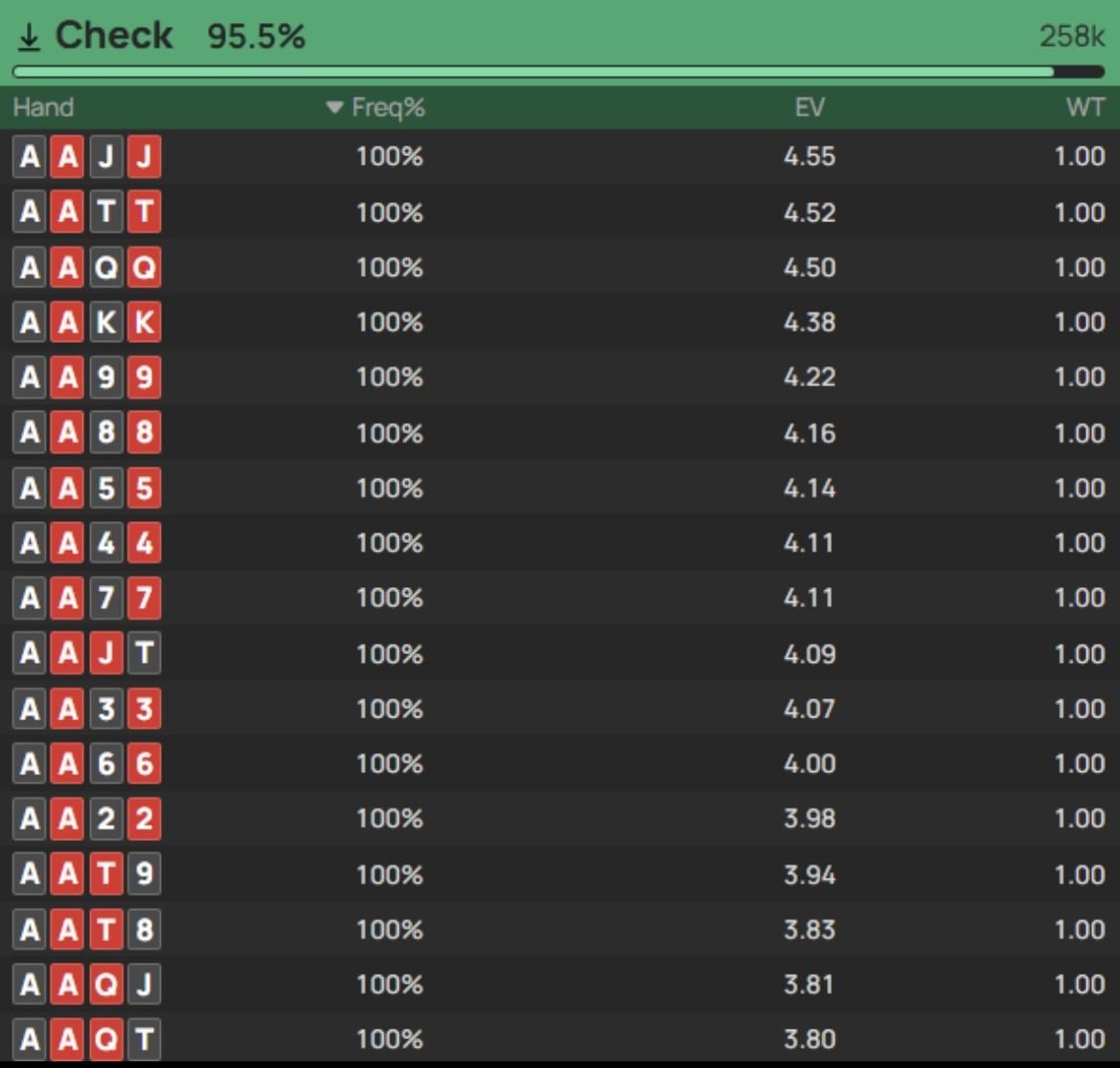SB) (AAxx) pot range in this 25/25 rake free:
(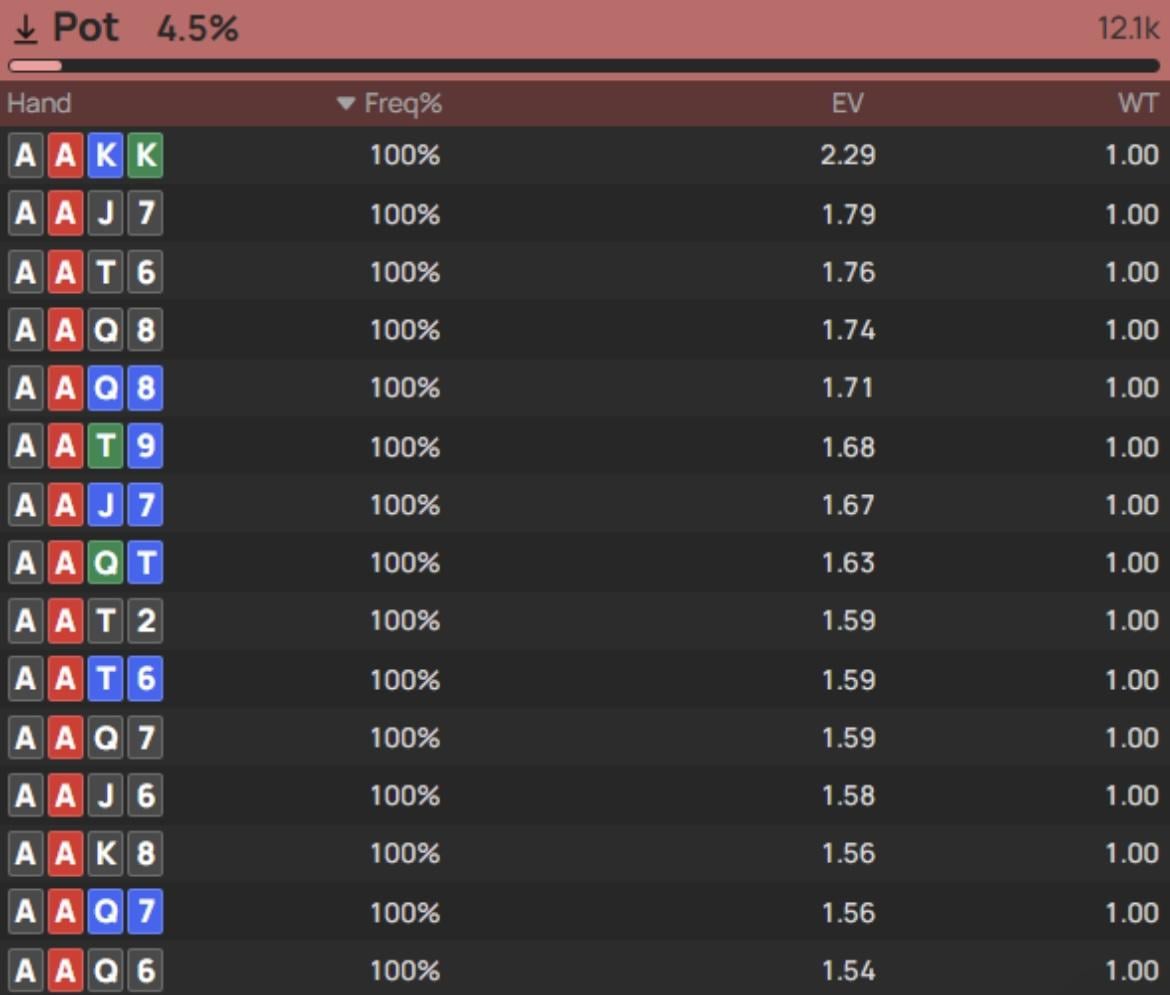 )
Some Takeaways for SB in this 25/25 8-max rake free. With equal blinds, we pot only 4.5% and check 95.5% leaving substantial strength in the checking range. The pure checks with double-suited aces make this especially clear: checking preserves access to both the BB’s weaker holdings and its potential raise, rather than simply conceding initiative with marginal hands.
Within single-suited mid/low pairs, only 3.2% pot, yet the selected examples range from nut-suited low connectivity to disconnected AQ22 with a non-nut suit. Their common feature is not one obvious structural advantage; the likely distinction is how their removal and postflop equity interact with the BB’s response to potting versus checking.
The rainbow double-pair examples show why we cannot rank actions by pair strength: 4433 and 5533 pot while KKJJ, KKTT, JJTT, and TT99 check. A plausible explanation is that the smaller pairs gain relatively more from denying equity, whereas the higher pairs retain more showdown value against the broad range left in by checking.
The checking range also retains both double-suited AQJT and KQJT, so strong connectivity and two suits do not automatically favor building the pot. AQJT’s 1.95 EV exceeds KQJT’s 1.47 despite its less continuous ranks, consistent with the additional value of its nut suit and ace rather than connectivity alone.
Three featured checks—at 4.55, 4.38, and 1.95 EV—exceed the second-highest potting EV of 1.79. The important comparison is each hand’s gain from potting over checking: a weaker hand can prefer aggression while a much stronger hand earns more by checking, making the combined picture across this SB section more informative than any isolated example.
EP RFI — 8 Max — 5% Rake, 4bb Cap Potting 12.4% (33.6k combos) and folding 87.6% (237k combos) We’ve now worked through 25/25 rake-free, and we’re moving into 5/5 with 5% rake capped at 4bb for supplemental training and review. The rake-free pass gave us a consistent baseline for understanding how position, hand structure, and equity realization shape our ranges. We can now build on that foundation by examining how rake changes the value of entering and continuing in pots. Rake rules vary across games, so the goal is to understand which decisions change and why, making our study more adaptable than memorizing ranges for one specific setup. This second pass will give us extra reps, reinforce the concepts, and highlight where the added cost shifts our preferred actions. It’s a marathon, not a sprint! https://gyazo.com/463667177ae0aa73f76ba7... (https://gyazo.com/463667177ae0aa73f76ba70b3a67985b)
(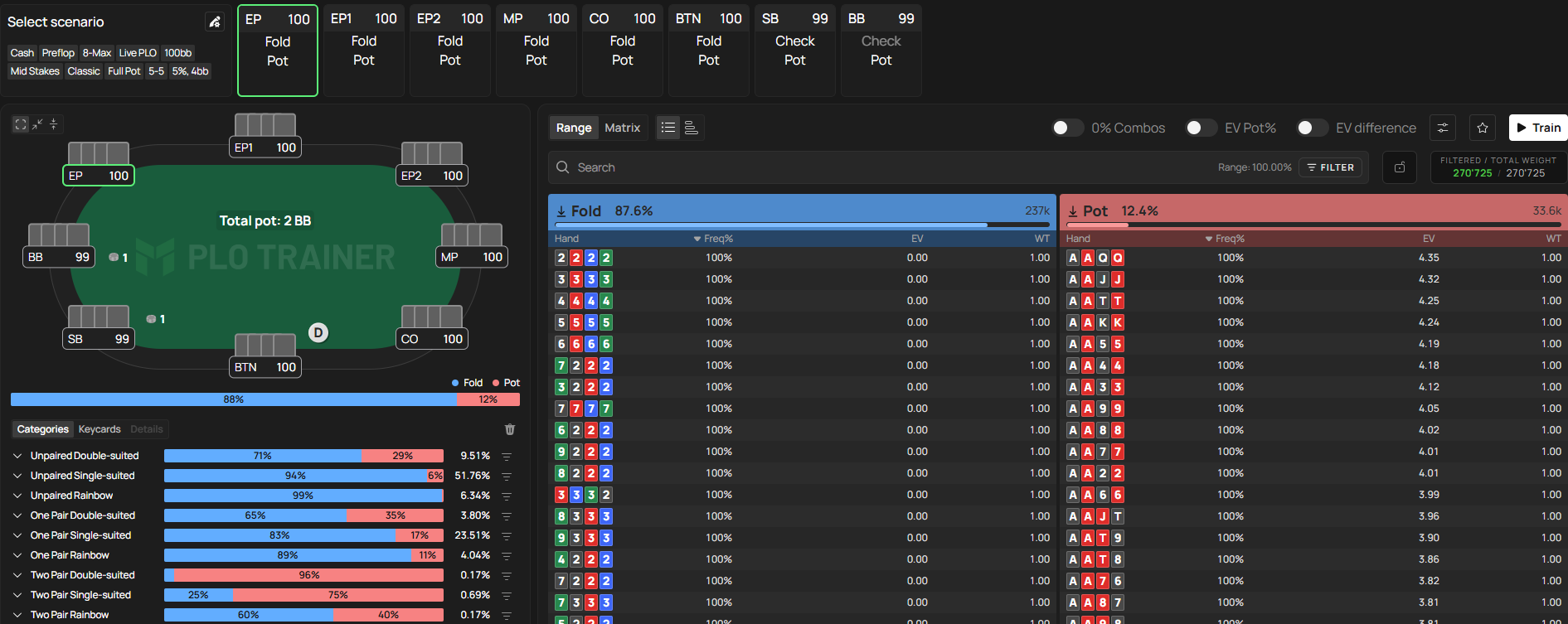 )
EP RFI — 8 Max — 5% Rake, 4bb Cap Post 2: Some pure opens from EP that stood out: Category: Unpaired Single-Suited ———> Connected J♥ T♦ 8♥ 7♠
K♦ J♥ T♥ 9♠
Q♦ J♦ T♥ 8♠
7♦ 6♦ 5♥ 4♠ Across this entire category, only 1.5% of combos—643 total—are opened from EP, while 98.5%—40.9k combos—are folded in this structure. Connectivity alone rarely offsets poor equity realization from EP. Gaps and non-nut suits leave many hands vulnerable to domination, while players still to act and 5% rake capped at 4bb make marginal draws expensive to pursue. J♥ T♦ 8♥ 7♠ retains two adjacent components around the missing nine, with JT providing nut-straight coverage on Q98 and 987. The J♥ 8♥ suit can accompany those straight draws, giving us additional equity on connected heart textures rather than relying on the straight component alone. K♦ J♥ T♥ 9♠ places three consecutive ranks beneath the king, preserving several usable straight combinations despite the missing queen. Suited JT concentrates its flush support in that connected core, allowing strong straight draws and a flush draw to develop together. Q♦ J♦ T♥ 8♠ keeps its three highest ranks consecutive, with QJ supplying nut-straight coverage on AKT, KT9, and T98. Suited QJ ties its strongest flush potential to that upper straight component, while the eight extends coverage onto lower boards. 7♦ 6♦ 5♥ 4♠ compensates for its low ranks with uninterrupted connectivity, providing more alternative two-card straight combinations than the gapped examples. Suited 76 places the suit at the top of the rundown, supporting its stronger straight connections even though seven-high flushes remain a significant limitation.
EP RFI — 8 Max — 5% Rake, 4bb Cap Post 3: Some pure opens from EP that stood out from an assortment of hand classes: T♠ 8♥ 7♥ 5♠
A♠ 7♠ 7♦ 4♥
K♠ K♦ J♥ 8♠
Q♥ 9♥ 7♠ 6♠ T♠ 8♥ 7♥ 5♠ has gaps at nine and six, but its overlapping T8, 87, and 75 connections retain several routes to strong straight draws. The suits distribute support across T5 and 87, allowing either flush draw to supplement connected-board equity despite neither being especially high. A♠ 7♠ 7♦ 4♥ combines a middle pair with nut-flush potential, while the four supplies separate A4 and 74 straight routes. The nut suit is especially valuable alongside the sevens: it gives us strong continuations beyond set flops and can provide a nut-flush redraw when a set faces substantial straight pressure. K♠ K♦ J♥ 8♠ supports its kings with KJ’s broadway potential and J8’s additional straight coverage, including the nuts on T97. The K♠ 8♠ suit also creates useful overlap on king-high flops containing two spades, where top set can carry a flush draw rather than relying entirely on the board pairing. Q♥ 9♥ 7♠ 6♠ divides its straight coverage between Q9 at the upper end and 97–76 below, with Q9 making the nut straight on JT8 and 76 doing so on 985. Its queen-high heart suit and lower spade suit support different parts of that coverage, though the six and seven contribute little on its strongest broadway boards. The paired examples supply more reliable nut potential, while the unpaired examples spread their equity across more straight combinations and two suits. That distinction helps explain how these very different structures can qualify as opens: each has supporting features beyond its most obvious attraction, without requiring every card to contribute equally on the same flop.
EP RFI — 8 Max — 5% Rake, 4bb Cap Post 4: On the other side, some pure folds from EP that stood out: Category: Two pair Single-Suited ———> KKxx–TTxx Across this entire category, 19.0% of combos—173 total—are folded from EP, while 81.0%—738 combos—are opened in this structure. T♠ T♦ 6♠ 6♥
J♠ J♦ 6♠ 6♥
J♠ J♦ 5♠ 5♥
T♠ T♦ 5♠ 5♥ A broadway pair, a second pocket pair, and a suit give this category substantial value: we have two set ranks, some unimproved showdown strength, and flush possibilities absent from rainbow versions. That helps explain the 81% opening frequency, although these particular combinations lack the interaction between ranks that would give us stronger continuations when neither pair improves. T♠ T♦ 6♠ 6♥ has a straight connection, but T6 requires exactly 789 and makes a ten-high straight below JT on that board. Its apparent connectivity therefore adds no nut-straight coverage, leaving the hand dependent on sets and a vulnerable ten-high suit for its stronger postflop outcomes. J♠ J♦ 6♠ 6♥ upgrades the high pair and flush potential, but J6 cannot form a straight at all. The jacks improve our showdown prospects on lower boards, yet the sixes contribute mainly through sets rather than straight draws that could support an unimproved overpair. J♠ J♦ 5♠ 5♥ preserves the jack-high suit while moving its secondary set rank lower, adding another rank that can sit above our smaller set. On a 965 flop, for example, we have bottom set without a straight draw or blocker to the already-made 87 straight, illustrating how the two pairs can fail to support one another. T♠ T♦ 5♠ 5♥ combines that disconnected five-pair component with a lower overpair and lower flush ceiling than the jack-pair examples. With no T5 straight route, its plausible weakness is the concentration of value in isolated set flops and non-nut flushes, offering fewer resilient continuations from EP when the opening is called.
EP RFI — 8 Max — 5% Rake, 4bb Cap Post 5: Some more pure folds from EP that stood out from an assortment of hand classes: K♥ Q♠ 6♥ 5♠
K♠ Q♦ J♠ J♥
K♠ K♥ J♠ 9♠
8♠ 8♥ 7♥ 5♠
K♥ Q♠ 6♥ 5♠ separates into KQ and 65, with no straight connection between either broadway and either low card. Double-suitedness adds useful equity, but neither suit is nut-high, leaving the hand vulnerable to stronger flush draws without the overlapping straight coverage of a more integrated rundown. K♠ Q♦ J♠ J♥ retains strong KQJ connectivity, but the second jack replaces a fourth distinct rank that could expand its straight coverage. The duplication also removes one of KQ’s straight-completing jacks, while the king-high suit cannot consistently compensate for the reduced draw breadth when our pair remains unimproved. K♠ K♥ J♠ 9♠ has useful KJ and J9 connections, but three spades leave only ten spades outside our hand rather than eleven. That extra spade reduces flush potential without creating a second suit, making this a weaker construction than the kings and connected side cards initially suggest. 8♠ 8♥ 7♥ 5♠ integrates its pair with 87, 85, and 75 straight routes, yet both flush possibilities are only eight-high. On T96, for example, 87 makes a ten-high straight beneath QJ and J8, showing how connected ranks can produce substantial-looking equity with an unfavorable ceiling. The two broadway-pair folds illustrate different costs: rank duplication restricts KQJJ’s straight coverage, while suit duplication reduces KKJ9’s flush potential. Neither weakness independently proves why the hand folds, but they identify concrete features to compare against nearby opens before treating high pairs and broadway support as sufficient from EP.
Some Takeaways — EP RFI — 8 Max — 5% Rake, 4bb Cap Only 1.5% of the connected single-suited category opens, yet 7♦ 6♦ 5♥ 4♠ survives alongside the higher examples. Its uninterrupted sequence supplies overlapping straight routes, showing that this narrow opening selection still includes low rundowns with modest flush potential. T♠ 8♥ 7♥ 5♠ opens while 8♠ 8♥ 7♥ 5♠ folds, making the replacement of the ten with another eight particularly revealing. We gain set potential but lose T8 and T7 straight coverage, while the spade suit drops from ten-high to eight-high. K♠ K♦ J♥ 8♠ opens while K♠ K♥ J♠ 9♠ folds, despite the latter’s closer side-card connection. The extra spade is a concrete structural cost: this comparison changes both connectivity and suit distribution, so the higher nine cannot be evaluated in isolation. A♠ 7♠ 7♦ 4♥ opens despite its small pair, whereas the featured JJ66ss and JJ55ss combinations fold. The ace supplies nut-flush potential and removal of opposing AA combinations, giving the sevens support that a higher pair with a non-nut suit does not replicate. Within single-suited KKxx–TTxx double pairs, 81% open, but T♠ T♦ 6♠ 6♥ falls into the 19% folding portion. Its T6 connection produces no nut straight: the required 789 board leaves it below JT, so that apparent connectivity offers less protection than the ranks initially suggest. K♥ Q♠ 6♥ 5♠ folds while Q♥ 9♥ 7♠ 6♠ opens, despite the former’s higher suits. Q976 links its lower ranks through 97, 96, and 76, whereas KQ65 divides into two isolated straight components—a useful contrast between suit height and the breadth of connected-board coverage.
5/5 — 8 Max — 5% Rake, 4bb Cap — EP1 RFI. potting 14.7% (39.7k combos) and folding 85.3% (230k combos) We’ve now worked through 25/25 rake-free, and we’re continuing with all positions in this 5/5 with 5% rake capped at 4bb for supplemental training and review. The rake-free pass gave us a consistent baseline for understanding how position, hand structure, and equity realization shape our ranges. This second pass will give us extra reps, reinforce the concepts, and highlight where the added cost shifts our preferred actions. https://gyazo.com/2d15e19eb77f4706fa8a72... (https://gyazo.com/2d15e19eb77f4706fa8a72a71995a64c)
(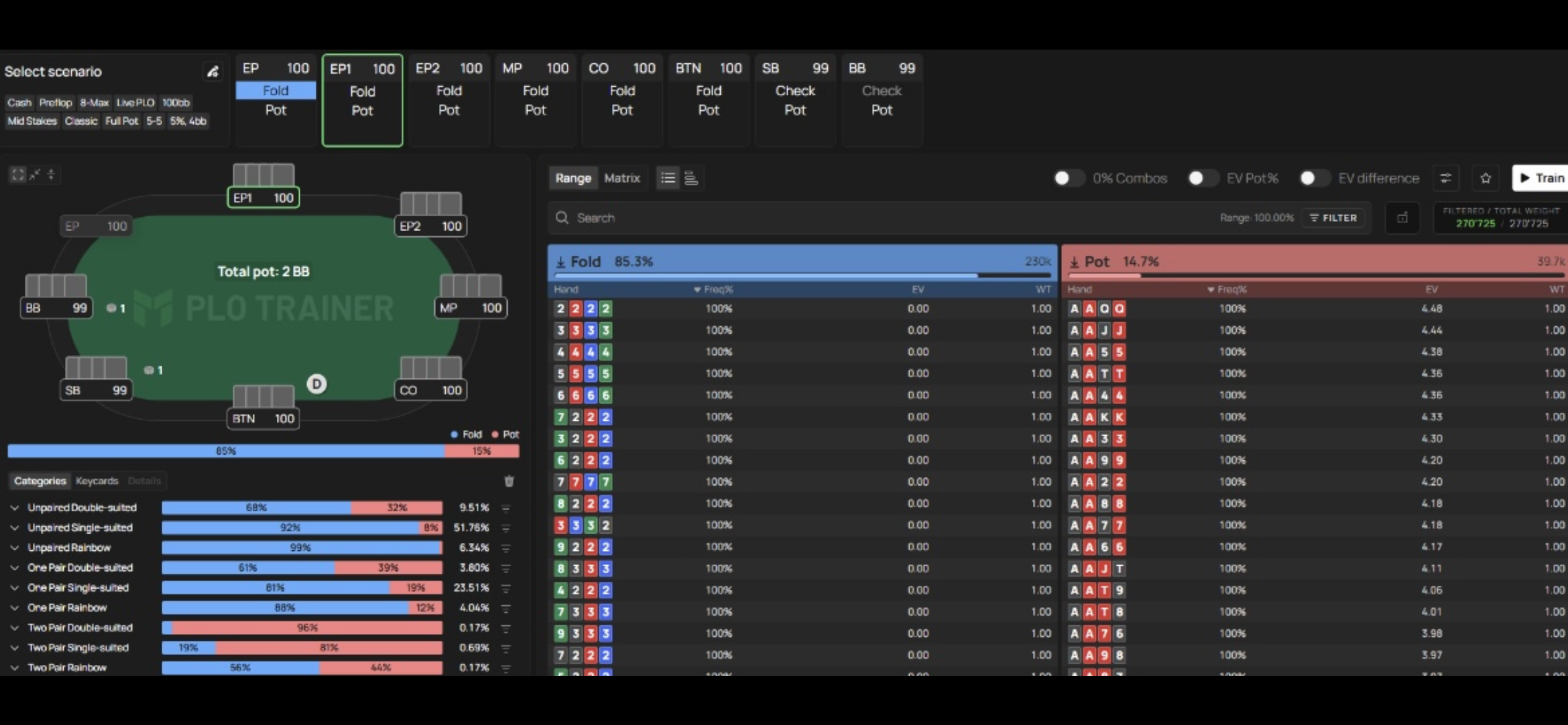 )
5/5 — 8 Max — 5% Rake, 4bb Cap — EP RFI. Post 2: Some pure opens from EP1 that stood out: Category: Unpaired Rainbow
A♠ J♥ T♦ 8♣
A♥ J♣ T♠ 8♦
A♦ Q♠ T♥ 9♣
A♣ K♦ T♠ 9♥
Across this entire category, only 1.1% of combos—192 total—are opened from EP1. 98.9% fold (16.9k combos) in optimal in this structure. The class is punished so heavily because rainbow construction removes suitedness as an equity and realization engine, leaving these hands dependent on raw rank connectivity while entering the pot from the earliest position. Without a suit to generate robust flush equity, many otherwise attractive-looking broadway-heavy structures struggle to continue cleanly across enough boards and are more exposed to domination when later positions enter with stronger Ace-high and paired ranges. What separates the small opening pocket is the concentration of high-card connectivity. These hands can interact with a meaningful number of Broadway and near-Broadway runouts without relying on isolated two-card combinations to make strong holdings. The Ace is also doing more than simply raising the hand’s high-card strength. In these tighter constructions, it combines with three reasonably coordinated side cards, giving the hand substantially more nut-straight access and fewer completely disconnected board interactions than most of the rainbow class. The key detail is that the solver is not opening rainbow hands merely because they contain an Ace and several big cards. The exceptions are compressed around structures where the four ranks work together unusually well, which is why even hands that look superficially close can remain pure folds while this narrow group survives.
5/5 - 8max - 5% rake, 4bb cap —- EP1 RFI Post 3: Some pure opens from EP1 that stood out from an assortment of hand classes:
K♠ K♥ Q♠ 9♠
A♠ 6♦ 5♥ 4♠
K♠ Q♥ J♥ 2♠
8♦ 7♥ 6♥ 5♠ With EP1 opening only 14.7%, these are useful examples of how a hand can overcome a fairly obvious structural defect and still clear the threshold at full frequency. None is simply a pristine premium: the KKQ9 is awkwardly three-spaded, A654 is rainbow, KQJ2 carries a weak deuce, and 8765 lacks high-card strength, but each retains enough concentrated equity-producing structure that its weakness does not drag the entire hand below an open. K♠ K♥ Q♠ 9♠ is particularly notable because the third spade actively reduces the value of what would otherwise be useful suitedness. The pair of kings is strong enough, however, that the Q9 connectivity and high-card coverage still give the hand considerably more postflop functionality than a disconnected KKxx holding. A♠ 6♦ 5♥ 4♠ survives despite having only the weak wheel-side suit because 654 is an unusually coherent group beneath the Ace. The Ace gives the hand nut potential while 456 creates multiple connected straight paths, so the limited flush value is being compensated for by much cleaner rank interaction than most Axxx constructions possess. K♠ Q♥ J♥ 2♠ shows how much weight the solver gives to the KQJ core even when the fourth card is poor. Q♥ J♥ supplies genuinely useful suited connectivity, while K♠ 2♠ preserves a second suit; the deuce is weak, but it is attached to a hand whose other three cards already generate enough high-board coverage to carry it. 8♦ 7♥ 6♥ 5♠ gets there from almost the opposite direction: virtually all of its value is concentrated in the four-card rundown. 8765 has exceptional internal connectivity, with very little rank waste and repeated ways to make or continue toward straights, allowing that density of interaction to compensate for the lack of an Ace, premium pair, or especially strong suit structure even from EP1.
5/5 - 8max - 5% rake, 4bb cap —- EP1 RFI Post 4: Some pure folds that stood out from EP1 from an assortment of hand classes:
K♦ K♣ Q♥ J♠
K♠ Q♠ 7♥ 6♠
K♥ Q♥ J♥ T♠
6♦ 6♣ 5♠ 5♥
K♦ K♣ Q♥ J♠ looks close because the kings are accompanied by two connected Broadway cards, but the hand is entirely rainbow and the QJ component does not connect tightly enough with KK. Improving to a set remains valuable, but many of the hand’s straight-producing runouts are driven primarily by QJ while the kings become little more than blockers. K♠ Q♠ 7♥ 6♠ has connectivity on both ends, but the pieces are separated rather than forming one coherent structure. The three-spade configuration is especially costly: KQ76 only produces a K-high flush draw while already removing three spades from the deck, and 76 frequently makes lower straight configurations that remain vulnerable to stronger wraps. K♥ Q♥ J♥ T♠ is the most striking fold because KQJT has excellent rank connectivity. The issue is how much of that apparent strength is compressed into hearts—KQJ all sharing the same suit leaves only a non-nut K-high flush draw, removes three hearts from the remaining deck, and gives the offsuit T no second suit to provide another route to robust equity. 6♦ 6♣ 5♠ 5♥ has four direct set outs, but very little else supporting those improvements. When it does flop a set it is always a relatively low one, while boards that interact strongly with 65 tend to create straights and higher-set possibilities that make its showdown value much less secure. These are four very different-looking folds, but each misses something specific that would otherwise push it across the EP1 threshold. KKQJ lacks suitedness, KQ76 is fragmented and tri-suited, KQJT wastes much of its connectivity through the three-heart construction, and 6655 is overwhelmingly dependent on low set value without meaningful suit or nut-straight support.
EP1 RFI — 8max — 5% rake, 4bb cap Post 5: Some Takeaways At 14.7% EP1 is already selecting aggressively enough that visually strong structure is not sufficient by itself; the contrast between the opens and folds here shows how much suitedness, nut potential, and card-to-card cooperation determine which marginal-looking constructions actually survive. The unpaired rainbow class is an extreme example: only 1.1% opens, yet A♠ J♦ T♥ 8♣, A♠ Q♦ T♥ 9♣, and A♠ K♦ T♥ 9♣ still make it through because their high-card density and connectedness compensate for having no suit. K♠ K♥ Q♠ 9♠ and K♠ Q♥ J♥ 2♠ show that a strong suited Broadway core can carry a weaker fourth card, whereas the rainbow K♦ K♣ Q♥ J♠ fold shows that premium ranks alone do not necessarily clear EP1 for combos without a suit. A♠ 6♦ 5♥ 4♠ and 8♦ 7♥ 6♥ 5♠ are especially useful reminders that coherent straight architecture can be valuable enough to open even without conventional high-pair strength. K♥ Q♥ J♥ T♠ is one of the sharper contrasts in the set: KQJT looks premium by rank, but the tri-suited heart configuration removes enough suit efficiency that it falls all the way to a pure fold. The biggest practical distinction in this section is therefore not simply “strong ranks versus weak ranks,” but how efficiently all four cards contribute to nut-making paths; EP1 will admit some ugly-looking hands when every card works together, while rejecting much prettier holdings when one suit pattern or structural defect wastes too much of their apparent strength.
EP2 RFI — 8 Max — 5% Rake, 4bb Cap Potting 17.9% (48.4k combos) and folding 82.1% (222k combos) We’ve completed our rake-free review and are now working through every position with 5% rake capped at 4bb. The first pass gave us a consistent baseline for understanding how position, hand structure, and equity realization shape our ranges. This second pass gives us additional reps, reinforces those concepts, and highlights where the added cost of rake changes our preferred actions. https://gyazo.com/4f3ca7cc7cecc14cc17f41... (https://gyazo.com/4f3ca7cc7cecc14cc17f417e5bbd6860)
(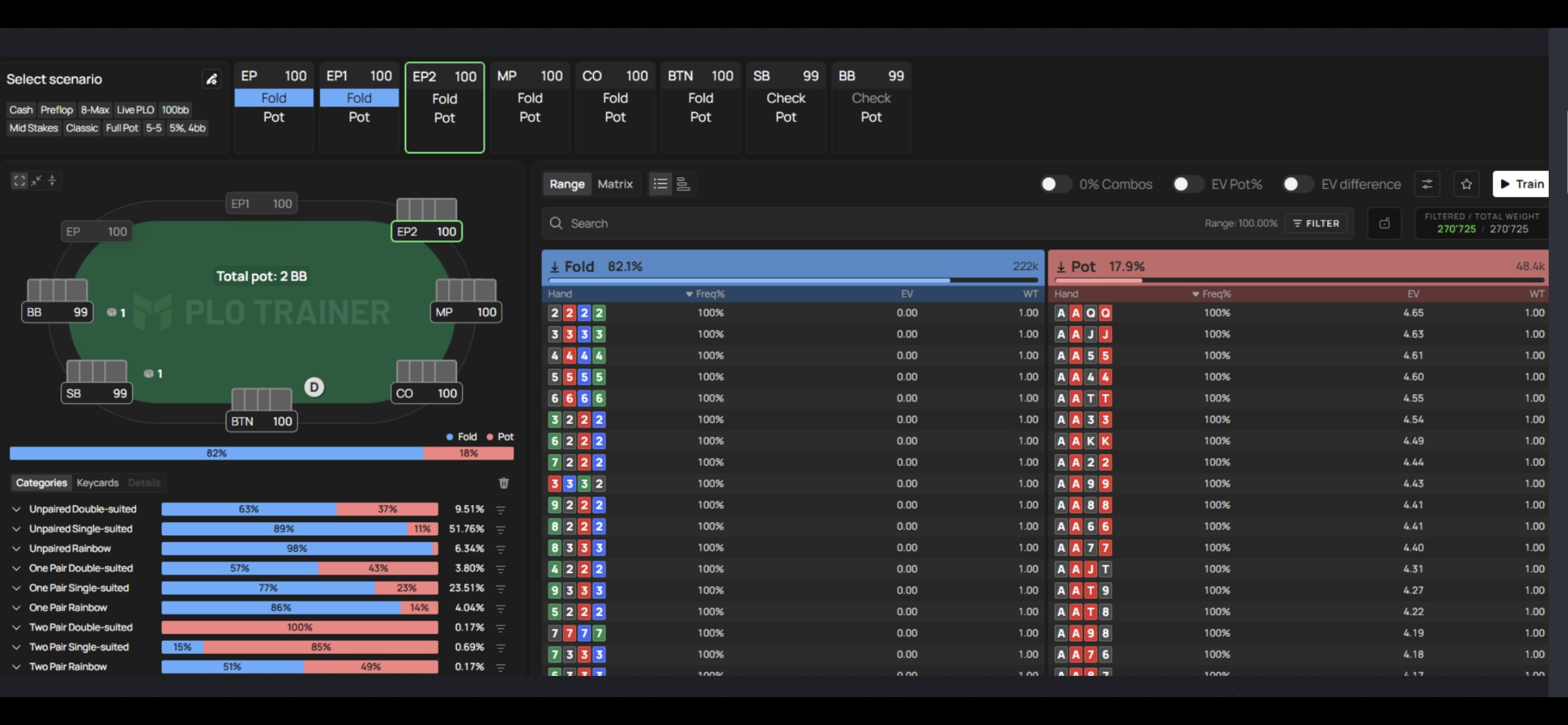 )
EP2 RFI - 8max - 5% rake, 4bb cap Post #2: Some pure opens from EP2 that stood out:
Category: One pair Rainbow ———> Mid/Low pair
A♠ 9♦ 9♣ 8♥
A♠ Q♦ 9♣ 9♥
A♠ T♦ 8♣ 8♥
A♠ J♦ 9♣ 9♥ Across this entire category, only 1.2% of combos—84 total—are opened from EP2. 98.8% fold in optimal in this structure (6.6k combos). The overwhelming folding frequency makes sense because mid/low one-pair rainbow hands begin with two major structural handicaps: the duplicated rank consumes a card slot while the rainbow construction makes a flush impossible. That leaves them heavily dependent on sets and straight development, and when the pair sits in the 8–9 region, even a flopped set is often exposed to higher-set interaction on the boards where several players can continue; with no suited component to stabilize equity, most of the class simply cannot support an EP2 open through players behind and the added rake. The small group that survives is noticeably more coordinated around the pair rather than carrying two unrelated side cards. The 8s and 9s are paired with ranks that either sit close enough to participate directly in straight development or give the hand access to stronger high-card runouts. The ace is also doing considerably more work here than merely supplying an overcard: paired with Q, J, or T it opens Broadway-oriented straight trees while simultaneously reducing the frequency of AA holdings behind. That extra top-end interaction is unusually valuable in a class that otherwise has no flush route whatsoever. These therefore sit near the extreme upper edge of what a rainbow mid/low pair can look like: set equity is being supplemented by unusually productive side-card structure rather than asked to carry the hand by itself. That combination is rare enough that only 84 combos survive, which helps explain why these particular constructions can pure open while almost the entire surrounding class disappears.
EP2 RFI - 8max - 5% rake, 4bb cap Post 3: Some pure opens from EP2 that stood out from an assortment of hand classes: A♠ J♠ T♠ 4♥
7♠ 7♥ 2♠ 2♥
Q♠ Q♥ 4♥ 3♠
A♠ 9♦ 9♣ 8♥ A♠ J♠ T♠ 4♥ survives despite the three-spade construction because the nut suit is attached to an AJT Broadway cluster with substantial straight coverage. The suited ace preserves nut-flush authority while AJT can continue across enough high-card textures that the disconnected 4 does not drag the hand below the EP2 threshold. 7♠ 7♥ 2♠ 2♥ gets an unusual amount from combining two pocket pairs with two suits. Four remaining cards can immediately make a set, and both 7s being independently suited to a 2 gives the hand additional equity routes instead of leaving 7722 almost completely set-dependent. Q♠ Q♥ 4♥ 3♠ has a premium-enough pair supported by two separate Q-high suits, which substantially improves how often QQ can continue without flopping a set. The connected 43 also contributes on lower straight textures, so neither side card is completely dead despite their low ranks. A♠ 9♦ 9♣ 8♥ is particularly notable because it comes from a rainbow mid/low-pair region that almost entirely folds. The adjacent 98 gives the pair meaningful straight development while the ace supplies top-card equity and an AA blocker, providing enough support for 99 that the absence of a suit does not force a mix or fold. The pure frequencies are significant because each hand has a very specific feature preventing its apparent weakness from becoming fatal: AJT4 retains the nut suit, 7722 is double-suited, QQ43 combines QQ with two suits, and A998 gives a rainbow pair unusually useful 98 connectivity. Those additions are substantial enough that all four clear a 17.9% EP2 opening range at full frequency rather than merely appearing as fringe mixes.
EP2 RFI —- 8max - 5% rake, 4bb cap post 4: On the other side some pure folds from EP2 that stood out:
Category: One Pair Double-Suited ———> Broadway Pair ——-> KKxx-QQxx
Q♠ Q♥ 8♥ 5♠
Q♠ Q♥ 9♥ 5♠
Q♠ Q♥ 7♥ 4♠ This is a heavily opened category overall: 85.5% of combos—1.1k total—pot from EP2, with only 14.5%, or 192 combos, folding. These hands therefore sit near the bottom edge of an otherwise strong one-pair double-suited class. The problem is not QQ or the double-suited construction itself, but how little the disconnected side cards add beyond those two assets. Q♠ Q♥ 8♥ 5♠, Q♠ Q♥ 9♥ 5♠, and Q♠ Q♥ 7♥ 4♠ all give QQ two Q-high suits, but the lower ranks are separated enough that they generate relatively few strong wraps or useful two-card straight continuations when the queens miss. That matters because these suits are valuable without being nut suits: Q-high flush potential improves realization, but it cannot completely compensate for side cards that frequently produce dominated or fragile straight equity. The hand therefore leans heavily on QQ retaining showdown value or improving to top set, while many neighboring double-suited QQxx constructions get materially more postflop coverage from their kickers. The exact pure-fold boundary should not be overlearned. Nearby hands like Q♠ Q♥ 4♥ 3♠ and Q♠ Q♥ 7♥ 5♠ can become pure opens through small differences in connectivity, rank removal, suit placement, and card availability; QQ43ds gets a clean 43 connector capable of developing low wraps, while QQ75ds gains the much stronger 75 relationship and more coordinated middling-board coverage, giving both hands enough additional EV to clear the threshold. The striking part is how narrow that distinction becomes inside a category opening more than 85% of its combinations. Once QQ and double-suitedness establish a strong baseline, the final decision can come down to whether the two side cards actually create enough incremental straight coverage and realization to justify opening through the remaining EP2 field and rake.
EP2 RFI - 8max - 5% rake, 4bb cap Post 5: Some more pure folds that stood out from EP2 from an assortment of hand classes: A♠ 9♥ 5♠ 4♥
T♥ 9♦ 8♥ 7♠
K♠ K♦ 8♥ 5♠
8♠ 7♦ 6♥ 5♠
A♠ 9♥ 5♠ 4♥ has two suits and the nut-spade draw, but the rank structure is badly split between A9 and 54. The hand can make strong flushes, yet relatively few flops allow three or four cards to contribute simultaneously, leaving too much of its equity concentrated in isolated draws.
T♥ 9♦ 8♥ 7♠ has excellent apparent connectivity, but its strongest straight development is concentrated in a region where higher rundowns frequently share or dominate its made straights. The lone T-high heart suit adds some realization, but it does little to solve the hand's lack of nut advantage when the board becomes highly connected. K♠ K♦ 8♥ 5♠ starts with a premium pair, but 8 and 5 contribute very little coherent support to it. The K-high spade suit is useful without being nutted, while the large 8-to-5 gap means KK is usually relying on pair/set strength rather than developing substantial straight equity alongside it. 8♠ 7♦ 6♥ 5♠ is the most deceptive fold because 8765 forms a complete four-card rundown. Its problem is where that connectivity sits: many of its strongest straight boards also interact extremely well with higher rundowns, and the only flush route is an 8-high suit that can itself be dominated. These hands fail for different reasons despite each containing something attractive enough to look close—nut-suitedness, a tight rundown, KK, or four-card connectivity. In each case, the attractive feature does not produce enough clean nut equity alongside the rest of the hand to justify a pot sized EP2 open through the remaining field and rake.
EP2 RFI —- 8max - 5% rake, 4bb cap post 6: some takeaways: At 17.9%, EP2 is still highly selective, but the examples here show that the solver is willing to tolerate one obvious weakness when the remaining three-card structure supplies enough nuttedness, connectivity, or realization to compensate. A♠ 9♦ 9♣ 8♥ is especially instructive because the rainbow mid/low-pair class opens only 1.2%, yet the ace plus adjacent 98 structure gives this exact construction enough additional coverage to survive. A♠ J♠ T♠ 4♥ shows that even tri-suitedness can be acceptable when the duplicated suit is the nut suit and attached to a strong AJT Broadway core. Q♠ Q♥ 4♥ 3♠ opening while Q♠ Q♥ 8♥ 5♠ folds is a useful boundary case: once QQ and double-suitedness are fixed, seemingly small differences in side-card connectivity can be enough to flip the decision completely. T♥ 9♦ 8♥ 7♠ and 8♠ 7♦ 6♥ 5♠ are reminders that excellent-looking rundowns can still pure fold when their strongest straights and flushes are too frequently non-nut or dominated by higher structures. K♠ K♦ 8♥ 5♠, A♠ 9♥ 5♠ 4♥, and the marginal QQxx folds reinforce the narrower point that EP2 is not simply rewarding premium pairs, an ace, or suitedness in isolation—it is measuring how efficiently those features combine with the other two cards. Near the threshold, exact suit placement and side-card interaction can be enough to move neighboring holdings from pure fold to pure open.
Outside the Felt #4 A little from the sports side to keep this series going alongside the poker theory. This snapshot is from Bet105 earlier in the week: 15 of 16 wagers beating the close, with average CLV of 4.9%. It represents a small slice of my overall action, but Bet105 is one of the sharper books online, so I have to pick my spots. There’s particular satisfaction in seeing the market move in my direction such a high percentage of the time—finding places where my processes put me ahead of even some of the sharpest models and algorithms. The more niche markets often have low limits or limited liquidity, so getting much down on an individual opportunity can be difficult. Even when the edge is there, the available volume doesn’t always let me do much with it. With most sportsbooks having either cut off my online action or restricted me to a few dollars or cents, much of the day-to-day work involves deciding where I can actually put my numbers to use. Sportsbooks, prediction markets, and exchanges each occupy a different place in that routine. I’ve also been moving more into market making: creating my own lines and posting wagers for anyone on the platform—or any bot—to take the other side. That adds another dimension to the work and makes precision even more important, since any mistake in my pricing is an opportunity for someone else.
(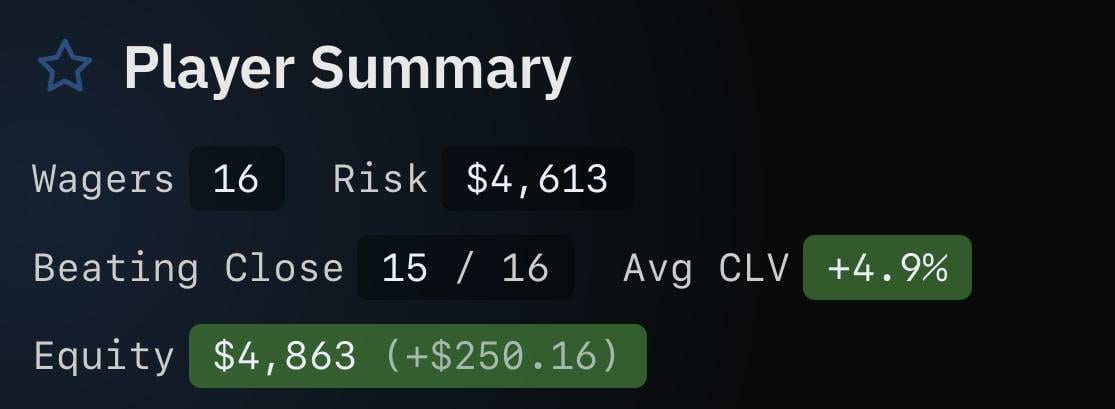Spoiler) Show
Leaving parts 1-3 below: https://forumserver.twoplustwo.com/showp... (https://forumserver.twoplustwo.com/showpost.php?p=59409828&postcount=3130) https://forumserver.twoplustwo.com/showp... (https://forumserver.twoplustwo.com/showpost.php?p=59406218&postcount=3094) https://forumserver.twoplustwo.com/showp... (https://forumserver.twoplustwo.com/showpost.php?p=59401559&postcount=3050)
MP RFI — 8 Max — 5% Rake, 4bb Cap Potting 22.2% (59.9k combos) and folding 77.8% (210k combos) We’ve completed our rake-free review and are now working through every position with 5% rake capped at 4bb. The first pass gave us a consistent baseline for understanding how position, hand structure, and equity realization shape our ranges. This second pass gives us additional reps, reinforces those concepts, and highlights where the added cost of rake changes our preferred actions. https://gyazo.com/d4dff05a8be22d3994622a... (https://gyazo.com/d4dff05a8be22d3994622a6fd278a1ec)
(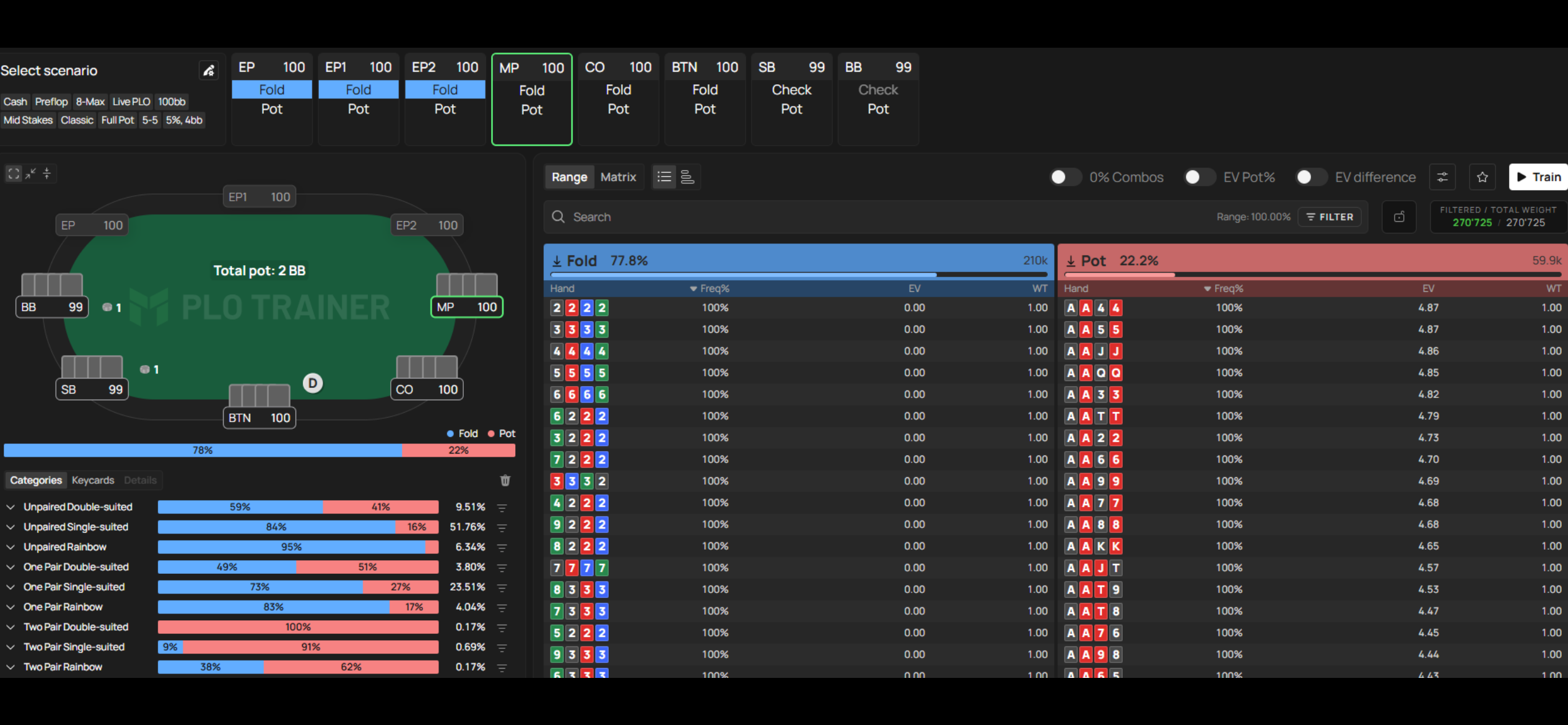 )
MP RFI - 8max - 5% rake, 4bb cap post 2: Some pure opens from MP that stood out:
Category: Unpaired Rainbow ———> Ace-High ———> Connected non broadway A♠ T♣ 9♦ 8♥
A♠ J♣ 9♦ 8♥
A♠ T♣ 8♦ 7♥
A♠ T♣ 9♦ 7♥ Across this entire category, only 10.5% of combos—96 total—are opened from MP. 89.5% fold in optimal in this structure (816 combos). This category folds so heavily because rainbow ace-high hands cannot make a flush and therefore need their three non-ace cards to generate unusually efficient straight equity; once those ranks are even slightly fragmented, the ace becomes largely an isolated high card rather than part of a coordinated four-card structure. Without either suitedness or strong Broadway concentration to supplement that connectivity, most combinations simply do not produce enough nut-heavy postflop equity to justify opening through the remaining field and rake. The surviving constructions cluster around tightly connected middling cards such as T98 or T87. Those three-card sequences can flop substantial wraps immediately and continue across a much wider range of 7–J textures than more disconnected ace-high rainbow holdings. The ace still matters even when it is separated from the main straight cluster because it supplies top-pair equity and blocks AA behind. That gives these hands an additional high-card route to realization without requiring the ace itself to participate in every straight draw. J98 and T97 are particularly useful examples of how one-gap connectivity can remain sufficient when the ranks still share multiple straight intervals. They sacrifice some of the density of T98, but retain enough overlapping runouts that the rainbow penalty does not push them below the MP threshold. The fact that only 96 combinations survive makes these opens a very narrow upper slice of the class rather than a broad permission to open ace-high rainbow connectivity. The common requirement is that the three side cards generate enough concentrated straight coverage to compensate for having no flush potential at all.
MP RFI - 8max - 5% rake, 4bb cap post 3: Some pure opens from MP that stood out from an assortment of hand classes: 7♥ 6♦ 5♥ 4♠
A♠ J♠ 8♠ 6♥
J♠ T♥ 9♥ 2♠
6♥ 5♠ 3♠ 3♥ 7♥ 6♦ 5♥ 4♠ gets there through an unusually dense four-card rundown despite being only single-suited and relatively low. 7654 can flop wraps across a broad band of low/middle boards, while the 7-high heart suit adds enough secondary equity that the hand is not relying exclusively on made straights. A♠ J♠ 8♠ 6♥ is much less connected, but the nut-spade suit does considerable work even with three spades in the hand. AJ gives it meaningful high-card interaction while 86 supplies just enough lower-board connectivity that the disconnected pieces still produce multiple usable postflop routes. J♠ T♥ 9♥ 2♠ effectively combines a very strong JT9 straight core with two separate suits. The 2 contributes almost nothing by rank, but pairing it with the J in spades prevents it from being completely dead while T9 hearts gives the strongest part of the hand additional flush equity. 6♥ 5♠ 3♠ 3♥ is particularly interesting because the low pair is supported by both double-suitedness and adjacent 65 connectivity. The 3s can improve directly to a set while 653 creates straight development around the pair, so the hand has substantially more coverage than a typical low pocket pair with disconnected side cards. These pure opens arrive at enough EV through very different mechanisms: concentrated four-card connectivity, a nut suit, a powerful three-card rundown with double suits, or a low pair embedded inside coordinated double-suited structure. in each of the examples: The apparent weak point—low ranks, tri-suitedness, a deuce, or pocket threes—is offset by a very specific source of additional realization rather than simply being tolerated by the wider MP range.
IRL Adventures #1 Went to a good friend’s wedding reception tonight with my mom. It was my first time dressing up in a couple of years. There were only a few people there, and I really liked how simple and intimate it was. It was lovely to celebrate with them, and I’m glad my mom could come along too. Life has been pretty quiet lately, in a way I’m really enjoying. My circle is small, and I’m happily locked in on work that feels entirely like play: clicking buttons, running sims, building and refining models, and taking down the bad guys. My working setup includes three iPhones, four iPads, two monitors, a laptop, and a flatscreen. It’s getting a bit excessive, so naturally I’ll be expanding it. Back in 2021, a friend spent around $10k on a setup to run sims, emulators, and other things I didn’t really understand at the time. He used to give me unrestricted remote access to his personal laptop and the entire setup while he was sleeping. It was like Disneyland for an autist. I learned so much from being able to explore and try things myself, getting highly accurate, low-exploitability solves for obscure nodes 500bb deep almost instantly. Looking at my own setup now, I can see where the trouble started. Between the man cave, imagining life with my future bride—who will be the luckiest (but also prettiest) girl on the planet—time with my mom, and getting out into nature with my cutie patootie pupper, I’m pretty content these days. Tonight was a lovely reason to step out of that little routine and celebrate someone I care about. Spoiler Show
That does bring me to my biennial maximum of one social appearance, though, so see you all in 2028.
MP RFI - 8max - 5% rake, 4bb cap Post 4: On the other side some pure folds from MP that stood out: Category: Unpaired single-suited ——-> Suited Ace ——-> Connected Broadway A♠ J♠ T♠ 4♠
A♠ K♠ T♠ 3♠
A♠ Q♠ T♠ 4♠
A♠ Q♠ J♠ 4♠
99% of combos—5.7k total—pot from MP, with only 1.0%, or 58 combos, folding. These hands therefore sit near the bottom edge of an otherwise very strong nut-suited connected Broadway class. The category opens almost universally because a suited ace supplies nut-flush potential while the Broadway ranks simultaneously create high-end straight coverage, strong top-pair interaction, and useful removal against AA and premium continues behind. Most constructions therefore have several overlapping ways to make or draw toward the nuts, which is more than enough to support an MP open despite rake. What makes these particular exceptions unusual is the extreme suit concentration: all four cards are spades, so the hand technically retains the nut suit while also removing four spades from the deck itself. That sharply reduces the frequency with which the flush component develops, and the 3 or 4 contributes almost nothing to the Broadway straight structure, leaving considerably more of the hand’s value concentrated in only three ranks. The Broadway pieces themselves are good but not equally cohesive: AJT and AQJ retain several strong Broadway sequences, while AKT and AQT contain larger internal gaps that need more specific cards to complete their best straights. Once the nut suit is weakened by four-spade blocking, those small differences in straight density become much more important than they would be in a normally suited version of the same ranks. The exact pure-fold boundary should not be overlearned. Nearby hands like A♠ K♠ J♠ 3♠ and A♠ Q♠ T♠ 5♠ can become pure opens through small differences in connectivity, rank removal, and card availability; AKJ has cleaner high-end straight structure than AKT, while the distinction between AQT5 and AQT4 is sufficiently marginal that some of it is likely solver threshold sensitivity. The striking point is that these are not weak hands in an absolute sense—they are the tiny 1% tail of a class that is otherwise opening essentially everything. Their fold comes from several marginal inefficiencies stacking at once: four-card suit duplication, a low disconnected fourth rank, and slightly weaker Broadway coverage, which together are just enough to push them below the MP threshold.
MP RFI - 8max - 5% rake, 4bb cap Post 5: Some more pure folds from MP that stood out from an assortment of hand classes: K♠ K♦ 9♥ 4♠
K♠ Q♦ J♥ 9♠
7♦ 6♥ 5♥ 4♠
4♦ 4♣ 3♠ 3♥ These four are useful because each has a visibly strong component, but in every case that strength is attached to a specific structural defect severe enough to keep the hand outside the MP opening range. K♠ K♦ 9♥ 4♠ starts with KK and a K-high suit, but 94 is exceptionally poor support for the pair: the side cards neither connect with one another nor meaningfully extend the kings into straight structures. When KK does not flop a set or strong overpair situation, there is very little secondary equity available to carry the hand through connected boards. K♠ Q♦ J♥ 9♠ looks substantially more coordinated because KQJ9 creates multiple Broadway and high-straight routes, but the missing ten leaves an important gap in what otherwise resembles a premium rundown. Its only suit is K9 spades, so the hand combines strong but imperfect straight coverage with a non-nut flush route rather than having either component at full strength. 7♦ 6♥ 5♥ 4♠ has excellent four-card continuity, yet the entire rundown occupies a relatively low part of the deck and its sole heart suit is only 6-high. It can make many straights, but too many of its strongest-looking boards also allow higher rundowns to share, redraw on, or dominate those straights while its flush equity offers almost no nut protection. 4♦ 4♣ 3♠ 3♥ has four set outs and two neighboring paired ranks, but neither pair can make a high set and the hand is completely rainbow. Even when 44 or 33 improves, the resulting set often lands on low, coordinated textures where straights are already available or develop immediately on later streets. The distinction across these folds is very specific: KK94 lacks usable side-card support, KQJ9 falls just short of premium rundown/suit quality, 7654 produces too much dominated low-end equity, and 4433 concentrates almost everything into vulnerable low-set outcomes.
MP RFI - 8max - 5% rake, 4bb cap Post 6: some takeaways: At 22.2%, MP is meaningfully wider than EP2, but the range is still highly sensitive to how efficiently all four cards work together; isolated strength remains surprisingly easy to fold when the supporting cards do not create enough additional equity. A♠ T♣ 9♦ 8♥, A♠ J♣ 9♦ 8♥, A♠ T♣ 8♦ 7♥, and A♠ T♣ 9♦ 7♥ show how selective the unpaired rainbow region remains: only 10.5% of that connected non-Broadway ace-high class opens, with the survivors concentrated around three-card structures that generate substantial wrap coverage despite having no flush potential. 7♥ 6♦ 5♥ 4♠ opening while 7♦ 6♥ 5♥ 4♠ folds is a particularly useful reminder that exact suit placement matters even when the ranks are identical. Moving the heart from the 7 to the 6 changes which straight-and-flush combinations can develop together, enough to move an otherwise identical rundown across the threshold. A♠ J♠ 8♠ 6♥ and J♠ T♥ 9♥ 2♠ also show how much MP can tolerate a visibly weak component when the rest of the hand supplies something unusually valuable. A nut suit attached to AJ or a dense JT9 core with two suits can carry a disconnected 6 or even a deuce without forcing the hand into a mix. The four-spade Broadway folds sit at the opposite extreme: A♠ J♠ T♠ 4♠, A♠ K♠ T♠ 3♠, A♠ Q♠ T♠ 4♠, and A♠ Q♠ J♠ 4♠ come from a class opening 99%, yet excessive suit duplication plus a disconnected low card is enough to create the tiny folding tail. The boundary is exceptionally thin here, so neighboring constructions moving back to pure open should be treated more as fine structural and solver-threshold distinctions than as rigid rules. K♠ K♦ 9♥ 4♠, K♠ Q♦ J♥ 9♠, and 4♦ 4♣ 3♠ 3♥ reinforce that premium-looking components do not automatically carry a hand at MP: KK can lack support, strong Broadway ranks can still fall short on nuttedness, and two pocket pairs can remain too dependent on vulnerable set equity. The MP pass is increasingly showing that the solver values not just what the strongest two cards are, but how much useful equity the weaker two cards add to them.
CO RFI — 8 Max — 5% Rake, 4bb Cap Potting 28.8% (78.1k combos) and folding 71.2% (192k combos) We’ve completed our rake-free review and are now working through every position with 5% rake capped at 4bb. The first pass gave us a consistent baseline for understanding how position, hand structure, and equity realization shape our ranges. This second pass gives us additional reps, reinforces those concepts, and highlights where the added cost of rake changes our preferred actions. https://gyazo.com/733169a7eb32807475b37c... (https://gyazo.com/733169a7eb32807475b37cff54d03315)
(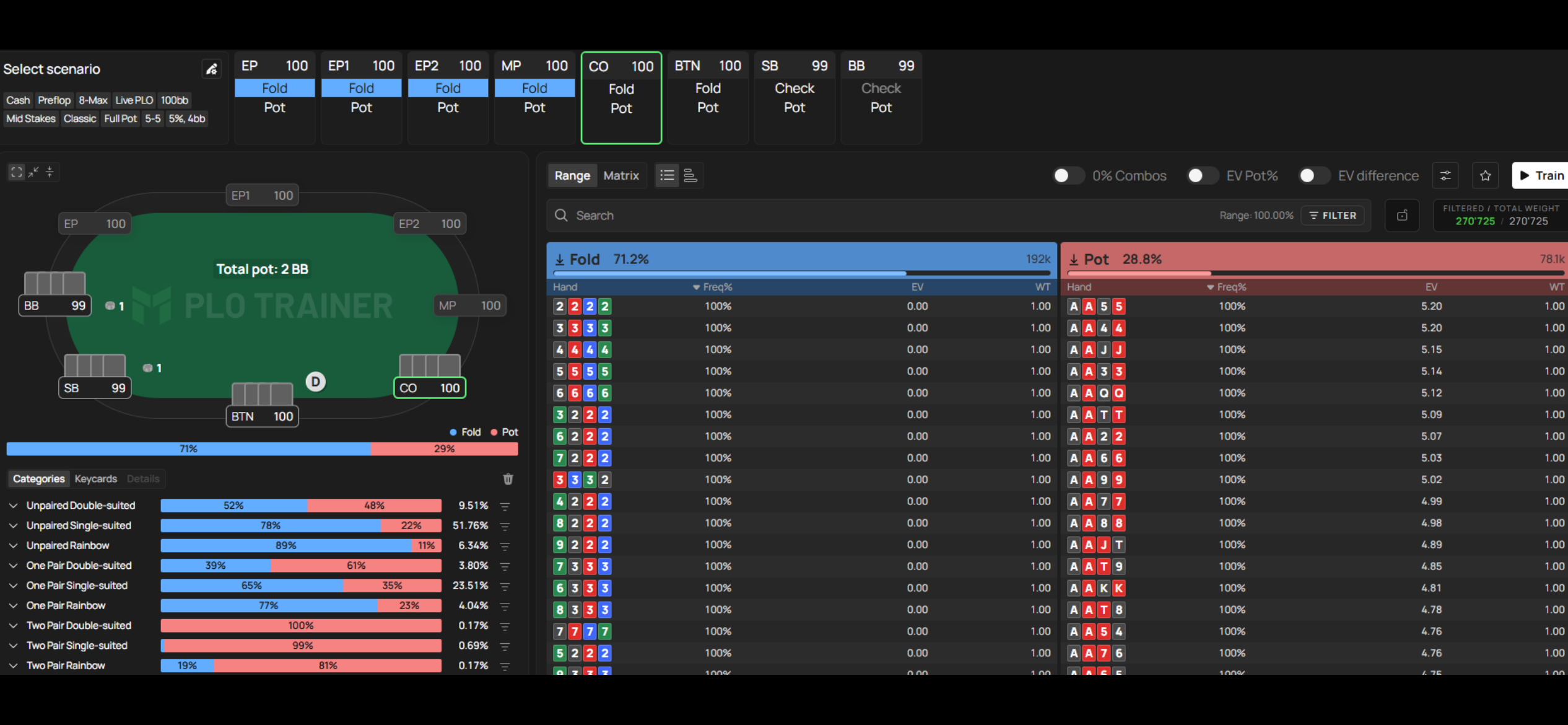 )
CO RFI - 8max - 5% rake, 4bb cap Post 2: Some pure opens from CO that stood out:
Category: Unpaired Single Suited ———> Connected ———> Near Broadway K♥ Q♥ T♥ 8♠
K♦ T♠ 9♥ 7♠
Q♦ T♦ 9♥ 7♠
K♥ J♠ T♠ 7♠ Across this entire category, only 12.9% of combos—1.4k total—are opened from CO. 87.1% fold in optimal in this structure (9.9k combos). This class folds so heavily because “near-Broadway + connected + single-suited” can look much stronger than it actually realizes: many hands sit one rank short of a genuinely dense rundown, lack an ace or nut suit, and make straights that are vulnerable to higher Broadway-heavy structures. The single suit helps, but when that suit is non-nut or concentrated across three cards, it often does not provide enough additional equity to rescue otherwise incomplete connectivity. K♥ Q♥ T♥ 8♠ and K♥ J♠ T♠ 7♠ survive because their Broadway cores are unusually productive. KQT and KJT generate high straight coverage across several J–A textures, while the lower card still participates in enough secondary straight sequences that it is not completely detached. K♦ T♠ 9♥ 7♠ and Q♦ T♦ 9♥ 7♠ lean more heavily on T97 as the engine of the hand. That structure retains multiple wrap-producing runouts, while the K or Q raises the ceiling of the straight trees enough that these are meaningfully stronger than lower connected hands built around the same T97 core. These pure opens therefore sit in a very narrow upper slice of an otherwise heavily folded class: they are not opening merely because they are “connected,” but because the connectivity is concentrated around strong three-card cores with enough high-rank overlap to improve both straight quality and realization. That extra density is what pushes them all the way to pure opens rather than marginal mixes even though the broader category folds almost nine times out of ten.
CO RFI - 8max - 5% rake, 4bb cap Post 3: Some more pure opens from CO that stood out from an assortment of hand classes: A♠ T♠ 6♠ 5♥
A♠ K♦ 7♠ 2♥
Q♥ 6♠ 6♥ 5♠
A♠ 8♦ 2♠ 2♥ A♠ T♠ 6♠ 5♥ is notable because the three-spade construction weakens flush availability, but the hand retains the nut suit alongside two distinct straight components. AT provides Broadway potential while T6 and 65 contribute to different middle and lower straight textures, giving this otherwise fragmented hand several ways to develop. A♠ K♦ 7♠ 2♥ has even less continuous connectivity, but AK supplies premium high-card strength while A2 introduces wheel potential. The nut-spade suit provides an additional source of equity, allowing the hand to tolerate the largely disconnected 7. The distinction between these two ace-high holdings is particularly interesting because neither has a conventional four-card rundown. AT65 sacrifices high-card strength for additional middling connectivity, whereas AK72 concentrates more value in AK, the nut suit, and wheel possibilities. Q♥ 6♠ 6♥ 5♠ combines a relatively weak pocket pair with two non-nut suits, yet the connected 65 component offers additional straight development. The Q-high heart suit is substantially stronger than the 6-high spade suit, and having multiple routes to improvement makes the hand less dependent on flopping a six. A♠ 8♦ 2♠ 2♥ is particularly surprising because pocket deuces offer limited set value, and the disconnected 8 contributes little to the hand’s straight potential. The nut-spade suit and A2 wheel possibilities provide the primary compensation, although the paired deuces also reduce the availability of some wheel-making combinations. The contrast between Q♥ 6♠ 6♥ 5♠ and A♠ 8♦ 2♠ 2♥ is especially useful: 66 benefits from double-suitedness and adjacent connectivity, while 22 survives with an ace-high nut suit despite substantially weaker set potential. Both reach pure-open status through very different supporting structures, rather than the intrinsic strength of their pocket pairs.
CO RFI - 8max - 5% rake, 4bb cap Post 4: On the other side, some pure folds from CO that stood out:
Category: Two pair rainbow
5♦ 5♣ 2♠ 2♥
T♠ T♦ 5♣ 5♥
7♦ 7♣ 4♠ 4♥
6♦ 6♣ 3♠ 3♥ Across this category, 80.8% of combos—378 total—pot from CO, with only 19.2%, or 90 combos, folding. These hands therefore sit near the bottom edge of an otherwise strong, high-EV category. Two pocket pairs give the hand two independent set draws, and with four live cards between them roughly 23% of flops contain at least one. The resulting sets are well disguised and carry a full-house-or-better redraw whenever the board pairs. Because that branch needs no help from suits or connectors, rainbow construction costs less here than it would for a rundown, and CO's positional edge over the blinds lets the class realize set value through large later-street bets while folding cleanly on misses. The structural weakness is that a double-paired hand has only one unpaired two-card combination, so all of its straight potential comes from a single rank pairing. For 5522, 7744, and 6633, that pairing reaches just two straights: A-5 and 2-6, 3-7 and 4-8, and 2-6 and 3-7, respectively. Each requires three specific board ranks, and those same textures tend to give the rundowns continuing behind made straights or wraps. The sets are also concentrated on the textures opponents hit hardest. A flop like 4-6-7 or 3-5-8 gives these hands a middle or bottom set while middling rundowns hold made straights and wraps, and the rainbow structure leaves no flush redraw to escape with. On boards that pair, the lowest set often fills to the lowest full house, which loses to any higher set or two pair that fills on the same card. Because PLO requires exactly two hole cards, the second pair never improves a set already made. If 5522 flops a set of fives, the deuces add nothing, so when the set is behind a straight it is drawing to seven turn outs to fill up or better, with no wrap or flush cards layered on top. When neither pair connects, which happens on about 77% of flops, there is usually little to continue with beyond a small overpair, so equity realization depends almost entirely on the set branch. TT55 shows that nominal pair strength is not the main driver, because T and 5 cannot appear in the same five-card straight. That leaves TT55 with zero straight potential, while each lower combination retains two straights. Its tens are a weak overpair in a four-card game and face set-over-set exposure to JJ+, while the T sits on the broadway and middle straights that connect with the ranges behind, so the better set quality buys back less than the missing connectivity costs. However, the exact pure-fold boundary should not be overlearned. 8855r keeps the two-straight profile of 7744 (4-8 and 5-9) while upgrading both sets, which is a plausible structural reason for it to open. 4422r versus 5522r is harder to separate, since 4-2 and 5-2 reach the same A-5 and 2-6 straights and the opening hand actually holds the lower set rank. A split that small, along with any card-removal effects against rundowns behind, more likely reflects where the solver's EV threshold falls, so the practical read is that low and mid rainbow double pairs are near zero from CO rather than reliably correct folds.
CO RFI — 8max - 5% rake, 4bb cap Post 5: Some more pure folds from CO that stood out from an assortment of hand classes:
Q♠ 8♥ 7♥ 5♠
T♠ 8♥ 8♦ 7♠
K♦ Q♦ 8♠ 8♥ These folds are particularly interesting because they include a double-suited connected hand and two pocket-eights constructions with very different side-card support. Q♠ 8♥ 7♥ 5♠ has two suits and reasonable connectivity, but its strongest rank interactions are concentrated around 875 rather than distributed evenly across all four cards. The Q8 combination can make a queen-high straight on 9-J-T, but the disconnected queen otherwise contributes relatively little to the lower straight structure, while the Q-high and 8-high flushes remain vulnerable to higher suited holdings. T♠ 8♥ 8♦ 7♠ has a more concentrated T87 structure, but duplicating the eight reduces the number of distinct straight combinations and leaves only two remaining eights for set improvement. Its T-high spade suit offers limited protection on connected boards, where the hand can develop substantial drawing equity without necessarily drawing to the nuts. K♦ Q♦ 8♠ 8♥ trades that middling connectivity for a considerably stronger KQ component, including Broadway potential and a K-high flush draw. However, KQ and 88 function largely as separate sources of equity: the eights provide set value, while the Broadway cards require specific high-card runouts, and neither component supplies a particularly strong redraw when the other improves.
CO RFI — 8max - 5% rake, 4bb cap ||| Post 6 — Part 1: Some Takeaways: • Unpaired single-suited hands open only 22% and one-pair single-suited hands only 35%, yet together they make up roughly two-thirds of CO's range. From the rounded category figures, they contribute about 39% and 28% of all opens, while double-suited hands of every type contribute only about a quarter. Within that single-suited mass, the connected near-Broadway subclass opens just 12.9% (≈1.4k of ≈11.3k combinations), below the 22% unpaired single-suited baseline, so it supplies under 5% of the ≈31k unpaired single-suited opens. The bulk must come from other single-suited structures; A♠ K♦ 7♠ 2♥ points toward nut-suited ace constructions, but the supplied data do not break that remainder down. • A♠ K♦ 7♠ 2♥ opens pure with almost no straight equity. Its only straight-capable pairings are AK (T–A) and A2 (A–5), each needing three specific board ranks, while A7, K7, K2 and 72 make nothing. Its value comes from A♠ 7♠, which makes an ace-high flush whenever it completes, plus the A♠ blocker and AK high-card strength: the ace matters because it is suited, and nothing here shows a rainbow A K 7 2 would open. Contrast Q♠ 8♥ 7♥ 5♠, a pure fold despite being double-suited. Q♠ 5♠ is a Q-high draw whose ranks are seven apart and never straight together, and 8♥ 7♥ is an 8-high draw, so two non-nut flush paths do not replace one nut path, consistent with unpaired double-suited hands opening only 48%. • Two-pair rainbow opens 81%, above one-pair double-suited (61%) and unpaired double-suited (48%), so on average a second pocket pair is worth more than both suits. Four set outs flop a set or better about 23.4% of the time [1 − C(44,3)/C(48,3)], versus 12.2% for one pair. Once the hand is double-paired, suits add only ~19 points (81 → ~99/100), against ~37–38 in the unpaired and one-pair families, though that is partly a ceiling effect. The structural cost is exact: two cards of the same rank cannot both play in a straight, so XXYY has a single straight-capable pairing, X with Y, which works only when the two ranks fit inside one five-rank window. • Two near-controlled comparisons suggest that whether a pair helps depends on which ranks it displaces.
CO RFI — 8max - 5% rake, 4bb cap ||| Post 6 — Part 2: Some Takeaways: • None of the Post 2 survivors is a rundown: K Q T 8, K T 9 7, Q T 9 7 and K J T 7 each contain gaps. Every one, though, has at least one pairing reaching the T–A straight, from 11–14 total straight windows across its six pairings. 7♥ 6♦ 5♥ 4♠, the gapless rundown, folds pure despite 20 such windows, because none of its straights is higher than T-high and its only flush is 7♥ 5♥. On connected runouts it plausibly holds the low end against higher wraps, though that is an interpretation of the solver result, not an output. The contrast separates straight quantity from straight height; still, one fold does not place low rundowns as a class, and the subclass's 87.1% fold rate shows near-Broadway connectivity alone is far from sufficient. • The aggregate frequencies are nearly additive:
From Zero to Twenty-One #1 ||| Part 1 — Doubling Down ♥ ♠ ♦ ♣ ♥ ♠ ♦ ♣ ♥ ♠ ♦ ♣ ♥ ♠ ♦ ♣ ♥ ♠ ♦ ♣ ♥ ♠ ♦ ♣ ♥ I’ll be mixing in some blackjack posts as I learn from scratch, aiming to maximize comp value while keeping the house edge and variance low. As usual, I’m posting about whatever I’m spending time on as I develop and refine new skills—hopefully it’ll help someone make a little money, learn something new, or simply enjoy following along. ♥ ♠ ♦ ♣ ♥ ♠ ♦ ♣ ♥ ♠ ♦ ♣ ♥ ♠ ♦ ♣ ♥ ♠ ♦ ♣ ♥ ♠ ♦ ♣ ♥ One of my first questions was what doubling actually does. With a $100 bet, doubling means putting up another $100 before receiving exactly one additional card, after which my turn ends. Draw something unhelpful and you’re stuck with it; a normal hit preserves the option to draw again. ♥ ♠ ♦ ♣ ♥ ♠ ♦ ♣ ♥ ♠ ♦ ♣ ♥ ♠ ♦ ♣ ♥ ♠ ♦ ♣ ♥ ♠ ♦ ♣ ♥ A practice hand of 5♠ 4♠ against 8♣ made that distinction concrete. If the next card is a 4, doubling leaves me on 13 with twice the money committed, while hitting lets me continue. For six decks with the dealer hitting soft 17—a 17 with an ace counted as 11—the expected results for this starting hand are: ♥ ♠ ♦ ♣ ♥ ♠ ♦ ♣ ♥ ♠ ♦ ♣ ♥ ♠ ♦ ♣ ♥ ♠ ♦ ♣ ♥ ♠ ♦ ♣ ♥ Expected net result per $100 original bet: Hit: then continue correctly: +$9.99 Double: putting $200 in play: -$2.17 Stand: -$51.34 ♥ ♠ ♦ ♣ ♥ ♠ ♦ ♣ ♥ ♠ ♦ ♣ ♥ ♠ ♦ ♣ ♥ ♠ ♦ ♣ ♥ ♠ ♦ ♣ ♥ These are long-run averages for that particular situation. Having a profitable hand when I can keep drawing doesn’t mean it stays profitable when I double and surrender that flexibility. ♥ ♠ ♦ ♣ ♥ ♠ ♦ ♣ ♥ ♠ ♦ ♣ ♥ ♠ ♦ ♣ ♥ ♠ ♦ ♣ ♥ ♠ ♦ ♣ ♥ My next reaction was that doubling sounded like a cheat code: I get to see my cards, then selectively put more money into favorable situations. That really is an advantage, but the original bet has to go in before I know whether I’ll receive a good hand or a bad one. ♥ ♠ ♦ ♣ ♥ ♠ ♦ ♣ ♥ ♠ ♦ ♣ ♥ ♠ ♦ ♣ ♥ ♠ ♦ ♣ ♥ ♠ ♦ ♣ ♥ The overall return already includes taking the correct doubles, alongside the expected losses from the unfavorable hands. ♥ ♠ ♦ ♣ ♥ ♠ ♦ ♣ ♥ ♠ ♦ ♣ ♥ ♠ ♦ ♣ ♥ ♠ ♦ ♣ ♥ ♠ ♦ ♣ ♥
From Zero to Twenty-One #1 ||| Part 2 Where the House Edge Comes From ♥ ♠ ♦ ♣ ♥ ♠ ♦ ♣ ♥ ♠ ♦ ♣ ♥ ♠ ♦ ♣ ♥ ♠ ♦ ♣ ♥ ♠ ♦ ♣ ♥ I also wanted to understand how all those player options could leave the game so close to even. The starting point is the dealer’s advantage when both sides bust: my bet is already lost when I go over 21, regardless of what happens to the dealer afterward. An eight-deck example shows how much the player’s options offset that disadvantage: ♥ ♠ ♦ ♣ ♥ ♠ ♦ ♣ ♥ ♠ ♦ ♣ ♥ ♠ ♦ ♣ ♥ ♠ ♦ ♣ ♥ ♠ ♦ ♣ ♥ Features added cumulatively | | | Villain edge Player copies the dealer’s drawing rules; blackjacks pay even money; player loses if both bust: 8.16% Add the 3:2 payout on winning blackjacks: 5.89% Allow strategic standing on hard 12–16: 2.63% Add correct doubling: 1.25% Add correct splitting: 0.58% ♥ ♠ ♦ ♣ ♥ ♠ ♦ ♣ ♥ ♠ ♦ ♣ ♥ ♠ ♦ ♣ ♥ ♠ ♦ ♣ ♥ ♠ ♦ ♣ ♥ Those figures apply to one particular set of rules, without surrender. It helped me see how a relatively large disadvantage gets reduced by several meaningful player advantages. ♥ ♠ ♦ ♣ ♥ ♠ ♦ ♣ ♥ ♠ ♦ ♣ ♥ ♠ ♦ ♣ ♥ ♠ ♦ ♣ ♥ ♠ ♦ ♣ ♥ Surrender can improve things further by allowing a half-bet loss in qualifying situations where continuing would lose more on average. There is still a loss attached to using it. ♥ ♠ ♦ ♣ ♥ ♠ ♦ ♣ ♥ ♠ ♦ ♣ ♥ ♠ ♦ ♣ ♥ ♠ ♦ ♣ ♥ ♠ ♦ ♣ ♥ And a return near 100% doesn’t require a rare jackpot: a fair coin toss paying even money has a 100% return with no jackpot at all. The important question is how the gains and losses balance across every possible outcome. ♥ ♠ ♦ ♣ ♥ ♠ ♦ ♣ ♥ ♠ ♦ ♣ ♥ ♠ ♦ ♣ ♥ ♠ ♦ ♣ ♥ ♠ ♦ ♣ ♥
From Zero to Twenty-One #1 ||| Part 3 - 3/2 and 6/5 ♥ ♠ ♦ ♣ ♥ ♠ ♦ ♣ ♥ ♠ ♦ ♣ ♥ ♠ ♦ ♣ ♥ ♠ ♦ ♣ ♥ ♠ ♦ ♣ ♥ The payout distinction was another basic point worth getting straight. A natural blackjack is an ace plus a ten-value card as the original two cards. ♥ ♠ ♦ ♣ ♥ ♠ ♦ ♣ ♥ ♠ ♦ ♣ ♥ ♠ ♦ ♣ ♥ ♠ ♦ ♣ ♥ ♠ ♦ ♣ ♥ For a winning natural on a $100 bet: Payout Profit Total returned 3:2 $150 $250 6:5 $120 $220 ♥ ♠ ♦ ♣ ♥ ♠ ♦ ♣ ♥ ♠ ♦ ♣ ♥ ♠ ♦ ♣ ♥ ♠ ♦ ♣ ♥ ♠ ♦ ♣ ♥ An ordinary winning hand, including a three-card 21, normally pays $100 profit on that same $100 bet. ♥ ♠ ♦ ♣ ♥ ♠ ♦ ♣ ♥ ♠ ♦ ♣ ♥ ♠ ♦ ♣ ♥ ♠ ♦ ♣ ♥ ♠ ♦ ♣ ♥ Switching from 3:2 to 6:5 costs roughly 1.4 percentage points of return across all hands, enough to turn a game with a 0.5% house edge into approximately 1.9%, with the other rules unchanged. Those differences matter when the broader goal is earning benefits at the lowest expected cost. ♥ ♠ ♦ ♣ ♥ ♠ ♦ ♣ ♥ ♠ ♦ ♣ ♥ ♠ ♦ ♣ ♥ ♠ ♣ ♦ ♥ ♠ ♣ ♦ ♥
From Zero to Twenty-One #1 ||| Part 4 - Status/Comp Goals ♥ ♠ ♦ ♣ ♥ ♠ ♦ ♣ ♥ ♠ ♦ ♣ ♥ ♠ ♦ ♣ ♥ ♠ ♦ ♣ ♥ ♠ ♦ ♣ ♥ Something else that interests me is how far that can go: complimentary rooms—including weekends—access to the highest loyalty tiers, and white-glove treatment across different destinations and properties within Caesars, MGM, and Wynn. ♥ ♠ ♦ ♣ ♥ ♠ ♦ ♣ ♥ ♠ ♦ ♣ ♥ ♠ ♦ ♣ ♥ ♠ ♦ ♣ ♥ ♠ ♦ ♣ ♥ I’ve already achieved Caesars Seven Stars, secured into January 2028, and I want to explore what blackjack and other forms of advantage play can contribute toward maintaining those benefits and earning comparable treatment elsewhere. ♥ ♠ ♦ ♣ ♥ ♠ ♦ ♣ ♥ ♠ ♦ ♣ ♥ ♠ ♦ ♣ ♥ ♠ ♦ ♣ ♥ ♠ ♦ ♣ ♥ That means understanding what level of play each program requires, how consistently benefits carry across properties, and how much comes from tier status versus individual offers and host relationships. ♥ ♠ ♦ ♣ ♥ ♠ ♦ ♣ ♥ ♠ ♦ ♣ ♥ ♠ ♦ ♣ ♥ ♠ ♦ ♣ ♥ ♠ ♦ ♣ ♥ For now, I’m working on understanding the decisions and choosing the rules while keeping the amount I put in play manageable. ♥ ♠ ♦ ♣ ♥ ♠ ♦ ♣ ♥ ♠ ♦ ♣ ♥ ♠ ♦ ♣ ♥ ♠ ♦ ♣ ♥ ♠ ♦ ♣ ♥ The comp question is ultimately how much those benefits are actually worth to me compared with the expected financial cost, time, and energy required to earn them—including this training and theory study. Opportunity cost, in put another way. ♥ ♠ ♦ ♣ ♥ ♠ ♦ ♣ ♥ ♠ ♦ ♣ ♥ ♠ ♦ ♣ ♥ ♠ ♦ ♣ ♥ ♠ ♦ ♣ ♥ Free rooms fri/sat night, premier experiences, and white glove treatment only goes so far if the expected losses and effort involved outweigh its value to me. ♥ ♠ ♦ ♣ ♥ ♠ ♦ ♣ ♥ ♠ ♦ ♣ ♥ ♠ ♦ ♣ ♥ ♠ ♣ ♦ ♥ ♠ ♣ ♦ ♥
From Zero to Twenty-One #1 ||| Part 5 - Putting it all Together ♥ ♠ ♦ ♣ ♥ ♠ ♦ ♣ ♥ ♠ ♦ ♣ ♥ ♠ ♦ ♣ ♥ ♠ ♦ ♣ ♥ ♠ ♦ ♣ ♥ I’m optimistic that if I put in the work, I can be selective enough to play almost exclusively when the game, comps, and promotions add up to an overall edge. That kind of analysis is both a passion and a strength of mine. ♥ ♠ ♦ ♣ ♥ ♠ ♦ ♣ ♥ ♠ ♦ ♣ ♥ ♠ ♦ ♣ ♥ ♠ ♦ ♣ ♥ ♠ ♦ ♣ ♥ Those opportunities won’t always be available, so knowing when to pass will be part of the process. I want to get comfortable evaluating an offer on its own terms and recognizing when the numbers justify playing. ♥ ♠ ♦ ♣ ♥ ♠ ♦ ♣ ♥ ♠ ♦ ♣ ♥ ♠ ♦ ♣ ♥ ♠ ♦ ♣ ♥ ♠ ♦ ♣ ♥ For now, I’m still building that foundation: practicing the decisions, understanding the rule differences, and learning how the comp side fits into the calculation. I’ll be working through the reasoning behind the plays as I get more familiar with the game. ♥ ♠ ♦ ♣ ♥ ♠ ♦ ♣ ♥ ♠ ♦ ♣ ♥ ♠ ♦ ♣ ♥ ♠ ♦ ♣ ♥ ♠ ♦ ♣ ♥ The hope is to turn that edge into real value over time, with favorable variance potentially producing a much stronger result. I’m interested in understanding both the expected outcome and how widely the actual results can vary. ♥ ♠ ♦ ♣ ♥ ♠ ♦ ♣ ♥ ♠ ♦ ♣ ♥ ♠ ♦ ♣ ♥ ♠ ♦ ♣ ♥ ♠ ♦ ♣ ♥ More blackjack posts should follow soon, mixed in with the poker theory. I’ll keep sharing the practice hands, rule differences, and comp questions I’m spending time on as the series develops. ♥ ♠ ♦ ♣ ♥ ♠ ♦ ♣ ♥ ♠ ♦ ♣ ♥ ♠ ♦ ♣ ♥ ♠ ♦ ♣ ♥ ♠ ♦ ♣ ♥
BTN RFI — 8 Max — 5% Rake, 4bb Cap Potting 43.2% (116k combos) and folding 56.8% (153k combos) We’ve completed our rake-free review and are now working through every position with 5% rake capped at 4bb. The first pass gave us a consistent baseline for understanding how position, hand structure, and equity realization shape our ranges. This second pass gives us additional reps, reinforces those concepts, and highlights where the added cost of rake changes our preferred actions. https://gyazo.com/51261f2066605727581100... (https://gyazo.com/51261f2066605727581100bb4819dc4a)
(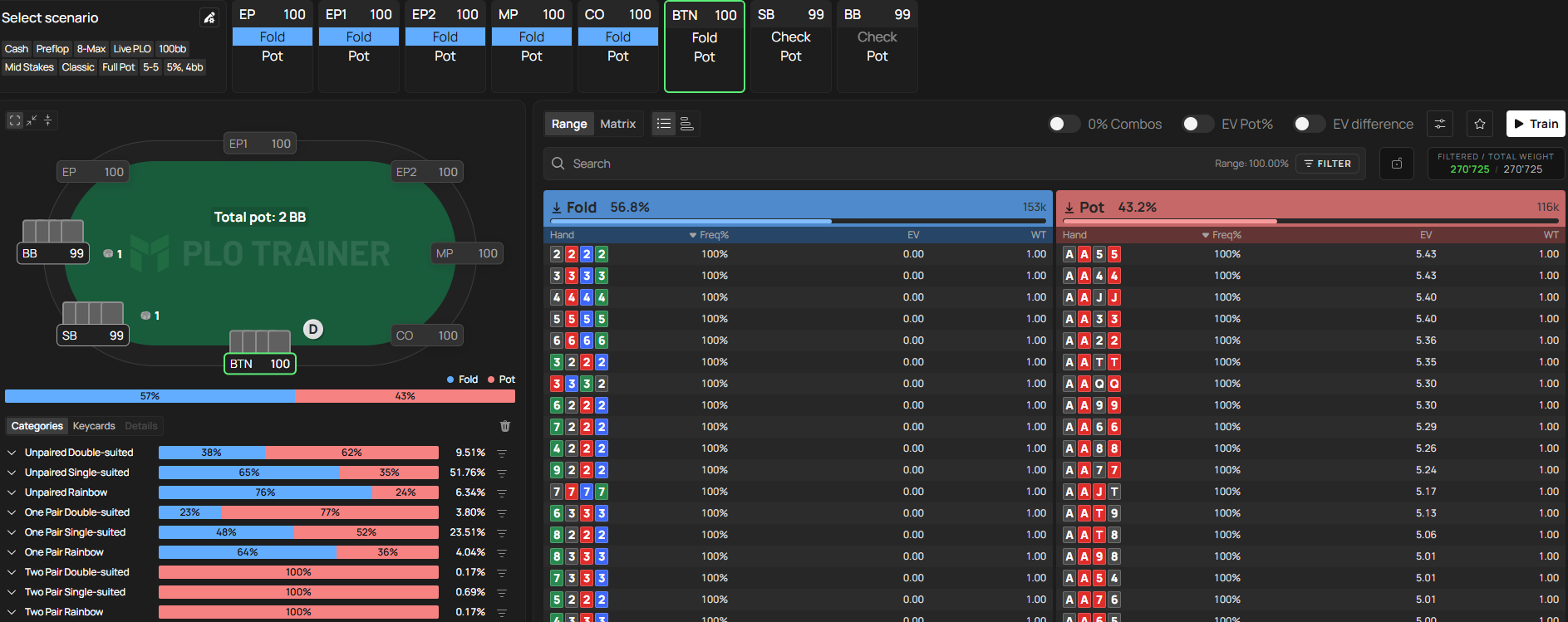 )
BTN RFI — 8max - 5% rake, 4bb cap
Post 2: Some pure opens from BTN that stood out: Category: One pair Rainbow ———> Mid/low pair K ♣ 9 ♦ 8 ♠ 8 ♥
K ♣ Q ♦ 7 ♠ 7 ♥
A ♠ Q ♣ 3 ♥ 3 ♦
A ♠ T ♣ 4 ♥ 4 ♦
Across this entire category, only 10.7% of combos—718 total—are opened from BTN. 89.3% fold in this structure (≈6k combos). The 89.3% fold rate makes sense once the liabilities of this exact class are combined: rainbow removes flush equity entirely, the pocket pair duplicates one of only four ranks while leaving just two unseen cards for set improvement, and a mid/low set is itself much less secure than a high one on many dynamic boards. That puts unusual pressure on the two side cards and their interaction with the pair—without strong straight routes, high-card value, or some second way to make a competitive hand using exactly two hole cards, there simply is not enough left to compensate. K ♣ 9 ♦ 8 ♠ 8 ♥ is interesting because the 9 and 8 give the pair a direct connection rather than leaving 88 as an isolated set draw. The 98 combination can participate in several straight structures, while the king supplies a separate high-card component, so the hand has more internal cooperation than a typical rainbow medium pair with two disconnected kickers. K ♣ Q ♦ 7 ♠ 7 ♥ takes almost the opposite route: the 77 contributes little to the KQ structure, but KQ itself is an unusually strong two-card side combination for this class, capable of making both Broadway and lower king-high straights on the appropriate three-card boards. That allows the low pair to function more as a secondary improvement route rather than being asked to carry the hand. A ♠ Q ♣ 3 ♥ 3 ♦ and A ♠ T ♣ 4 ♥ 4 ♦ are also not opening merely because they contain an ace; AQ and AT can each complete Broadway using three specific board ranks, while A3 and A4 add separate low-straight possibilities. The 33 and 44 remain vulnerable set components, but those hands therefore have several legal two-card rank pairings that can matter instead of being reduced to ace-high plus a small pocket pair. The four opens also show two different ways of escaping an otherwise heavily folded class: K ♣ 9 ♦ 8 ♠ 8 ♥ integrates its pair rank into the useful 98 connection, whereas K ♣ Q ♦ 7 ♠ 7 ♥, A ♠ Q ♣ 3 ♥ 3 ♦, and A ♠ T ♣ 4 ♥ 4 ♦ derive much of their non-set value from stronger side-card pairings that operate separately from the pocket pair. That distinction is more informative here than the shared "one-pair rainbow" label, because most combinations in the category lack either form of support. ♥ ♠ ♦ ♣ ♥ ♠ ♦ ♣ ♥ ♠ ♦ ♣ ♥ ♠ ♦ ♣ ♥ ♠ ♦ ♣ ♥ ♠ ♦ ♣ ♥
BTN RFI — 8max - 5% rake, 4bb cap Post 3: Some more pure opens from BTN that stood out from an assortment of hand classes: A ♠ T ♣ 6 ♦ 4 ♥
J ♠ J ♦ 9 ♥ 2 ♠
T ♥ 9 ♠ 3 ♠ 3 ♥
9 ♥ 7 ♠ 6 ♥ 4 ♠ A ♠ T ♣ 6 ♦ 4 ♥ is completely rainbow and lacks a conventional four-card rundown, but several of its two-card combinations still reach distinct straight regions: AT accesses Broadway, A4 accesses the wheel, 64 participates in multiple low/middle straights, and T6 can complete 6789T. The important feature is that the disconnected appearance does not leave the hand dependent on one narrow improvement path. J ♠ J ♦ 9 ♥ 2 ♠ is much more concentrated around the pocket jacks, with the deuce contributing almost nothing to its straight structure. JJ supplies relatively strong set equity for a one-pair holding, while J9 gives the hand a legitimate secondary route through several 9-to-K straight configurations rather than leaving the pair completely isolated. The contrast between those two opens is particularly sharp: A ♠ T ♣ 6 ♦ 4 ♥ spreads its utility across several different rank pairings without possessing a pair or flush draw, whereas J ♠ J ♦ 9 ♥ 2 ♠ concentrates most of its value in JJ and J9. In the latter, the 2 is close to a passenger; in the former, even the lower cards materially expand the set of boards on which two hole cards can combine with three board cards. T ♥ 9 ♠ 3 ♠ 3 ♥ pairs a very low set draw with the much stronger adjacent T9 side-card combination, while also being double-suited through T ♥ 3 ♥ and 9 ♠ 3 ♠. Neither flush is especially robust, but having both available alongside T9 gives the 33 component substantially more support than a rainbow low pair would receive. 9 ♥ 7 ♠ 6 ♥ 4 ♠ gets there through a different kind of density: all four ranks participate in the hand's straight structure, with 76 and 64 covering lower regions while 97 and 96 extend it upward. Its 9-high and 7-high flushes are vulnerable and therefore cannot carry the hand themselves, but the two suits sit on top of a rank structure capable of developing numerous straight and wrap-type continuations. T ♥ 9 ♠ 3 ♠ 3 ♥ and 9 ♥ 7 ♠ 6 ♥ 4 ♠ are therefore useful complements despite both being double-suited: the former divides its equity between T9, a low pocket pair, and two modest flush draws, while the latter derives far more of its value from four-rank cooperation. That makes the pure-open classification notable for different reasons—the first survives substantial structural separation between its components, while the second compensates for weak flush ceilings with unusually broad straight interaction. ♥ ♠ ♦ ♣ ♥ ♠ ♦ ♣ ♥ ♠ ♦ ♣ ♥ ♠ ♦ ♣ ♥ ♠ ♦ ♣ ♥ ♠ ♦ ♣ ♥
BTN RFI — 8max - 5% rake, 4bb cap Post 4: On the other side, some pure folds from BTN that stood out: T ♠ T ♥ 3 ♥ 2 ♠
T ♠ T ♥ 6 ♥ 2 ♠
T ♠ T ♥ 7 ♥ 2 ♠ These hands are much stronger superficially than many conventional folds on the button because TT supplies a legitimate high set draw and both remaining ranks complete a second suit with one of the tens. The weakness is that the double suits are only T-high, while the side cards often contribute little enough that much of the hand’s equity remains concentrated in making a set rather than producing strong, mutually reinforcing straight and flush continuations. T ♠ T ♥ 3 ♥ 2 ♠ is the most internally compressed of the three: 32 creates wheel-region straight possibilities, but those low ranks interact very little with TT, leaving two largely separate pieces of the hand. Even when 32 develops straight equity, the resulting low-board structures can expose the hand to higher straight redraws, while the ten-high flushes provide limited insulation on suited runouts. Moving from 32 to 62 or 72 changes the straight map without necessarily solving that fragmentation. T ♠ T ♥ 6 ♥ 2 ♠ gains T6 possibilities on specific 7-8-9 boards and some 62 low connectivity, while T ♠ T ♥ 7 ♥ 2 ♠ gives the ten a somewhat closer partner through T7, but the deuce remains poorly integrated with the upper ranks in both constructions. The pocket tens themselves are valuable but also create a subtle card-availability cost: two tens are removed from the deck, so only two remain available for set improvement, and duplicated ranks reduce the number of distinct rank pairings the four-card hand can deploy. That matters more when the remaining two ranks do not form a particularly productive side-card combination, because there is less non-set equity available to compensate. The exact pure-fold boundary should not be overlearned. Nearby hands such as J ♠ J ♥ 7 ♥ 2 ♠ and T ♠ T ♥ 5 ♥ 2 ♠ can become pure opens through relatively small changes in pair rank, straight coverage, card removal, and the number or quality of legal two-card combinations, so part of the distinction is structural and part is likely sensitivity around a very narrow EV threshold. That last comparison is particularly useful because neither opening neighbor introduces some dramatic new premium feature: J ♠ J ♥ 7 ♥ 2 ♠ upgrades the pair and changes the high-rank interactions, while T ♠ T ♥ 5 ♥ 2 ♠ alters the low-card spacing enough to change which three-card boards can connect with 52 or T5. The solver is therefore drawing an unusually fine line within hands that share the same basic TT-plus-two-side-cards architecture, which is exactly where individual pure classifications should be treated as boundary evidence rather than a broad heuristic. ♥ ♠ ♦ ♣ ♥ ♠ ♦ ♣ ♥ ♠ ♦ ♣ ♥ ♠ ♦ ♣ ♥ ♠ ♦ ♣ ♥ ♠ ♦ ♣ ♥
BTN RFI — 8max - 5% rake, 4bb cap Post 5: Some more pure folds from BTN that stood out from an assortment of hand classes: Q ♠ Q ♦ 6 ♥ 2 ♠
T ♣ 9 ♥ 9 ♦ 8 ♠
J ♥ 8 ♠ 5 ♥ 4 ♠
A ♠ 7 ♠ 5 ♠ 4 ♠ These folds stand out because each contains something normally associated with playable BTN equity—QQ, a tightly connected T99 8 structure, two suits with multiple connected ranks, or the nut-spade ace—yet each has a specific structural defect that keeps those assets from combining efficiently. Q ♠ Q ♦ 6 ♥ 2 ♠ has the strongest pair of the group, but Q6, Q2, and 62 contribute very little straight coverage, leaving QQ responsible for an unusually large share of its useful rank equity. The Q ♠ 2 ♠ suit adds flush potential, but it is only queen-high and therefore does relatively little to improve the hand on boards where a bare overpair or set of queens needs strong redraw support. T ♣ 9 ♥ 9 ♦ 8 ♠ looks considerably more coordinated because T98 forms a compact three-rank structure around the pair, with T8 and T9/98 combinations reaching several straight boards. Pairing the nine nevertheless removes one distinct rank from what would otherwise be a four-card rundown, and the completely rainbow construction gives those straight routes no accompanying flush equity. The contrast between Q ♠ Q ♦ 6 ♥ 2 ♠ and T ♣ 9 ♥ 9 ♦ 8 ♠ is therefore unusually sharp: the former has much better set quality but almost no rank cooperation, while the latter has much better straight interaction but a weaker pair and no suit support. Neither construction supplies enough of the missing dimension for its strongest component to become a pure BTN open. J ♥ 8 ♠ 5 ♥ 4 ♠ does have two suits and meaningful 85/54/84 straight interactions, but its connectivity is broken between J and the lower three ranks, while both available flushes are capped at J-high or 8-high. A ♠ 7 ♠ 5 ♠ 4 ♠ solves the flush-ceiling problem with the ace but creates a different one by holding four spades itself, removing two additional spades from the deck beyond the two needed for any flush and materially reducing the frequency with which that nut-flush component can develop. The particularly instructive contrast is that J ♥ 8 ♠ 5 ♥ 4 ♠ has abundant suit availability but weak flush ceilings, whereas A ♠ 7 ♠ 5 ♠ 4 ♠ has the nut-flush ceiling but unusually poor flush-card availability, leaving both pure folds despite arriving there through almost opposite suit-related deficiencies. ♥ ♠ ♦ ♣ ♥ ♠ ♦ ♣ ♥ ♠ ♦ ♣ ♥ ♠ ♦ ♣ ♥ ♠ ♦ ♣ ♥ ♠ ♦ ♣ ♥
BTN RFI — 8max - 5% rake, 4bb cap ||| Post 6 — Part 1: Some Takeaways: • BTN pots 43.2% of hands (≈116k combinations) and folds 56.8% (≈153k), but the selected examples show why that expansion cannot be described simply as accepting weaker versions of the same structures. K♣ Q♦ 7♠ 7♥ opens rainbow while T♣ 9♥ 9♦ 8♠ folds rainbow; 9♥ 7♠ 6♥ 4♠ opens double-suited while J♥ 8♠ 5♥ 4♠ folds double-suited. In each comparison, the folder has an apparently stronger component—higher pair or higher flush draws—but that component does not settle the decision. These examples locate specific exceptions within the range; without a category breakdown, they do not establish which hand families supply most of BTN’s additional opens. • The rainbow pair opens are not all relying on the same kind of connectivity. K♣ Q♦ 7♠ 7♥ has only KQ available for straights, covering the 9–K and T–A windows, whereas K♣ 9♦ 8♠ 8♥ has K9 and 98, covering five pairing-window combinations altogether. A♠ Q♣ 3♥ 3♦ and A♠ T♣ 4♥ 4♦ each have just two: one Broadway pairing and one wheel pairing. The low pair therefore does more than supply set outs in the ace-high examples: a trey or four can also play alongside the ace, while neither seven connects to K or Q in the first hand. Both arrangements survive, so sharing cards between value sources is useful descriptive information rather than a requirement every open must satisfy. • T♣ 9♥ 9♦ 8♠ is a particularly useful counterexample to treating rainbow paired hands as a contest between set rank and connectivity. Its T9, T8 and 98 pairings cover eleven straight windows in total, versus only two for the opening K♣ Q♦ 7♠ 7♥, and its nines make higher sets than sevens. What it lacks is access to Broadway: its highest possible straight is K-high, whereas KQ makes the nut straight on A-J-T. Eleven windows also do not mean eleven independent ways to win; the pairings overlap on connected boards, and the duplicated nine adds no new distinct-rank pairing. The contrast supports distinguishing straight coverage from top-end access, but it does not prove that Broadway alone explains the solver’s choice. • A♠ T♣ 6♦ 4♥ opening rainbow shows that neither a pocket pair nor a flush draw is necessary in this sample. Its straight-capable pairings are AT, A4, T6 and 64: one Broadway window, one wheel window, the single 6–T window, and three windows through 64. That gives the hand routes at both ends of the rank ladder, although these remain overlapping possibilities rather than six independent events. Compare A♠ T♣ 4♥ 4♦ replacing one four with a six removes the pocket pair and its set potential but adds T6 and 64 while retaining AT and A4. Both are pure opens, so BTN can accept either allocation of the fourth card; the supplied results do not establish which hand has the higher opening EV. • Every one-pair hand discussed here has the same two remaining cards of its pair rank available, giving a 12.2% chance of flopping at least one of them [1 − C(46,3)/C(48,3)]. That includes the opening A♠ Q♣ 3♥ 3♦ and the folding Q♠ Q♦ 6♥ 2♠, despite the enormous difference in set quality. The distinction must therefore involve the value of those hits and the rest of the hand’s outcomes, not a higher frequency of making a set. Rainbow hands cannot make a flush at all under the exactly-two-hole-cards rule, so the surviving low pairs are being carried by a combination of set value, their side cards, and the opportunities available from BTN—not by a concealed backdoor flush route. ♥ ♠ ♦ ♣ ♥ ♠ ♦ ♣ ♥ ♠ ♦ ♣ ♥ ♠ ♦ ♣ ♥ ♠ ♦ ♣ ♥ ♠ ♦ ♣ ♥
BTN RFI — 8max - 5% rake, 4bb cap Post 6 — Part 2: Some Takeaways: • J♠ J♦ 9♥ 2♠ opens while Q♠ Q♦ 6♥ 2♠ folds, even though the folder improves both the pocket pair and the spade draw by one rank. Their suited structure is closely matched: each uses one pair card with 2♠, while the other pair card and remaining side card have separate suits. The important visible change is J9 versus Q6: J9 participates in three straight windows, while Q6 participates in none, leaving the queens hand with only 62 and its single 2–6 window. The jack also serves both the set component and the J9 straight component. This is a concrete reason to value the nine’s contribution, although the comparison changes several ranks and cannot isolate its exact EV contribution. • T♥ 9♠ 3♠ 3♥ opens despite its low pair and non-nut flush draws, while T♠ T♥ 3♥ 2♠, T♠ T♥ 6♥ 2♠ and T♠ T♥ 7♥ 2♠ all fold double-suited. The opening hand has T-high hearts and 9-high spades; the folders have T-high draws in both suits and much stronger sets. Its compensating feature is T9, which covers four straight windows and can make the nut straight on an 8-J-Q board. By contrast, the three tens hands each cover only two distinct pairing-window combinations. The lesson is specific: retaining two adjacent upper ranks can matter more than upgrading the pair and the second flush draw, but these examples do not establish a general preference for low pairs over tens. • The unpaired double-suited comparison reverses the flush-quality ordering again. 9♥ 7♠ 6♥ 4♠ opens with 9-high hearts and 7-high spades, while J♥ 8♠ 5♥ 4♠ folds with J-high hearts and 8-high spades. The opener has five straight-capable pairings—97, 96, 76, 74 and 64—covering fourteen windows; the folder has J8, 85, 84 and 54, covering nine. In the opener, 76 links the overlapping 976 and 764 rank groups, while the jack in the folder connects only to the eight. This makes connectivity a plausible explanation for the reversal, but the rainbow KQ77-versus-T998 comparison in Part 1 prevents turning “more windows” into a universal rule. • A♠ 7♠ 5♠ 4♠ folds despite having an ace-high flush route and several low straight connections. Four spades in the hand leave only nine unseen, compared with eleven when exactly two hole cards are spades; the chance of flopping three spades falls from about 0.954% to 0.486% [C(11,3)/C(48,3) versus C(9,3)/C(48,3)]. All six possible hole-card pairings are spade-spade, but they depend on the same board suit, so they do not provide six separate flush routes. Nor can the hand use three or four of its spades with fewer than three board spades. Unlike the opening rainbow A♠ T♣ 6♦ 4♥, it also has no Broadway pairing; the contrast changes both ranks and suits, so the fold cannot be attributed entirely to the four-flush penalty. • The nearby tens examples expose a boundary that the obvious structural measures do not resolve. T♠ T♥ 5♥ 2♠ is listed as a pure open, while T♠ T♥ 3♥ 2♠ folds, despite identical pocket pairs, identical T-high flush ranks, and the same two available straight windows: A–5 and 2–6. The required board ranks differ—52 needs A34 or 346, while 32 needs A45 or 456—but counting windows or comparing straight height cannot explain the split. Likewise, the opening J♠ J♥ 7♥ 2♠ has only one straight window through J7, whereas the folding T♠ T♥ 7♥ 2♠ has two through T7; the jacks improve pair and flush rank while reducing straight coverage. These are places to preserve the solver result without manufacturing a clean rule: card removal and interactions across board textures may matter, but without action EVs or convergence information, neither the precise cause nor a claim of solver noise is established. ♥ ♠ ♦ ♣ ♥ ♠ ♦ ♣ ♥ ♠ ♦ ♣ ♥ ♠ ♦ ♣ ♥ ♠ ♦ ♣ ♥ ♠ ♦ ♣ ♥
1st blind — 8 Max — 5% Rake, 4bb Cap Potting 0.3% (694 combos) and checking 99.7% (270k combos) We’ve completed our rake-free review of this two blind 8-max structure and have been working through every position with 5% rake capped at 4bb. The first pass gave us a consistent baseline for understanding how position, hand structure, and equity realization shape our ranges. This second pass gives us additional reps, reinforces those concepts, and highlights where the added cost of rake changes our preferred actions. https://gyazo.com/4ea2f384ed2d8ff9217d15... (https://gyazo.com/4ea2f384ed2d8ff9217d157b0cff608a)
(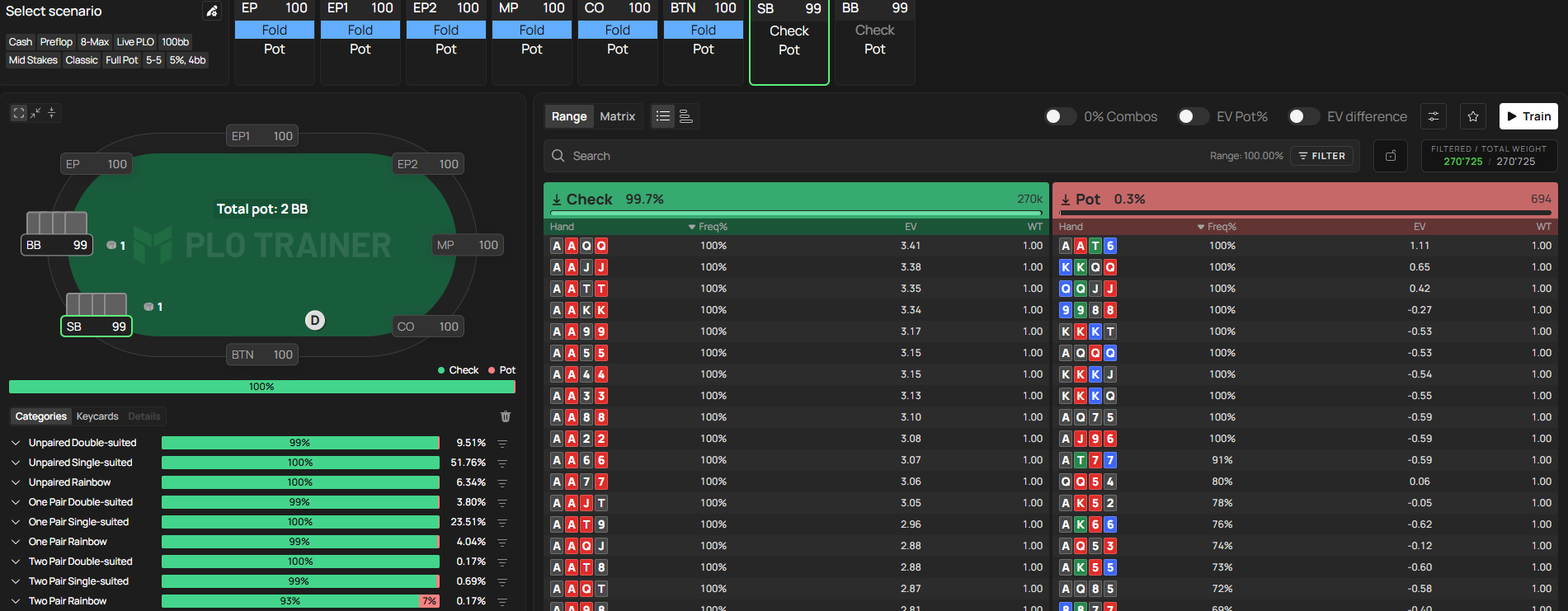 )
1st blind — 8 Max — 5% Rake, 4bb Cap Post 2: A Few Preliminary Notes This simulation does not use a conventional SB/BB structure, as the SB and BB are effectively identical in their initial commitments. The strategic implications of that distinction deserve their own discussion, and I expect to revisit them separately, likely in considerable depth over time, although I’m not yet sure when. Unlike my usual posts, I’ll be including the EVs of every combination associated with the action being examined. With almost the entire range checking in this simulation, action frequencies alone offer relatively little to distinguish one hand from another. The EVs provide an additional dimension for examining how different structures perform, even when they arrive at the same strategic decision. Consequently, this section will be somewhat more abstract than the preceding positional analyses. Rather than concentrating on pure opens, folds, or meaningful frequency thresholds, I’ll be looking more closely at relative EVs, structural differences, and the underlying mechanics of equity realization. There is still plenty to investigate even when the solver’s preferred action is overwhelmingly the same. The objective is to give this otherwise fairly uneventful portion of the simulation some meaningful consideration without manufacturing strategic distinctions where there are essentially none. Some observations may prove more useful than others, but I’ll work through the relevant hand classes and extract whatever insights the EV distributions and nearby comparisons can reasonably support. ♥ ♠ ♦ ♣ ♥ ♠ ♦ ♣ ♥ ♠ ♦ ♣ ♥ ♠ ♦ ♣ ♥ ♠ ♦ ♣ ♥ ♠ ♦ ♣ ♥
1st blind — 8 Max — 5% Rake, 4bb Cap Post 3: Some “-EV” pure pots and their EV from SB that stood out from an assortment of hand classes: A ♠ Q ♠ 7 ♠ 5 ♠ (-0.59) K ♠ K ♥ K ♦ Q ♠ (-0.55) A ♠ Q ♠ Q ♥ Q ♦ (-0.53) 9 ♦ 9 ♣ 8 ♠ 8 ♥ (-0.27) These four pure pots illustrate an important distinction in this equal-blind structure: negative absolute EV does not preclude potting when checking performs even worse, although the specific reasons for that preference must be evaluated separately from the hands’ structural weaknesses. A ♠ Q ♠ 7 ♠ 5 ♠ and A ♠ Q ♠ Q ♥ Q ♦ both possess the nut-spade combination, but the former removes four spades from circulation, leaving only nine available, whereas the latter retains eleven and instead concentrates its card-removal problem in the queen rank. The first can use AQ for Broadway, A5 for wheel straights, and 75 for several lower straights, while the second sacrifices that variety for a pocket pair with only one remaining queen available for set improvement. K ♠ K ♥ K ♦ Q ♠ shares that triplication problem, leaving just one king available, but its KQ combination accesses both Broadway and lower king-high straights while providing a king-high rather than nut-high flush draw. The -0.55 and -0.53 EVs of the two trip-heavy hands are remarkably similar despite AQQQ’s superior flush ceiling and KKKQ’s different straight coverage, making their common restriction on pair improvement particularly conspicuous without establishing its precise EV contribution. 9 ♦ 9 ♣ 8 ♠ 8 ♥ presents almost the reverse construction, retaining two unseen cards of each paired rank and therefore four remaining cards capable of producing a set on the board, compared with just one for either trip-heavy holding. Its 98 combination also participates in multiple straights, but the rainbow distribution removes flush possibilities entirely, and neither resulting set enjoys the rank protection associated with kings or queens. The contrast with A ♠ Q ♠ 7 ♠ 5 ♠ is especially interesting because the monotone hand offers several distinct straight-producing rank pairings and the nut-flush ceiling, whereas 9988 concentrates its improvement potential in two independent pairs and the single distinct 98 straight combination. Meanwhile, A ♠ Q ♠ Q ♥ Q ♦ combines the nut-flush ceiling with premium rank removal but has much less remaining pair-improvement capacity than 9988, illustrating how differently these pure pots distribute their equity across sets, straights, flushes, and blockers. The comparatively favorable -0.27 EV of 9 ♦ 9 ♣ 8 ♠ 8 ♥ is consistent with its less restricted improvement profile, but these four results ultimately establish the solver’s preference for potting over checking rather than isolating the numerical value of any individual structural advantage. ♥ ♠ ♦ ♣ ♥ ♠ ♦ ♣ ♥ ♠ ♦ ♣ ♥ ♠ ♦ ♣ ♥ ♠ ♦ ♣ ♥ ♠ ♦ ♣ ♥
From Zero to Twenty-One #2 ||| An Ugly 16 J♠ 6♦ against K♦. Hard 16 against a dealer ten, with surrender unavailable. I hit, and the trainer marked it correct. Drawing feels uncomfortable here: an ace through a five keeps me alive, while anything higher busts me. But standing leaves me needing the dealer to bust. Keeping my 16 intact doesn’t accomplish much when the dealer finishes with 17 or better. The trainer gives hitting an EV of −0.538: an expected loss of $53.80 per $100 original bet from this position. That’s still ugly, but standing loses more on average. ♥ ♠ ♦ ♣ ♥ ♠ ♦ ♣ ♥ ♠ ♦ ♣ ♥ ♠ ♦ ♣ ♥ ♠ ♦ ♣ ♥ ♠ ♦ ♣ ♥
From Zero to Twenty-One #3 ||| Standing doesn’t mean I’m ahead 7♣ K♠ against 10♠. Hard 17, and I stand. The trainer calls this a “pat hand”—a hand I can leave alone, even though I’m still more likely to lose than win. The trainer shows an EV of −0.419, or an expected loss of $41.90 per $100 bet. For a fuller comparison, assuming six decks and the dealer has already checked for blackjack, standing loses about $42 on average, hitting loses about $58, and doubling loses about $116 per $100 original bet. Standing wins when the dealer busts, pushes against another 17, and loses to 18–21. Once dealer blackjack is ruled out, that’s roughly 23% wins, 12% pushes, and 65% losses. The trainer’s 21% bust figure is closer to the probability before that check. If I hit, only an ace, two, three, or four keeps me alive. Anything else busts me—about 69% of the time under those assumptions. The chance to improve to 18–21 doesn’t make up for how often I immediately lose the hand. Doubling takes that same draw with $200 committed instead of $100, which explains the roughly doubled expected loss. Even if late surrender were available, giving up $50 would cost more on average than standing. Splitting isn’t an option with these cards. Against the same ten-value upcard, my previous hard 16 was a hit. This extra point lets me push against a dealer 17 while leaving fewer safe cards to draw, enough to make standing the better play. ♥ ♠ ♦ ♣ ♥ ♠ ♦ ♣ ♥ ♠ ♦ ♣ ♥ ♠ ♦ ♣ ♥ ♠ ♦ ♣ ♥ ♠ ♦ ♣ ♥
From Zero to Twenty-One #4 ||| Taking another card 4♥ Q♥ against 9♣. Hard 14, and I hit. The trainer marks it correct with an EV of −0.430, or an expected loss of $43 per $100 bet from this spot. Standing leaves me relying entirely on the dealer busting, which happens roughly 23% of the time against a nine. The other 77% ends with the dealer making 17 or better and beating my 14. There’s no possibility of a push if I stay here. Hitting gives me more room than the previous hands: an ace through a seven keeps me alive, while an eight or higher busts me. That’s roughly a 46% chance of busting on the next card. Drawing an ace or two leaves me on 15 or 16, where I can hit again. Using six decks with the dealer hitting soft 17 as a comparison, the expected losses are about $42.82 for hitting, $54.20 for standing, and $87.21 for doubling, all measured against a $100 original bet. Hitting saves about $11.38 on average compared with standing. Doubling puts $200 at risk and ends my turn after one card, including if I draw that ace or two. Even if surrender were offered, its fixed $50 loss would be worse than hitting here. The comparison uses a six-deck calculation; the trainer’s deck count isn’t shown. ♥ ♠ ♦ ♣ ♥ ♠ ♦ ♣ ♥ ♠ ♦ ♣ ♥ ♠ ♦ ♣ ♥ ♠ ♦ ♣ ♥ ♠ ♦ ♣ ♥
From Zero to Twenty-One #5 ||| Why not split the 20? I’m using the trainer’s US Casino Standard settings: six decks, blackjack pays 3:2, dealer hits soft 17, doubling allowed on any first two cards and after splitting, and no surrender. Here I have K♠ J♥ against the dealer’s J♠. Both of my cards count as ten, so I have 20. The correct play is to stand. The trainer shows an expected value of +0.559: about $55.90 in average profit on a $100 bet from this position, after the dealer has checked and ruled out blackjack. The trainer’s “never split 10s; greed costs EV” comment addresses the temptation to turn one strong hand into two potential winners. Where splitting different ten-value cards is allowed, I could add another $100 and start two separate hands with a ten each. But I’m giving up an already-made 20, and both new hands still have to face the dealer’s ten. Under these six-deck rules, splitting produces an expected loss of about $42 combined per original $100 bet, compared with roughly $56 in expected profit from standing. That makes splitting approximately $98 worse in expected value. The extra bet buys another hand, but the two hands together are worth less than the 20 I already had. So “never split tens” is the basic-strategy rule I’m learning here. The trainer’s wording makes it sound like a lesson about greed, but the reason is mathematical: keeping this 20 has a much higher expected return than breaking it up. The action values use six-deck H17 calculations allowing resplitting to four hands. ♥ ♠ ♦ ♣ ♥ ♠ ♦ ♣ ♥ ♠ ♦ ♣ ♥ ♠ ♦ ♣ ♥ ♠ ♦ ♣ ♥ ♠ ♦ ♣ ♥
1st blind — 8 Max — 5% Rake, 4bb Cap Post 4: Some “+EV” pure pots and their EV from SB that stood out from an assortment of hand classes — Part 1: Categories: Two-pair rainbow and one-pair rainbow — selected pure pots. Supplied EVs in parentheses.
Q♦ Q♣ J♠ J♥ (0.42)
K♦ K♣ Q♠ Q♥ (0.65)
A♠ A♥ T♣ 6♦ (1.11) All three hands are rainbow, so none can make a flush using the required two hole cards. Nevertheless, each pots pure within a simulation that otherwise checks overwhelmingly often; the interesting comparison is how QQJJ and KKQQ combine two high pairs with Broadway connectivity, while AAT6 produces the highest displayed EV despite having only one pair and substantially weaker side-card coordination. QQJJ and KKQQ have identical chances of finding their paired ranks on the flop: four matching cards remain among 48 unseen cards, giving approximately 23.4% to flop at least one of them. Their 0.23 EV separation therefore cannot come from KKQQ hitting sets more frequently. The distinction is the quality of those sets and the surrounding board coverage: on Q-7-2 both make top set, whereas on K-Q-2, KKQQ makes top set and QQJJ makes middle set. The connectivity comparison pulls in a different direction. QQJJ makes the nut straight on T-9-8 using QJ, while KKQQ has no straight on that board; both can make Broadway, but QQJJ needs A-K-T and KKQQ needs A-J-T. QQJJ consequently has useful coverage below Broadway that KKQQ lacks, yet its lower pairs leave more higher ranks available to opponents. The displayed ordering is consistent with higher pair quality outweighing that particular connectivity advantage here, without establishing how much each feature contributes. AAT6 has only two remaining aces to hit, approximately a 12.2% chance of seeing at least one on the flop, but a single ace gives it top set rather than introducing the top-set-versus-middle-set distinction between the two-pair hands. On an unpaired flop without an ace, AA also remains the highest possible overpair; KKQQ and QQJJ can encounter higher overpairs even when the board itself looks harmless. That does not make bare AA comfortable across every texture, but it supplies strength that does not depend on first improving to a set. The T6 side cards are uneven rather than entirely disconnected from useful outcomes. AT makes the nut straight on K-Q-J, whereas T6 makes a ten-high straight on 9-8-7 that loses to JT—two very different realizations of “having a straight.” Holding two aces also reduces opponents’ available AA combinations from six to one, although the EV figures alone do not tell us how much of AAT6’s advantage comes from that removal effect, its overpair strength, or its subsequent betting opportunities. The important distinction is between positive displayed EV and the additional EV gained by potting instead of checking. These figures rank the three hands at 0.42, 0.65, and 1.11, but they do not supply their checking EVs, so 1.11 should not be read as the amount AAT6 earns specifically by raising. With equal blinds and checking available, the pure-pot result identifies the preferred action; the missing comparison is how much each hand gives up by taking the free alternative. ♥ ♠ ♦ ♣ ♥ ♠ ♦ ♣ ♥ ♠ ♦ ♣ ♥ ♠ ♦ ♣ ♥ ♠ ♦ ♣ ♥ ♠ ♦ ♣ ♥
From Zero to Twenty-One #6 ||| Missing a Double I’m using the trainer’s US Casino Standard settings: six decks, blackjack pays 3:2, dealer hits soft 17, doubling allowed on any first two cards and after splitting, and no surrender. Here I have 6♠ 5♦against the dealer’s 8♠. Hard 11, and the correct play is to double: add another $100 to my original $100 bet and receive exactly one more card. The appeal is that I can’t bust on that next card, and any ten-value card gives me 21. But there’s a tradeoff: drawing a small card could leave me stuck with something like 13 or 14, with no option to hit again. Doubling is still worth more here because getting extra money behind this favorable position outweighs losing that flexibility. The trainer shows +0.349, or about $34.90 in expected profit per original $100 bet, with $200 now at risk. A calculation accounting specifically for my 6–5 in six decks puts doubling closer to +$35.35, versus +$23.02 for hitting and continuing optimally. Hitting is profitable too; it just gives up roughly $12.33 in expected value compared with doubling. The trainer also mentions that the dealer’s eight busts about 24% of the time. That’s only part of the explanation: I can also draw a strong hand and beat the dealer without a bust. “Missing doubles costs EV” means passing up opportunities to earn more on favorable hands—even when the alternative is itself a winning play. ♥ ♠ ♦ ♣ ♥ ♠ ♦ ♣ ♥ ♠ ♦ ♣ ♥ ♠ ♦ ♣ ♥ ♠ ♦ ♣ ♥ ♠ ♦ ♣ ♥
From Zero to Twenty-One #7 ||| Getting out of the Dealer’s Way I’m using the trainer’s US Casino Standard settings: six decks, blackjack pays 3:2, dealer hits soft 17, doubling allowed on any first two cards and after splitting, and no surrender. I got this one wrong. With 8♣ 5♦ against the dealer’s 3♠, the correct play is to stand on hard 13. It’s a weak hand, but the dealer’s weak upcard changes how I should approach it. Standing means I only win if the dealer busts. That happens roughly 38% of the time here, so I’m still losing more often than winning. The trainer’s EV of −0.245 means an average loss of $24.50 per $100 bet from this position—not that standing turns it into a good spot. Hitting gives me a chance to improve, but a nine or any ten-value card busts me immediately. If that happens, I lose even if the dealer subsequently busts. For this specific six-deck hand, standing averages about −$24.12 versus −$29.42 for hitting and continuing optimally: roughly $5.30 saved per $100 bet by standing. The trainer’s “patience wins here” comment really means patience loses less. The dealer still has to draw to at least 17, while I’m allowed to stop at 13 and let that play out. ♥ ♠ ♦ ♣ ♥ ♠ ♦ ♣ ♥ ♠ ♦ ♣ ♥ ♠ ♦ ♣ ♥ ♠ ♦ ♣ ♥ ♠ ♦ ♣ ♥
From Zero to Twenty-One #8 ||| Part 1 - Two Aces, Two Hands I’m using the trainer’s US Casino Standard settings: six decks, blackjack pays 3:2, dealer hits soft 17, doubling allowed on any first two cards and after splitting, and no surrender. I got this one wrong too. A♥ A♠ against the dealer’s 9♥ is a split. Together, the aces make soft 12—one counts as 11 and the other as 1. Splitting lets each ace start its own hand, with another $100 added alongside my original $100 bet. The trainer’s comment about “21-making potential” becomes clearer with an example. Keep the aces together and draw a king, and I have 12: both aces now have to count as 1. Split them and draw that king to either ace, and that hand has 21. There’s a restriction worth knowing: split aces commonly receive only one additional card each. An ace plus a ten-value card after splitting also normally pays even money, not the 3:2 blackjack payout. The comparison here assumes that one-card restriction and no resplitting aces. Even with those restrictions, splitting averages about $23.78 in combined profit per original $100 bet, with $200 total in play. Hitting and continuing optimally is almost exactly breakeven, while standing averages a $53.81 loss and doubling a $45.09 loss. The trainer’s +0.238 is the rounded splitting value—not the profit on each separate hand. The dealer’s roughly 23% bust rate helps, but I’m also splitting to make hands that can beat a completed dealer hand. Unlike splitting tens, where I’d be breaking up an already strong 20, here I’m turning soft 12 into two hands that each start with an ace. The action values assume six decks, H17, one card to each split ace, and no resplitting aces. ♥ ♠ ♦ ♣ ♥ ♠ ♦ ♣ ♥ ♠ ♦ ♣ ♥ ♠ ♦ ♣ ♥ ♠ ♦ ♣ ♥ ♠ ♦ ♣ ♥
1st blind — 8 Max — 5% Rake, 4bb Cap Post 5: Some AAxx pure checks and their EV that stood out (to me) from an assortment of hand classes — Part 1: A ♠ A ♥ Q ♠ Q ♥ (3.41)
A ♠ A ♥ J ♥ T ♠ (3.05)
A ♠ A ♥ K ♥ J ♠ (2.64)
A ♠ A ♥ 8 ♣ 2 ♦ (0.81) A ♠ A ♥ Q ♠ Q ♥ is particularly striking as the highest-EV combination in the entire simulation at 3.41, yet remains a pure check alongside three AAxx constructions with substantially different secondary characteristics. The three double-suited holdings all possess two nut-flush combinations, but A ♠ A ♥ Q ♠ Q ♥ distinguishes itself by pairing premium set potential with a second pocket pair capable of making queens full on suitable runouts. Its two queens also remove half of the remaining queens from opponents' possible holdings, while the duplicated ranks leave AQ as its only straight-producing two-card rank combination, requiring K-J-T on the board to complete Broadway. A ♠ A ♥ J ♥ T ♠ and A ♠ A ♥ K ♥ J ♠ instead distribute their rank equity across three distinct ranks, with AJ/AT/JT in the former and AK/AJ/KJ in the latter. All six combinations can complete Broadway with specific three-card boards, but JT additionally reaches king-high, queen-high, and jack-high straights, whereas KJ reaches king-high and Broadway, with its Broadway completion requiring A-Q-T on the board despite two aces already being held. The 3.05 EV of A ♠ A ♥ J ♥ T ♠ exceeding the 2.64 of A ♠ A ♥ K ♥ J ♠ is especially interesting because replacing the ten with a king improves the highest side-card rank without improving either flush ceiling. JT's closer connectivity provides access to several additional straight configurations, while AK introduces different high-card removal effects, so the numerical ordering should not be attributed entirely to connectivity without examining the solver's underlying equity realization. A ♠ A ♥ 8 ♣ 2 ♦ is a much sharper departure, retaining the premium pair but losing both flush possibilities and almost all meaningful straight potential. Its A2 combination can complete the wheel specifically on a 3-4-5 board, but neither A8 nor 82 can participate in a five-card straight, leaving AA and that narrow wheel possibility as its principal rank-based sources of improvement. What makes these four checks especially informative is that the solver preserves the checking action across an EV spread of 2.60, from its highest-valued AAQQds combination to a disconnected rainbow AA82, demonstrating that absolute hand strength and the preferred action are distinct dimensions of this equal-blind solution. ♥ ♠ ♦ ♣ ♥ ♠ ♦ ♣ ♥ ♠ ♦ ♣ ♥ ♠ ♦ ♣ ♥ ♠ ♦ ♣ ♥ ♠ ♦ ♣ ♥
1st blind — 8 Max — 5% Rake, 4bb Cap Post 6: Some non-AAxx pure “+EV” checks and their EV that stood out (to me) from an assortment of hand classes: A ♠ K ♥ J ♠ T ♥ (1.19)
T ♠ T ♥ 9 ♠ 9 ♥ (0.84)
K ♥ Q ♠ J ♥ T ♠ (0.77)
J ♥ T ♥ 9 ♠ 8 ♠ (0.14)
All four combinations are double-suited pure checks with positive EV, but their values range from 0.14 to 1.19 despite substantial differences in straight coverage, flush quality, and pair structure. A ♠ K ♥ J ♠ T ♥ leads this group at 1.19, combining the nut-spade draw with six distinct two-card rank pairings capable of completing Broadway on appropriate boards. K ♥ Q ♠ J ♥ T ♠ has a more continuous four-rank structure and additional lower straight possibilities, but its flush ceilings fall to K-high hearts and Q-high spades, compared with the former's nut-spade and K-high heart combinations. T ♠ T ♥ 9 ♠ 9 ♥ takes a fundamentally different route to its 0.84 EV, offering two independent set possibilities alongside T-high flush draws in both suits. Its duplicated ranks restrict straight construction to the nine–ten pairing, which can participate in four distinct five-card straight sequences, while holding two cards of each rank also removes potential board cards needed for some of those completions. The contrast between T ♠ T ♥ 9 ♠ 9 ♥ and J ♥ T ♥ 9 ♠ 8 ♠ is particularly interesting because the latter extends the nine–ten structure into a fully connected four-card rundown, substantially increasing its available two-card straight combinations. Nevertheless, the double-paired holding retains a considerably higher EV (0.84 versus 0.14), with its two set-making ranks providing an improvement route unavailable to the unpaired rundown despite the latter's broader straight coverage. K ♥ Q ♠ J ♥ T ♠ and J ♥ T ♥ 9 ♠ 8 ♠ both possess four consecutive ranks and six distinct two-card rank pairings, but their straight and flush ceilings differ considerably. K ♥ Q ♠ J ♥ T ♠ can make Broadway through several pairings and carries K-high and Q-high flush possibilities, whereas J ♥ T ♥ 9 ♠ 8 ♠ reaches further into middle straights with J-high and 9-high flushes, leaving more of its drawing potential vulnerable to higher completed holdings. The EV ordering is therefore notable without establishing a precise causal decomposition: A ♠ K ♥ J ♠ T ♥ combines premium straight and nut-flush potential, T ♠ T ♥ 9 ♠ 9 ♥ retains strong set-making alternatives, and the two unpaired rundowns differ substantially in the quality of their possible completions, yet all four remain pure checks rather than pots in this particular solution. ♥ ♠ ♦ ♣ ♥ ♠ ♦ ♣ ♥ ♠ ♦ ♣ ♥ ♠ ♦ ♣ ♥ ♠ ♦ ♣ ♥ ♠ ♦ ♣ ♥
From Zero to Twenty-One #8 ||| Part 2 - What Resplitting Aces Adds Same US Casino Standard settings: six decks, blackjack pays 3:2, dealer hits soft 17, doubling allowed on any first two cards and after splitting, and no surrender. Here I’m looking at what changes if resplitting aces is allowed, with a maximum of four hands. Resplitting comes up when I split A–A and receive another ace on one of those hands. I can add another $100 and resplit, taking me from two $100 hands to three. Without that option, the one-card restriction leaves that A–A hand stuck on 12. Keeping the other rules unchanged, allowing resplitting aces lowers the overall house edge by about 0.07 percentage points. For this setup with basic strategy and a cut card, that’s approximately 0.64% without resplitting aces versus 0.57% with it. That works out to roughly seven cents less expected loss per $100 initially wagered. It’s measured before any cards are dealt and averaged across all hands, including those where I never receive aces. The calculation already accounts for the additional money required to resplit. The earlier +$23.78 figure was the expected profit from choosing to split once I already had A♥ A♠ against the dealer’s 9♥, without resplitting allowed. This smaller figure measures what having the extra option contributes across the entire game. ♥ ♠ ♦ ♣ ♥ ♠ ♦ ♣ ♥ ♠ ♦ ♣ ♥ ♠ ♦ ♣ ♥ ♠ ♦ ♣ ♥ ♠ ♦ ♣ ♥
From Zero to Twenty-One #9 ||| Letting the Dealer Draw I’m using the trainer’s US Casino Standard settings: six decks, blackjack pays 3:2, dealer hits soft 17, doubling allowed on any first two cards and after splitting, and no surrender. I got this one right: 5♠ K♠ against the dealer’s 5♠ is a stand. My hard 15 only wins if the dealer busts, which happens about 42% of the time here. The trainer’s −0.160 means roughly $16 in expected loss per $100 bet, even with the correct decision. Hitting risks ending the hand before the dealer has to finish theirs. An ace through six keeps me alive, but a seven or higher busts me—about 54% of possible next cards. And surviving the hit doesn’t necessarily give me a strong hand: an ace only gets me to 16. For this specific hand, standing averages about −$16.00 versus −$38.85 for hitting and continuing optimally. That’s roughly $22.85 in expected value preserved per $100 bet by standing. Doubling would be worse still, averaging −$77.70 with $200 at risk. The trainer’s “let the dealer self-destruct” wording makes the bust sound more certain than it is. The dealer still finishes without busting about 58% of the time. But they have to keep drawing on 16 or less—even if they’re already ahead of my 15—so standing gives their drawing requirement a chance to work in my favor. ♥ ♠ ♦ ♣ ♥ ♠ ♦ ♣ ♥ ♠ ♦ ♣ ♥ ♠ ♦ ♣ ♥ ♠ ♦ ♣ ♥
From Zero to Twenty-One #10 ||| Same 15, Different Decision I’m using the trainer’s US Casino Standard settings: six decks, blackjack pays 3:2, dealer hits soft 17, doubling allowed on any first two cards and after splitting, and no surrender. I got this one wrong: J♣ 5♦ against the dealer’s 8♠ is a hit. Same hard 15 as the previous post, but changing the dealer’s five to an eight changes the correct decision. The trainer’s “completes hands 76% of the time” means the dealer finishes with 17–21 roughly 76% of the time, busting the other 24%. Every one of those completed hands beats my 15 if I stand. That’s a much worse position than facing the five, where the dealer busted about 42%. Hitting still busts me about 54% of the time: an ace through six keeps me alive, while a seven or higher puts me over 21. The risk is worth taking because the chance to improve outweighs waiting for the dealer to bust. Drawing an ace only leaves me on 16, which I should hit again here. For this specific six-deck hand, hitting and continuing optimally averages a $41.69 loss per $100 original bet, versus $51.26 for standing. That’s about $9.57 in expected value gained by hitting, despite the immediate bust risk. The trainer’s −0.416 is close to that hitting value; doubling would average an $84.19 loss with $200 at risk. ♥ ♠ ♦ ♣ ♥ ♠ ♦ ♣ ♥ ♠ ♦ ♣ ♥ ♠ ♦ ♣ ♥ ♠ ♦ ♣ ♥ ♠ ♦ ♣ ♥
From Zero to Twenty-One #11 ||| A Different Kind of 17 I’m using the trainer’s US Casino Standard settings: six decks, blackjack pays 3:2, dealer hits soft 17, doubling allowed on any first two cards and after splitting, and no surrender. I got this one right: A♥ 6♦ against the dealer’s 10♣ is a hit. This is soft 17: the ace currently counts as 11, but it can switch to 1 if another card would otherwise put me over 21. That means I cannot bust on this next draw. A three gives me 20, while a ten-value card leaves me with hard 17. An eight drops me to hard 15, so the trainer’s “free improvement” wording needs a little care: the draw is safe from busting, but it doesn’t guarantee a better total. If I stand, my 17 wins only when the dealer busts, pushes against another 17, and loses to 18–21. Hitting gives me a chance to improve, with the option to keep drawing if the ace switches to 1 and leaves me with a weak total. Once dealer blackjack has been checked and ruled out, the six-deck calculation puts hitting and continuing optimally at about −$19.56 per $100 original bet, versus −$41.96 for standing. That’s roughly $22.39 gained in expected value by hitting, close to the trainer’s displayed −0.197. Doubling averages −$45.46 with $200 at risk: I’d be putting more money behind the hand while giving up the option to draw again after that first card. ♥ ♠ ♦ ♣ ♥ ♠ ♦ ♣ ♥ ♠ ♦ ♣ ♥ ♠ ♦ ♣ ♥ ♠ ♦ ♣ ♥ ♠ ♦ ♣ ♥
From Zero to Twenty-One #12 ||| Missing Another Double I’m using the trainer’s US Casino Standard settings: six decks, blackjack pays 3:2, dealer hits soft 17, doubling allowed on any first two cards and after splitting, and no surrender. I missed another double. 8♦ 3♠ against the dealer’s 5♦ is a double. In Post 6, I had 6♠ 5♦ against 8♠—also hard 11, also a double. The mechanics are the same: add $100 to my original $100 bet and receive exactly one more card. I can’t bust on that draw, and any ten-value card makes 21. The dealer’s five makes this opportunity stronger: their bust rate is roughly 42%, compared with about 24% against the eight. There’s also a useful difference in what I give up. Against the five, basic strategy has me stand on every total that one card could produce from 11: hard 12 through 21. So the one-card restriction doesn’t prevent a further hit I’d otherwise want. Against the eight in Post 6, drawing a small card could leave me on 12–16, where hitting again would normally be correct. For this specific six-deck hand, doubling averages about $62.79 in profit per original $100 bet, with $200 at risk—close to the trainer’s +0.631. Hitting averages +$31.40, while standing on the original 11 averages −$15.93. In Post 6, doubling was worth about $35.35 versus $23.02 for hitting, a $12.33 difference. Here, choosing to hit instead of double gives up about $31.40 in expected value. Both hands are profitable doubles, but the weaker dealer upcard makes missing this one considerably more expensive. ♥ ♠ ♦ ♣ ♥ ♠ ♦ ♣ ♥ ♠ ♦ ♣ ♥ ♠ ♦ ♣ ♥ ♠ ♦ ♣ ♥ ♠ ♦ ♣ ♥
From Zero to Twenty-One #13 ||| Standing on Just 12 I’m using the trainer’s US Casino Standard settings: six decks, blackjack pays 3:2, dealer hits soft 17, doubling allowed on any first two cards and after splitting, and no surrender. I got this one wrong. J♠ 2♣ against the dealer’s 4♣ is a stand. Twelve feels unfinished, but improving my total isn’t automatically worth taking another card. Only a ten-value card busts me immediately—roughly 31% of the remaining cards. But drawing an ace through four leaves me on 13–16, which still only wins if the dealer busts. Drawing five through nine gives me 17–21 and a chance to beat a completed dealer hand. Standing leaves me relying entirely on the dealer’s roughly 40% bust rate. That also means losing about 60% of the time, so the trainer’s “patience wins” wording needs context: standing still loses money on average. It just loses slightly less than hitting. For this specific hand in six decks, standing averages a $20.59 loss per $100 bet, compared with $21.07 for hitting. That’s only about 48 cents between them. Doubling averages a $42.13 loss with $200 at risk. The trainer’s −0.202 translates to a $20.20 expected loss, slightly different from the hand-specific standing calculation. This resembles Post 9’s 15 against a five, where standing also lets the dealer draw. Here, though, the decision is much closer because hitting 12 carries considerably less immediate bust risk than hitting 15. Under these rules, hard 12 stands against four through six, but hits against two or three—the dealer’s exact upcard matters. ♥ ♠ ♦ ♣ ♥ ♠ ♦ ♣ ♥ ♠ ♦ ♣ ♥ ♠ ♦ ♣ ♥ ♠ ♦ ♣ ♥ ♠ ♦ ♣ ♥
1st blind — 8 Max — 5% Rake, 4bb Cap Post 7 — Part 1: Some Takeaways: • The first blind pots just 0.3% of the range—694 reported combinations—and checks 99.7%, approximately 270k combinations. The structure matters: both blinds have already contributed the same amount, so checking requires no completion, although the second blind can still raise. This changes the alternative against which a pot-sized raise must compete: the first blind can retain its hand without immediately investing more, while remaining out of position for the subsequent betting. The checking range consequently contains almost the entire distribution of hand strengths, including the highest-EV combination identified in this section. • The displayed EV and the incentive to raise are separate quantities. A♠ Q♠ 7♠ 5♠ is a pure pot at −0.59, while A♠ A♥ Q♠ Q♥ is a pure check at +3.41; the relevant action comparison is EV(pot) − EV(check) for the same hand. A negative value can still accompany the best available action when the EV reference point includes a forced contribution, but the supplied notes do not establish that reference point or show both action values. The signs therefore describe the reported values on the solver’s scale; they do not, by themselves, identify bluffs, mistakes, or the size of the advantage behind a pure action. • The rainbow double-paired pots provide a useful comparison because their basic set frequency is identical: 9♦ 9♣ 8♠ 8♥ returns −0.27, Q♦ Q♣ J♠ J♥ +0.42, and K♦ K♣ Q♠ Q♥ +0.65. Each holds four cards whose ranks leave four remaining set outs, giving a 23.4% chance of flopping at least one [1 − C(44,3)/C(48,3)], and none can make a flush. Their straight coverage moves in the opposite direction to their displayed EV: 98 spans four windows, QJ three, and KQ two. The higher double pairs produce stronger sets and retain Broadway access, whereas 98 tops out at Q-high; the progression illustrates why the frequency of connecting cannot substitute for the quality of the resulting hands. • K♠ K♥ K♦ Q♠ (−0.55) and A♠ Q♠ Q♥ Q♦ (−0.53) expose the cost of holding a third copy of a premium rank. Exactly two hole cards must play, so the extra king or queen does not itself give the hand three of a kind, and only one card of that rank remains available: its flop arrival probability is 6.25%, compared with 12.2% for at least one of the two remaining cards when holding an ordinary pocket pair. Neither hand can make quads in its tripled rank, because that would require two matching board cards. Those same holdings remove every opposing pocket pair of the tripled rank, but that blocker effect accompanies substantial damage to their own improvement potential; the action values supplied do not isolate which effect determines the pure pot. • A♠ Q♠ 7♠ 5♠ has more distinct ranks than the tripled-queen hand and shares its A♠ Q♠ nut-flush route, yet its displayed pot EV is slightly lower at −0.59. Four spades leave only nine unseen, versus eleven with exactly two spades, reducing the chance of a three-spade flop from approximately 0.954% to 0.486% [C(11,3)/C(48,3) versus C(9,3)/C(48,3)]. Its AQ, A5 and 75 pairings supply Broadway, wheel and middle straight possibilities, but the extra spades do not create another independent flush suit. The comparison shows two different forms of redundancy—too many cards of one suit and too many cards of one rank—appearing among the negative-valued pots, without establishing that either defect is itself a reason to raise. ♥ ♠ ♦ ♣ ♥ ♠ ♦ ♣ ♥ ♠ ♦ ♣ ♥ ♠ ♦ ♣ ♥ ♠ ♦ ♣ ♥ ♠ ♦ ♣ ♥
1st blind — 8 Max — 5% Rake, 4bb Cap Post 7 — Part 2: Some Takeaways: • The AA checks separate the value of a second pocket pair from the value of additional straight connections. A♠ A♥ Q♠ Q♥ returns +3.41, the highest displayed EV identified in this section, ahead of A♠ A♥ J♥ T♠ at +3.05 and A♠ A♥ K♥ J♠ at +2.64; all three have two ace-high flush routes. The double-paired hand has four set outs and a 23.4% flop hit rate, while the other two have two ace-set outs and a 12.2% rate, although they can improve through their side cards in other ways. Its only straight-capable rank pairing is AQ, whereas the JT construction has AJ, AT and JT and the KJ construction has AK, AJ and KJ. The highest value here belongs to the hand with the narrowest straight coverage because that coverage sits alongside two premium pairs and two nut-flush routes. • Within the two single-paired, double-suited AA checks, replacing the KJ side-card structure with JT increases displayed EV by 0.41 despite lowering the highest side card. Both retain two nut-flush routes and three rank pairings capable of making Broadway, but JT also spans the 7–J, 8–Q and 9–K windows, while KJ has only 9–K below Broadway. Summed across their distinct rank pairings, the JT hand has six pairing-window combinations against four for the KJ hand. This gives the lower side cards a concrete connectivity advantage; those counts describe available structures rather than independent straight probabilities, and the 0.41 difference is the result for these complete hands rather than a universal value assigned to JT over KJ. • The rainbow aces show that the presence of AA does not determine the action. A♠ A♥ T♣ 6♦ pots at +1.11, while A♠ A♥ 8♣ 2♦ checks at +0.81; both lack a flush route and have the same ace-set probability. In the first hand, AT reaches Broadway and T6 reaches the 6–T straight, whereas the second has only A2 and its wheel window: neither A8 nor 82 can make a straight. The ten therefore participates in two straight-capable pairings while the eight participates in none. That difference helps describe the stronger displayed value of the selected pot, but its raising incentive still depends on its own checking EV, not on outperforming a different AA hand. • The unpaired double-suited checks make straight quantity and straight quality diverge again: A♠ K♥ J♠ T♥ returns +1.19, K♥ Q♠ J♥ T♠ +0.77, and J♥ T♥ 9♠ 8♠ +0.14. Across their six hole-card pairings, their straight-window counts increase from eleven to sixteen to twenty as displayed EV falls. All six pairings in each of the first two hands can reach Broadway, whereas only JT does so in the lower rundown; the flush routes also step down from A-high/K-high to K-high/Q-high to J-high/9-high. The gapless lower rundown consequently has the most coverage but more ways to arrive at a non-nut straight or flush. The ordering is consistent with the value of stronger endpoints, without measuring how much of each EV difference comes from suits, high cards, or straight structure individually. • T♠ T♥ 9♠ 9♥ checks at +0.84, above the displayed pot values of both rainbow Q♦ Q♣ J♠ J♥ (+0.42) and K♦ K♣ Q♠ Q♥ (+0.65). All three have four set outs, but the tens-and-nines hand adds two T-high flush routes and four straight windows through T9, while surrendering the higher sets and Broadway access of the other two. Its value demonstrates that the extra suits and connectivity can accompany a stronger overall result even when the pairs are lower, yet that stronger result still sits in the checking range. Together with the premium AA checks, it makes clear why the small potting range cannot be reconstructed simply by ranking these hands by displayed EV and raising the highest ones. • The 0.3% potting frequency establishes how rarely that action is used, but it does not quantify the cost of replacing it with a complete checking strategy. That cost depends on the pot-versus-check EV gaps for the affected hands and their frequencies; a pure action can reflect either a substantial preference or a very small difference. The unusual pots are therefore useful candidates for closer inspection, especially the four-spade and tripled-rank constructions, but neither their rarity nor their negative displayed values establishes solver noise. The supplied results support a checking range containing everything from weak holdings to the strongest premiums; the precise reasons that the remaining hands prefer potting require the competing action EVs. ♥ ♠ ♦ ♣ ♥ ♠ ♦ ♣ ♥ ♠ ♦ ♣ ♥ ♠ ♦ ♣ ♥ ♠ ♦ ♣ ♥ ♠ ♦ ♣ ♥
From Zero to Twenty-One #14 ||| Even 18 can need another card I’m using the trainer’s US Casino Standard settings: six decks, blackjack pays 3:2, dealer hits soft 17, doubling allowed on any first two cards and after splitting, and no surrender. I got this one wrong. A♥ 7♥ against the dealer’s Q♣ is a hit. This is soft 18: the ace currently counts as 11, but can switch to one. Eighteen looks respectable, yet against a ten-value upcard, taking another card is worth slightly more than keeping it. The trainer’s “zero risk” means I can’t bust on this next draw. It doesn’t mean my hand can’t get worse. A two makes 20, a three makes 21, and a ten-value card leaves me with hard 18. But a six turns my hand into hard 14, where I’d need to hit again and could then bust. This follows the same idea as Post 11’s soft 17 against a ten. Both hands can take a card without immediately busting, but standing on 18 has more value: it beats a dealer 17 and pushes against 18. That makes the advantage of hitting much smaller here. For this specific six-deck hand, after the dealer has checked and ruled out blackjack, hitting and continuing optimally averages a $14.29 loss per $100 bet. Standing averages a $17.96 loss, while doubling averages a $34.27 loss with $200 at risk. Hitting saves about $3.67 compared with standing—versus roughly $22.39 in the soft-17 hand. The trainer’s −0.144 is close to that $14.29 expected loss. Doubling also takes a card, but it forces me to stop afterward. If I draw that six and land on 14, I’m stuck there with twice the money out. Hitting preserves the option to keep drawing when the new total needs help. ♥ ♠ ♦ ♣ ♥ ♠ ♦ ♣ ♥ ♠ ♦ ♣ ♥ ♠ ♦ ♣ ♥ ♠ ♦ ♣ ♥ ♠ ♦ ♣ ♥
From Zero to Twenty-One #15 ||| Letting the Six Draw I’m using the trainer’s US Casino Standard settings: six decks, blackjack pays 3:2, dealer hits soft 17, doubling allowed on any first two cards and after splitting, and no surrender. I got this one wrong. 9♥ 4♥ against the dealer’s 6♣ is a stand. My hard 13 can’t beat any completed dealer hand, but the dealer still has to draw under the table rules—even if they already have more than 13. Hitting risks ending the hand before the dealer gets that chance. A nine or any ten-value card busts me immediately, roughly 39% of the remaining cards. An ace, two, or three leaves me on 14–16, still dependent on a dealer bust. Only four through eight gets me to 17–21. For this specific six-deck hand, standing averages a $12.02 loss per $100 bet, matching the trainer’s rounded −0.120. Hitting averages a $23.86 loss, while doubling averages a $47.72 loss with $200 at risk. Standing saves about $11.84 compared with hitting. The trainer lists a 42% dealer bust rate, but under these H17 rules the hand-specific figure is closer to 44%. Standing therefore wins about 44% and loses about 56%, with no pushes. That’s why the correct decision still has negative expected value: the dealer remains more likely to finish a hand than bust. In Post 7, I also had hard 13, then against a three. Standing was correct there too, but its advantage over hitting was only about $5.30 per $100. Against this six, the dealer’s greater bust chance makes leaving my hand alone considerably more valuable. ♥ ♠ ♦ ♣ ♥ ♠ ♦ ♣ ♥ ♠ ♦ ♣ ♥ ♠ ♦ ♣ ♥ ♠ ♦ ♣ ♥ ♠ ♦ ♣ ♥
From Zero to Twenty-One #16 ||| Taking the Risk on 16 I’m using the trainer’s US Casino Standard settings: six decks, blackjack pays 3:2, dealer hits soft 17, doubling allowed on any first two cards and after splitting, and no surrender. I got this one wrong. Q♦ 6♠ against the dealer’s 7♥ is a hit. Standing avoids busting myself, but leaves me needing the dealer to bust—and that happens only about 26% of the time here. Taking a card busts me roughly 61% of the time. That sounds awful, but every surviving draw gives me a finished hand: an ace makes 17, a two makes 18, and so on through a five making 21. Those outcomes create chances to win or push when the dealer doesn’t bust. For this specific six-deck hand, hitting averages a $40.86 loss per $100 bet, compared with $47.65 for standing. Hitting saves about $6.79 in expected value. The trainer’s −0.412 translates to a $41.20 expected loss, close to the hand-specific calculation. Doubling averages an $81.72 loss with $200 at risk: I’d take the same single card, but double the financial exposure to a losing position. This is a sharp change from the dealer’s six in Post 15. With this same hard 16 against a six, standing would lose about $12.45 versus $43.75 for hitting. Change only the dealer’s upcard to a seven, and hitting becomes better. The seven can already make 17 with a ten-value hole card; the six would make 16 and still have to draw. It also brings me back to Post 2’s 16 against a ten. The decision is the same, but a seven gives my surviving draws more room to compete. Busting on the next card would feel bad, yet it wouldn’t make the decision wrong—the comparison already includes all those immediate losses. ♥ ♠ ♦ ♣ ♥ ♠ ♦ ♣ ♥ ♠ ♦ ♣ ♥ ♠ ♦ ♣ ♥ ♠ ♦ ♣ ♥ ♠ ♦ ♣ ♥
BB vs EP RFI — 8max — Rake Free
Post 1: Introduction and Overall Frequencies We're starting a new section examining BB defense against an RFI across all positions in our 8-max structure. As with our previous work, we'll begin with rake-free simulations to establish a consistent baseline for understanding how position, hand structure, and equity realization shape our ranges. We'll then make a second pass using 5% rake capped at 4bb, giving us additional reps to reinforce those concepts while identifying where the added cost of rake changes our preferred actions. Against an EP open, BB pots 3.6% (≈9.7k combinations), calls 21.8% (≈59.1k combinations), and folds 74.6% (≈201k combinations). That leaves us continuing with just 25.4% of our starting combinations, with calling accounting for the overwhelming majority of our defenses. The relatively narrow continuing range reflects the strength of EP's opening range alongside BB's positional disadvantage. Although we're receiving a discount on a call and closing the preflop action, realizing equity out of position against a relatively strong range remains difficult. This makes raw equity alone an insufficient basis for defending, particularly when considering how different hand structures interact with the opener's range across postflop runouts. Our 3.6% potting frequency is especially selective, while the much larger calling range allows us to continue with hands that prefer seeing a flop without building a substantially larger pot out of position. The distinction between these actions should become more informative as we examine specific hand classes, their structural properties, and the EVs associated with each decision. This EP configuration gives us our tightest positional starting point for BB defense. As we work through progressively later opening positions, we'll be able to examine how expanding RFI ranges change our opportunities to call and pot, before revisiting those same configurations under rake and comparing where the incentives diverge. https://gyazo.com/cecca8089caf5c68f789bf... (https://gyazo.com/cecca8089caf5c68f789bf1f0edecfa5)
(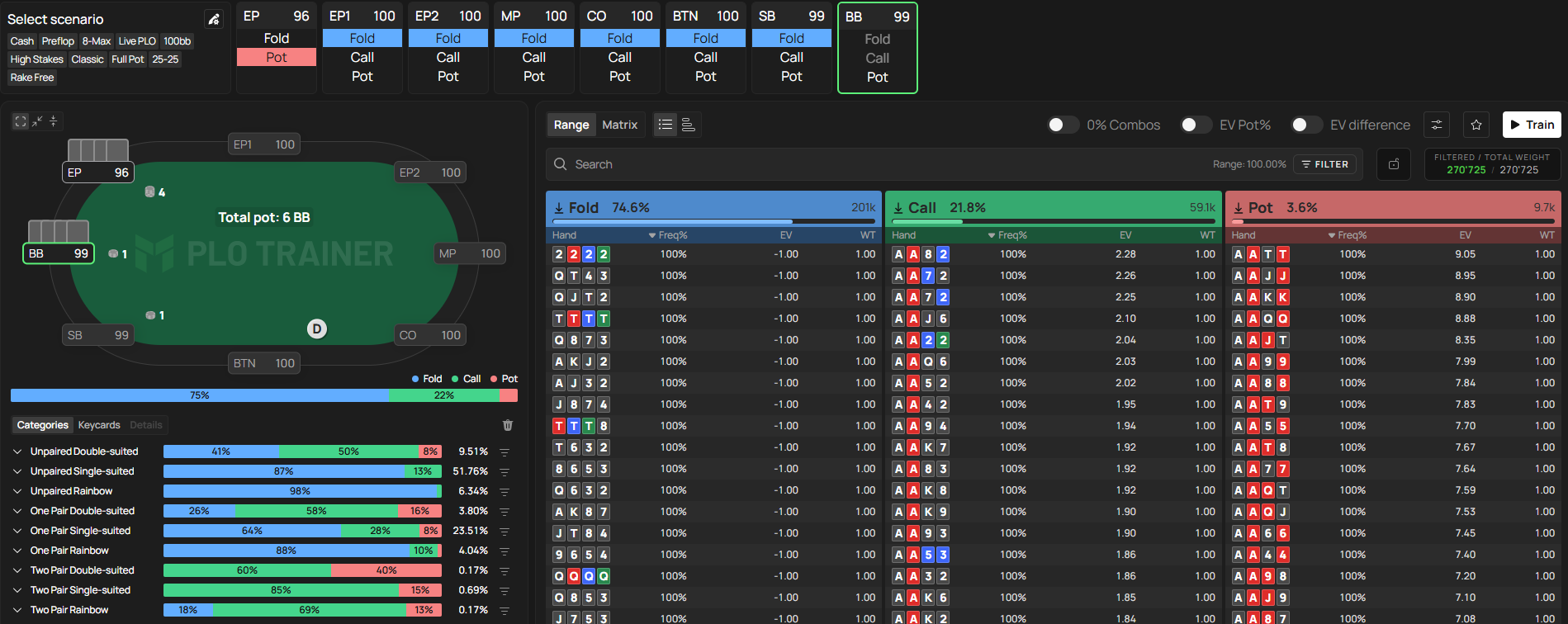 )
♥ ♠ ♦ ♣ ♥ ♠ ♦ ♣ ♥ ♠ ♦ ♣ ♥ ♠ ♦ ♣ ♥ ♠ ♦ ♣ ♥ ♠ ♦ ♣ ♥
From Zero to Twenty-One #17 ||| One Point Less, Still a Double I’m using the trainer’s US Casino Standard settings: six decks, blackjack pays 3:2, dealer hits soft 17, doubling allowed on any first two cards and after splitting, and no surrender. I missed another double. 7♠ 3♣ against the dealer’s 8♠ is a double. That means adding $100 to my original $100 bet and taking exactly one more card. I can’t bust on that draw. Any ten-value card makes 20, and an ace makes 21. The dealer’s roughly 24% bust rate helps, but much of the appeal is making a strong enough hand to beat the dealer when they finish. The restriction still matters. Drawing a two through six leaves me on 12–16, where I’d normally want another hit against an eight. Doubling forces me to stop there. Getting more money behind the favorable starting hand outweighs losing that flexibility. For this specific six-deck hand, doubling averages $29.26 in profit per original $100 bet, with $200 at risk. Hitting and continuing optimally averages +$20.07, while standing averages −$51.32. The trainer’s +0.291 represents about $29.10 in expected profit, close to the hand-specific doubling figure. Choosing to hit gives up about $9.19 compared with doubling. In Post 6, I had hard 11 against the same dealer upcard. Doubling was worth about $35.35 there: a ten-value draw made 21, whereas here it makes 20. Both are profitable doubles, but the extra point made that earlier opportunity stronger. ♥ ♠ ♦ ♣ ♥ ♠ ♦ ♣ ♥ ♠ ♦ ♣ ♥ ♠ ♦ ♣ ♥ ♠ ♦ ♣ ♥ ♠ ♦ ♣ ♥
From Zero to Twenty-One #18 ||| Where 12 and 13 Part Ways I’m using the trainer’s US Casino Standard settings: six decks, blackjack pays 3:2, dealer hits soft 17, doubling allowed on any first two cards and after splitting, and no surrender. I got this one wrong. 6♣ 7♦ against the dealer’s 2♣ is a stand. Hitting this hard 13 busts me on any nine or ten-value card, roughly 39% of the remaining cards. Drawing an ace through three leaves me on 14–16, still needing the dealer to bust. Standing wins about 36% of the time here and loses about 64%, with no pushes. The dealer’s two is vulnerable, but a bust still isn’t the most likely outcome. The trainer’s “patience wins” wording is really describing the option that loses less. For this specific six-deck hand, standing averages a $28.22 loss per $100 bet, compared with $31.25 for hitting. Standing saves about $3.03. Doubling averages a $62.50 loss with $200 at risk. The trainer’s −0.286 represents a $28.60 expected loss, slightly different from the hand-specific standing figure. In Post 13, I mentioned that an unpaired hard 12 hits against a two. One point changes the decision here. A nine makes 21 from 12 but busts 13, adding another rank to the cards that immediately lose. Even though neither starting total beats a completed dealer hand, their drawing prospects are different enough that I hit one and stand on the other. ♥ ♠ ♦ ♣ ♥ ♠ ♦ ♣ ♥ ♠ ♦ ♣ ♥ ♠ ♦ ♣ ♥ ♠ ♦ ♣ ♥ ♠ ♦ ♣ ♥
From Zero to Twenty-One #19 ||| Doubling on Nine I’m using the trainer’s US Casino Standard settings: six decks, blackjack pays 3:2, dealer hits soft 17, doubling allowed on any first two cards and after splitting, and no surrender. I missed this one. 2♠ 7♦ against the dealer’s 5♦ is a double. Even with only nine, the position is favorable enough to add another $100 to my original $100 bet and accept exactly one more card. I can’t bust on that draw, although I can’t reach 21 either. A ten-value card makes 19, and an ace makes 20. The dealer’s roughly 42% bust rate also gives my weaker results a way to win: drawing a five and getting stuck on 14 doesn’t automatically lose the hand. There’s a useful difference from Post 12’s hard 11 against a five. There, every possible draw left a total I’d stand on anyway. Here, drawing a two leaves me on 11, where I’d want another card. Doubling takes away that option, so the one-card restriction has a real cost this time. For this specific six-deck hand, doubling averages $25.64 in profit per original $100 bet, with $200 at risk. Hitting and continuing optimally averages +$16.34, while standing averages −$15.89. The trainer’s +0.263 represents about $26.30 in expected profit, slightly above the hand-specific calculation. Even after accounting for the restriction, doubling earns about $9.30 more than hitting. ♥ ♠ ♦ ♣ ♥ ♠ ♦ ♣ ♥ ♠ ♦ ♣ ♥ ♠ ♦ ♣ ♥ ♠ ♦ ♣ ♥ ♠ ♦ ♣ ♥
From Zero to Twenty-One #20 ||| Moving into Pair Practice - Splitting Nines After spending the last several sessions working through core practice, I’m switching over to pair practice. The rules remain unchanged, but splitting introduces another layer of decisions, particularly because it requires putting additional money at risk to play two separate hands. US Casino Standard — Six decks, dealer hits soft 17, doubling allowed on any first two cards and after splitting, and no surrender. My hand is 9♠ 9♦ against the dealer’s 9♣. The correct decision is split, although I incorrectly played the 18 as a standing hand. At first glance, standing on 18 against a dealer 9 seems reasonable. But the dealer’s 9 is a strong upcard, busting only about 23% of the time. Splitting gives each 9 an opportunity to develop into a stronger hand, with the additional benefit of being able to double after splitting. Using my usual $100 starting bet, splitting requires another $100, leaving $200 in play across two hands. The trainer reports an EV of -0.081 for the correct decision, equivalent to an expected loss of approximately $8.10 relative to the original $100 wager. It’s still a negative-expectation situation, but splitting performs better than keeping the 18 intact. This is a useful introduction to pair practice because the strongest decision isn’t necessarily the one that preserves an already respectable total. I’ll be looking more closely at when the additional wager is justified, how dealer upcards influence splitting decisions, and where keeping the original hand is preferable. ♥ ♠ ♦ ♣ ♥ ♠ ♦ ♣ ♥ ♠ ♦ ♣ ♥ ♠ ♦ ♣ ♥ ♠ ♦ ♣ ♥ ♠ ♦ ♣ ♥
From Zero to Twenty-One #21 ||| Moving into Pair Practice - Splitting Eights Against a Dealer Eight Continuing with pair practice under the same US Casino Standard rules: six decks, blackjack pays 3:2, dealer hits soft 17, doubling allowed on any first two cards and after splitting, and no surrender. This time I’m holding 8♥ 8♥ against the dealer’s 8♦. I incorrectly chose to play the hand as a hard 16 rather than splitting, which the trainer identifies as the optimal action with an EV of -0.029. Unlike the previous 9-9 against a dealer 9, where I was breaking up a relatively strong 18, this decision involves escaping one of the worst starting totals in blackjack. Standing on 16 against an 8 is particularly unattractive, while hitting leaves me vulnerable to busting with any card valued at six or higher. Splitting requires an additional wager, but it transforms one weak 16 into two separate hands beginning with 8. Each hand can improve independently, and doubling after splitting remains available. The dealer’s 8 busts approximately 24% of the time, so neither standing nor relying on the dealer to break is particularly appealing. With my usual $100 starting wager, splitting commits another $100, and the reported EV of -0.029 corresponds to approximately $2.90 in expected losses relative to the original wager, assuming the trainer uses that normalization. This is considerably less negative than the -0.081 reported for splitting nines against a dealer 9, although the two situations are structurally different. The distinction I’m beginning to appreciate is that splitting isn’t exclusively about creating additional opportunities to win. Sometimes it’s about replacing a particularly poor starting position with two hands that can realize their equity more effectively, even when the overall decision remains negative EV. ♥ ♠ ♦ ♣ ♥ ♠ ♦ ♣ ♥ ♠ ♦ ♣ ♥ ♠ ♦ ♣ ♥ ♠ ♦ ♣ ♥ ♠ ♦ ♣ ♥
From Zero to Twenty-One #22 ||| Pair Practice - Splitting Threes Against a Dealer Three US Casino Standard — Six decks, blackjack pays 3:2, dealer hits soft 17, doubling allowed on any first two cards and after splitting, and no surrender. My Hand — 3♠ 3♠ Dealer Hand — 3♦ Continuing with pair practice, I incorrectly chose not to split my threes against a dealer 3. The trainer identifies splitting as optimal, with an EV of -0.046. Unlike the previous two examples involving pairs of eights and nines, this decision starts with a particularly weak total of just 6. The dealer’s 3 is a relatively weak upcard, with an approximately 37% probability of busting. However, keeping the pair together means playing a single hard 6, which has little immediate value and requires substantial improvement. Splitting allows both threes to develop independently while taking advantage of the dealer’s relatively vulnerable position. An important consideration here is doubling after splitting. Receiving a 6, 7, or 8 on either three produces totals of 9, 10, or 11, respectively, creating potential doubling opportunities against the dealer’s 3. Without DAS, the value of splitting weaker pairs diminishes, and the optimal strategy can change. With my usual $100 initial wager, splitting requires another $100, leaving two hands in play. The reported EV of -0.046 implies approximately $4.60 in expected losses relative to the original wager, assuming the trainer normalizes EV that way. Although splitting remains negative EV in this situation, it performs better than retaining the original hard 6. The contrast with splitting eights is particularly interesting. There, the primary objective was escaping a vulnerable hard 16 against a strong dealer upcard. Here, splitting a weak total of 6 creates two opportunities to develop stronger hands against a comparatively weak dealer, with DAS adding further value. Both involve breaking apart a pair, but the underlying advantages are somewhat different. ♥ ♠ ♦ ♣ ♥ ♠ ♦ ♣ ♥ ♠ ♦ ♣ ♥ ♠ ♦ ♣ ♥ ♠ ♦ ♣ ♥ ♠ ♦ ♣ ♥
A Little Good From Reddit #1 Starting a little series of wholesome things I come across on Reddit that resonate with me. Stories, pictures, or even comments that stay with me long enough to want to share them here. This one made me imagine what it would feel like to finally see the face of a dog you’d already trusted to guide you through the world. Knowing their footsteps, their habits, the feeling of them beside you—and then getting to look at them. Having Willie, that thought gets me. There’s something especially sweet about the goodnight kiss, too. Before anything extraordinary happened, she was just leaning down to give her dog some love.
(%E2%99%A5) ♠ ♦ ♣ ♥ ♠ ♦ ♣ ♥ ♠ ♦ ♣ ♥ ♠ ♦ ♣ ♥ ♠ ♦ ♣ ♥ ♠ ♦ ♣ ♥
BB vs EP RFI — 8 Max — Rake-Free Post 2: Some pure pots from BB that stood out: Category: One-Pair Single-Suited — Broadway Pair 4.9% pot / 48.9% call / 46.2% fold 967 pure-pot combinations — all pure fold versus a 4-bet.
A♠ Q♥ Q♦ T♥ (−0.25 EV)
Category: Unpaired Double-Suited — Connected 12.9% pot / 65.2% call / 21.9% fold 981 pure-pot combinations — all pure call versus a 4-bet. Q♥ 9♠ 8♥ 6♠ (−0.70 EV)
Analysis: Broadway-paired single-suited hands pot just 4.9%, compared with 12.9% for connected double-suited hands. Both categories predominantly call against EP, but the latter's connectivity and dual-suit coverage support a greater proportion of aggressive actions despite generally weaker high-card strength. The Broadway-paired examples combine an ace blocker with a premium pair, but their side-card structures offer relatively limited postflop flexibility. The QQ hand benefits from additional Broadway connectivity, while the KK hand sacrifices that connectivity for stronger immediate pair equity. Neither provides particularly attractive equity realization against a strong 4-betting range. Among the unpaired double-suited examples, the Q-high holding has gaps that weaken its straight potential, whereas the T-high holding benefits from a more concentrated connected structure. Their respective pot EVs of −0.70 and −0.19 illustrate how substantially performance can vary even within the same suitedness and connectivity classification. The most striking difference emerges against a 4-bet: all 967 pure-pot Broadway-paired combinations pure fold, while all 981 connected double-suited combinations pure call. The former rely more heavily on blockers and immediate pair strength, whereas the latter retain multiple ways to improve against EP's strongest holdings. This creates distinctly different continuations from superficially similar pure-pot decisions. ♥ ♠ ♦ ♣ ♥ ♠ ♦ ♣ ♥ ♠ ♦ ♣ ♥ ♠ ♦ ♣ ♥ ♠ ♦ ♣ ♥ ♠ ♦ ♣ ♥
BB vs EP RFI — 8 Max — Rake-Free
Category: One-Pair Double-Suited — Mid/Low Pair 4.5% pot / 55.2% call / 40.3% fold 282 pure-pot combinations — all pure fold versus a 4-bet. A♠ 8♠ 8♥ 5♥ (−0.37 EV)
Category: Unpaired Single-Suited — Suited Ace 0.8% pot / 36.9% call / 62.3% fold 191 pure-pot combinations — all pure fold versus a 4-bet. A♠ K♦ J♠ T♥ (+0.25 EV)
Analysis: The mid/low-pair double-suited category pots 4.5%, with calling accounting for another 55.2%. A♠ 8♠ 8♥ 5♥ combines an ace-high suit with middling pair strength and relatively weak side-card connectivity, while A♠ K♥ 5♠ 5♥ benefits from stronger high-card blockers and a king-high secondary suit. Their pot EVs differ by 0.46 despite both belonging to the same broad structural category. The unpaired single-suited suited-ace category is considerably more selective, potting only 0.8% while folding 62.3%. The listed A-high Broadway-heavy holdings illustrate the importance of high-card concentration and straight connectivity. A♠ Q♠ J♦ T♥ has a particularly cohesive Broadway structure with nut-spade potential, producing +0.48 EV compared with +0.25 for A♠ K♦ J♠ T♥. Interestingly, both categories pure fold every combination that reaches a 4-bet after pure potting: 282 mid/low-pair double-suited combinations and 191 unpaired single-suited combinations. Their initial aggression is therefore highly selective without translating into a willingness to continue against EP's strongest preflop range. The contrast is especially interesting given the positive pot EVs of both unpaired examples versus the mixed results for the paired holdings. Premium ranks, blockers, connectivity and nut potential can matter considerably more than simply holding a pair or having two suits, particularly when constructing a narrow 3-betting range against EP. ♥ ♠ ♦ ♣ ♥ ♠ ♦ ♣ ♥ ♠ ♦ ♣ ♥ ♠ ♦ ♣ ♥ ♠ ♦ ♣ ♥ ♠ ♦ ♣ ♥
(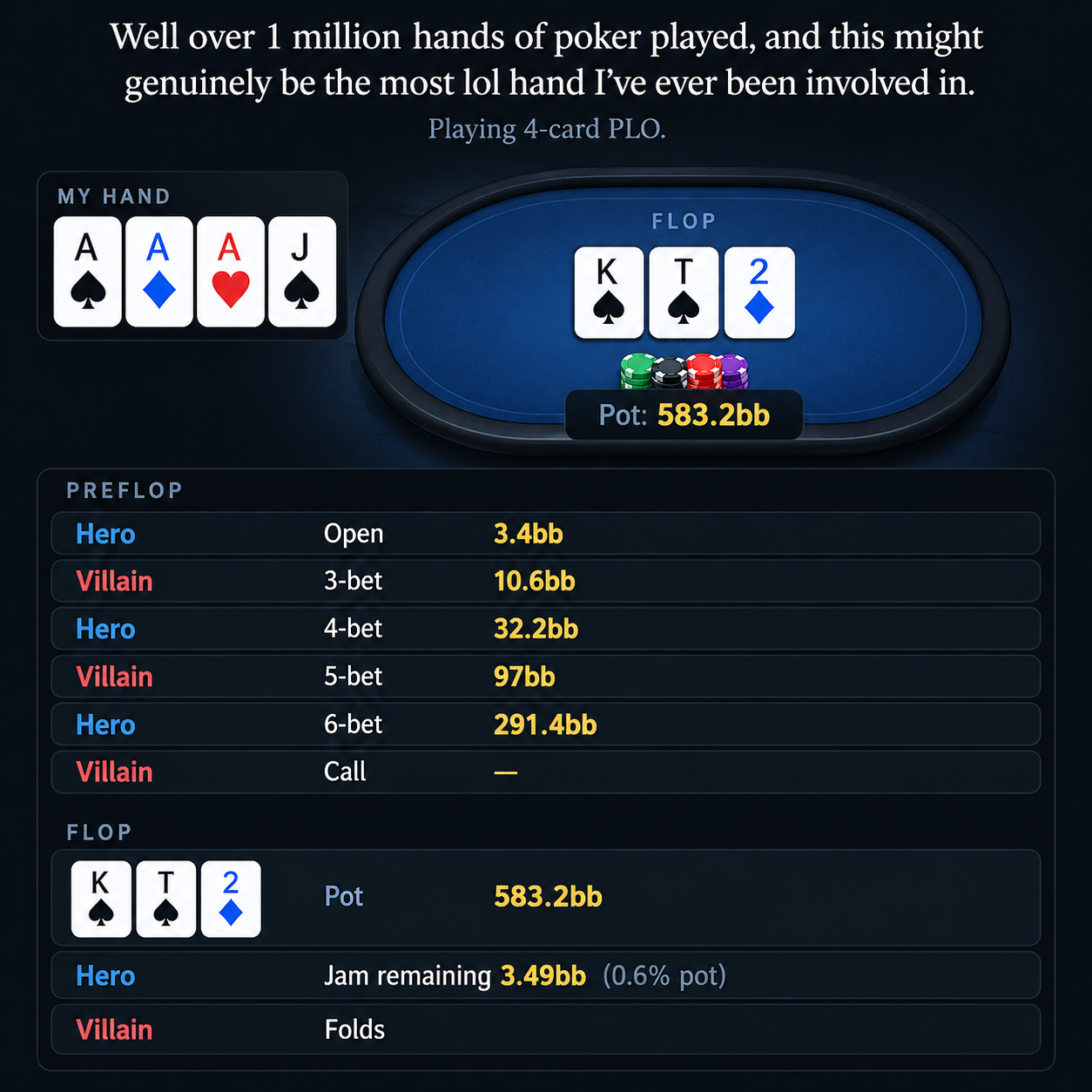%E2%99%A5) ♠ ♦ ♣ ♥ ♠ ♦ ♣ ♥ ♠ ♦ ♣ ♥ ♠ ♦ ♣ ♥ ♠ ♦ ♣ ♥ ♠ ♦ ♣ ♥
( )
(
 )
(
%E2%99%A5) ♠ ♦ ♣ ♥ ♠ ♦ ♣ ♥ ♠ ♦ ♣ ♥ ♠ ♦ ♣ ♥ ♠ ♦ ♣ ♥ ♠ ♦ ♣ ♥
(%E2%99%A5) ♠ ♦ ♣ ♥ ♠ ♦ ♣ ♥ ♠ ♦ ♣ ♥ ♠ ♦ ♣ ♥ ♠ ♦ ♣ ♥ ♠ ♦ ♣ ♥
(%E2%99%A5) ♠ ♦ ♣ ♥ ♠ ♦ ♣ ♥ ♠ ♦ ♣ ♥ ♠ ♦ ♣ ♥ ♠ ♦ ♣ ♥ ♠ ♦ ♣ ♥
(%E2%99%A5) ♠ ♦ ♣ ♥ ♠ ♦ ♣ ♥ ♠ ♦ ♣ ♥ ♠ ♦ ♣ ♥ ♠ ♦ ♣ ♥ ♠ ♦ ♣ ♥
(%E2%99%A5) ♠ ♦ ♣ ♥ ♠ ♦ ♣ ♥ ♠ ♦ ♣ ♥ ♠ ♦ ♣ ♥ ♠ ♦ ♣ ♥ ♠ ♦ ♣ ♥
(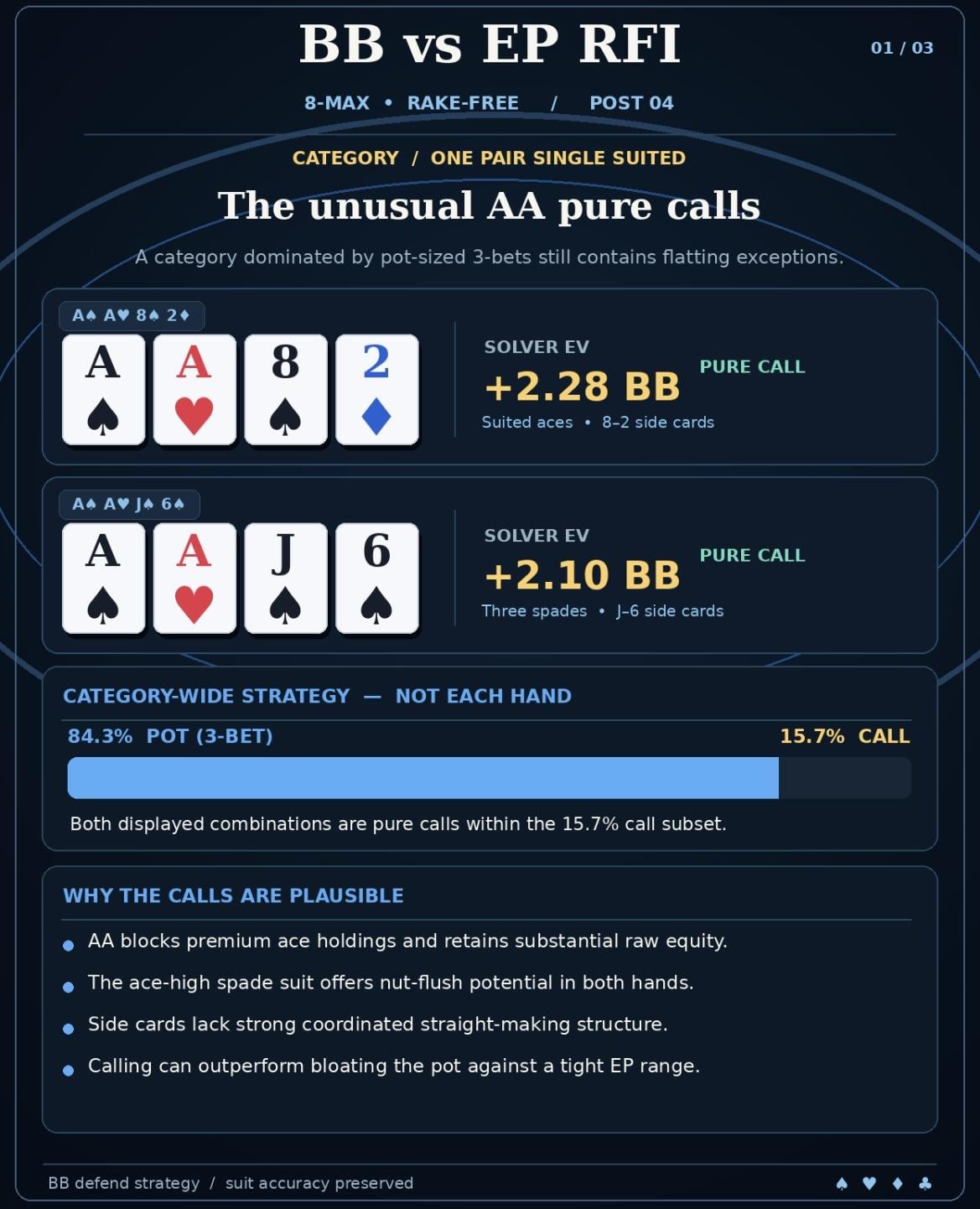%E2%99%A5) ♠ ♦ ♣ ♥ ♠ ♦ ♣ ♥ ♠ ♦ ♣ ♥ ♠ ♦ ♣ ♥ ♠ ♦ ♣ ♥ ♠ ♦ ♣ ♥
(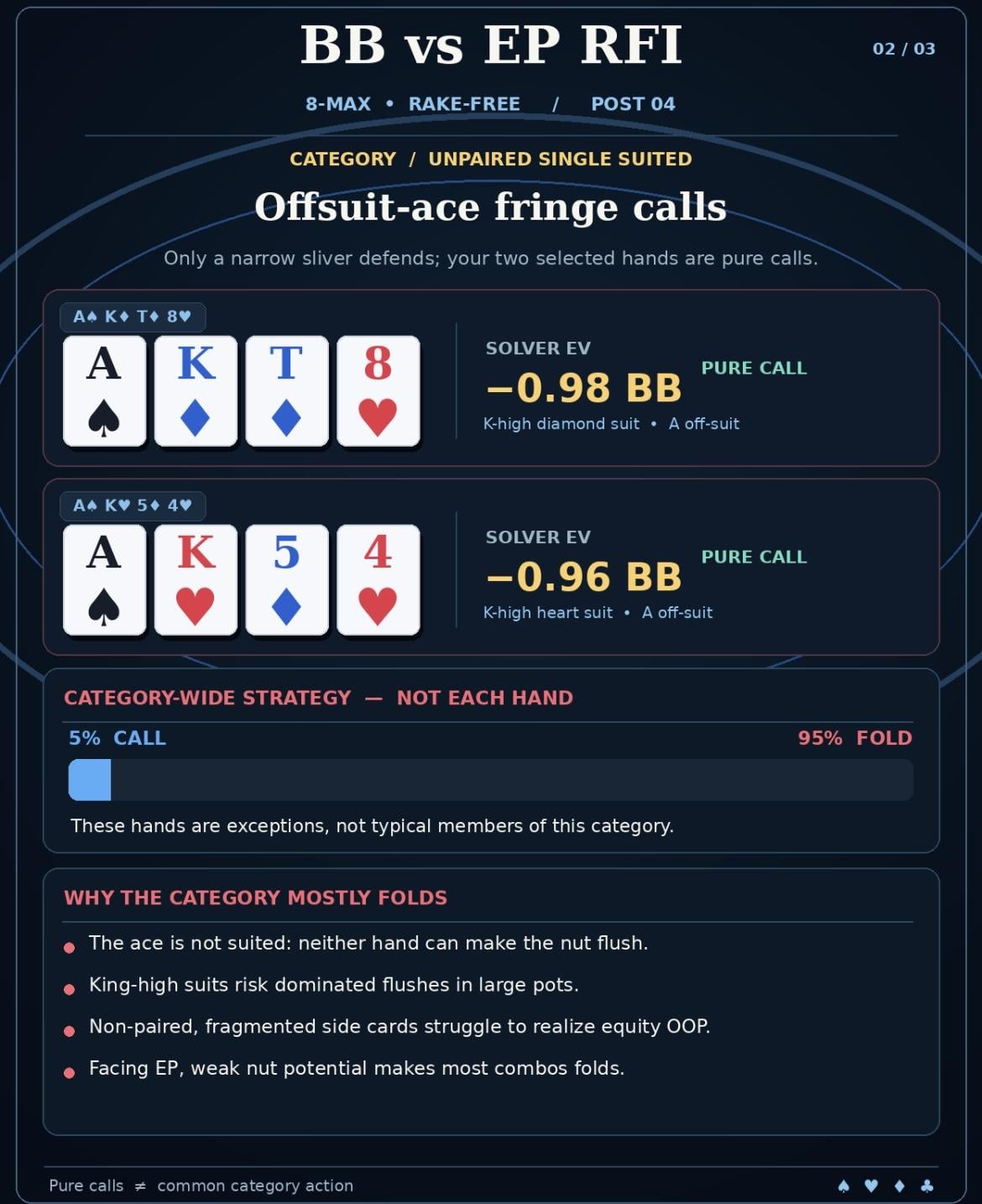%E2%99%A5) ♠ ♦ ♣ ♥ ♠ ♦ ♣ ♥ ♠ ♦ ♣ ♥ ♠ ♦ ♣ ♥ ♠ ♦ ♣ ♥ ♠ ♦ ♣ ♥
(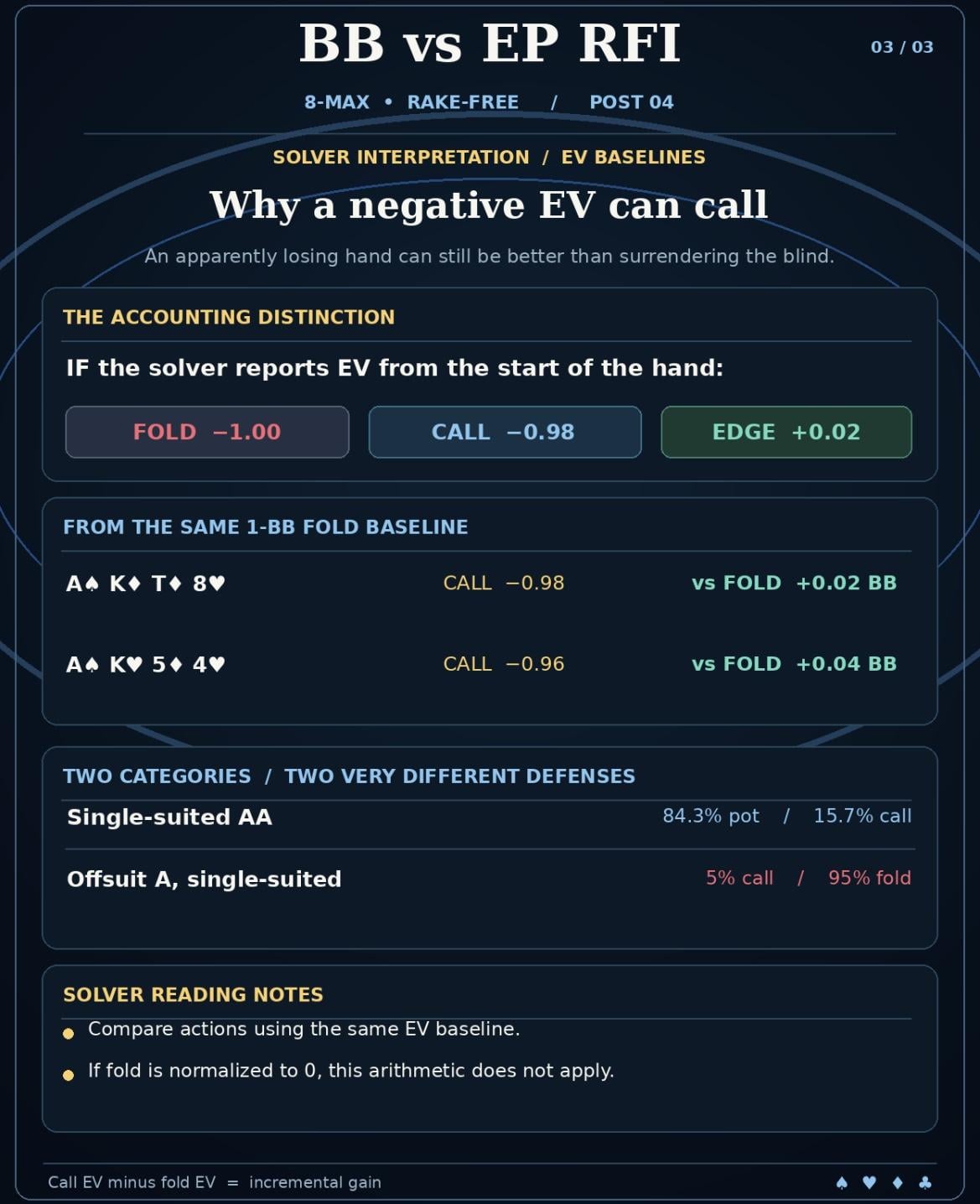%E2%99%A5) ♠ ♦ ♣ ♥ ♠ ♦ ♣ ♥ ♠ ♦ ♣ ♥ ♠ ♦ ♣ ♥ ♠ ♦ ♣ ♥ ♠ ♦ ♣ ♥
(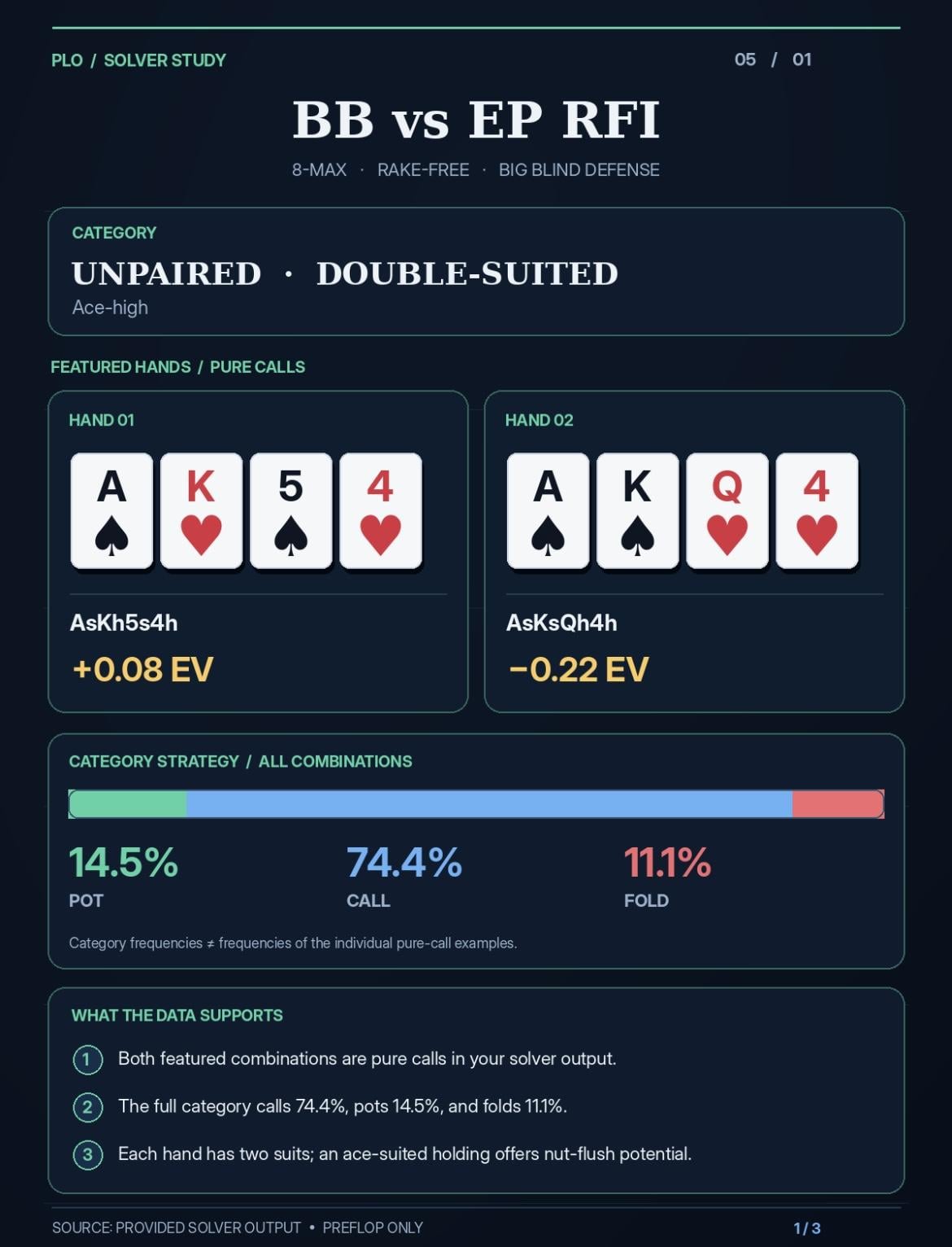%E2%99%A5) ♠ ♦ ♣ ♥ ♠ ♦ ♣ ♥ ♠ ♦ ♣ ♥ ♠ ♦ ♣ ♥ ♠ ♦ ♣ ♥ ♠ ♦ ♣ ♥
(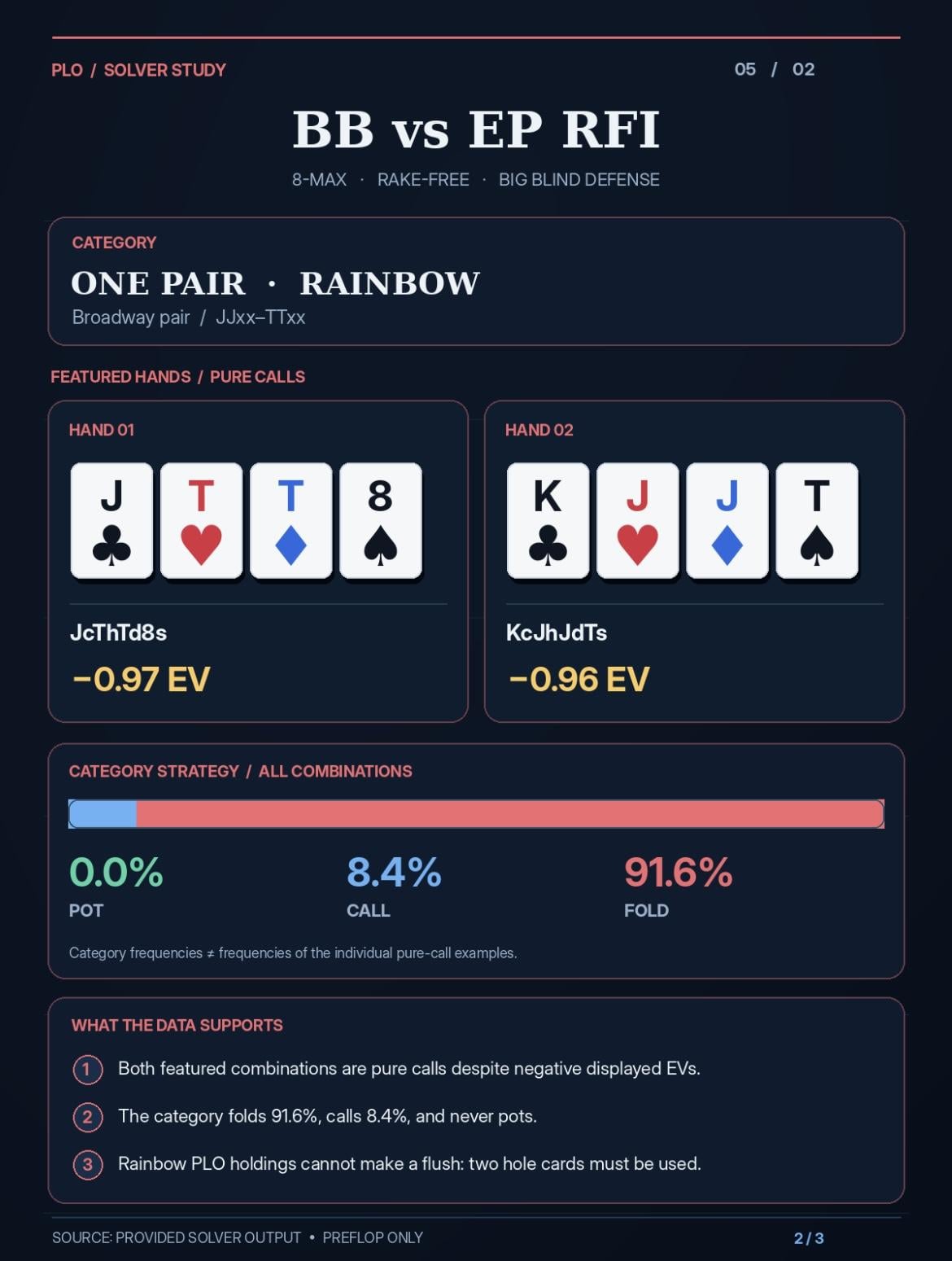%E2%99%A5) ♠ ♦ ♣ ♥ ♠ ♦ ♣ ♥ ♠ ♦ ♣ ♥ ♠ ♦ ♣ ♥ ♠ ♦ ♣ ♥ ♠ ♦ ♣ ♥
(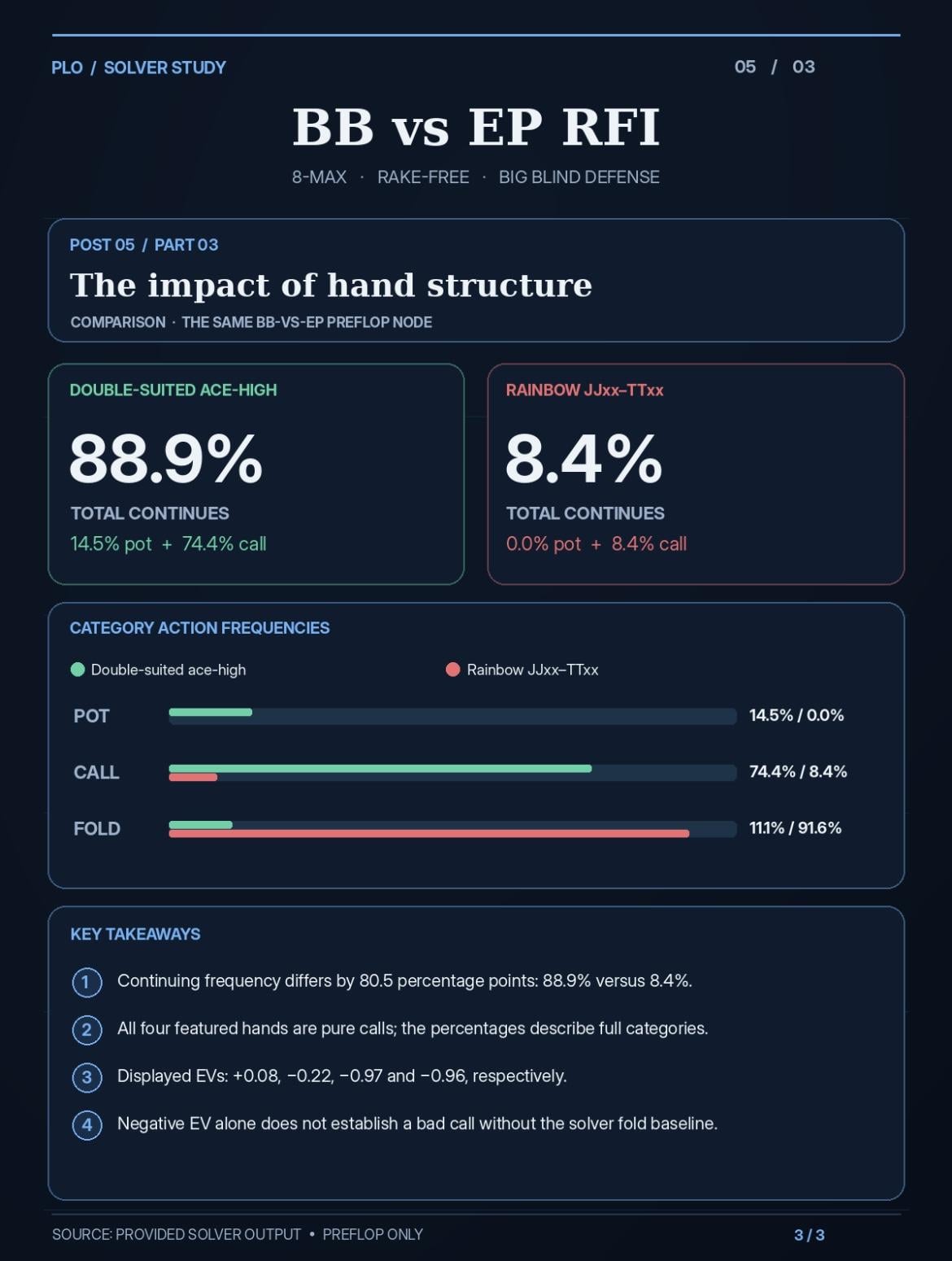%E2%99%A5) ♠ ♦ ♣ ♥ ♠ ♦ ♣ ♥ ♠ ♦ ♣ ♥ ♠ ♦ ♣ ♥ ♠ ♦ ♣ ♥ ♠ ♦ ♣ ♥
(%E2%99%A5) ♠ ♦ ♣ ♥ ♠ ♦ ♣ ♥ ♠ ♦ ♣ ♥ ♠ ♦ ♣ ♥ ♠ ♦ ♣ ♥ ♠ ♦ ♣ ♥
(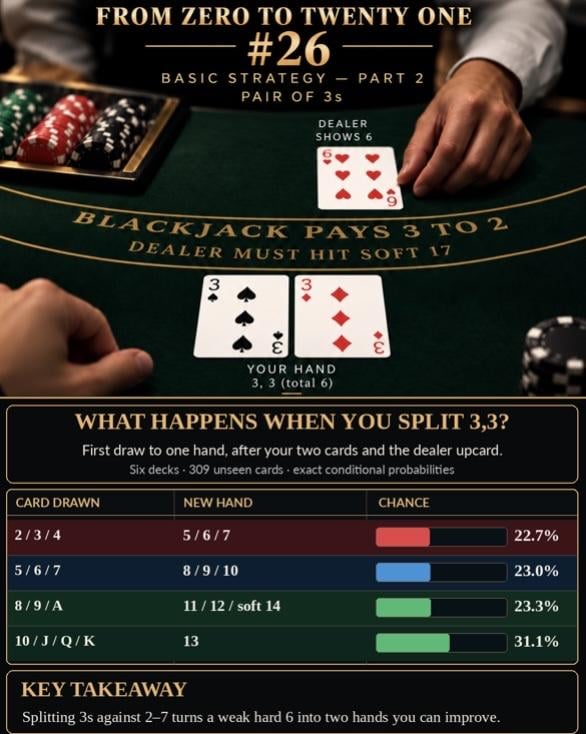%E2%99%A5) ♠ ♦ ♣ ♥ ♠ ♦ ♣ ♥ ♠ ♦ ♣ ♥ ♠ ♦ ♣ ♥ ♠ ♦ ♣ ♥ ♠ ♦ ♣ ♥
Post 6 — Part 1: Double-Suited Broadway Pairs One thing worth considering is how much the side cards contribute beyond the pocket pair itself. Neither hand has an ace-high flush suit, and the low side cards offer relatively little connectivity. It’s easy to overestimate the strength of a double-suited JJxx or TTxx holding without considering how often it can make something genuinely strong postflop.
(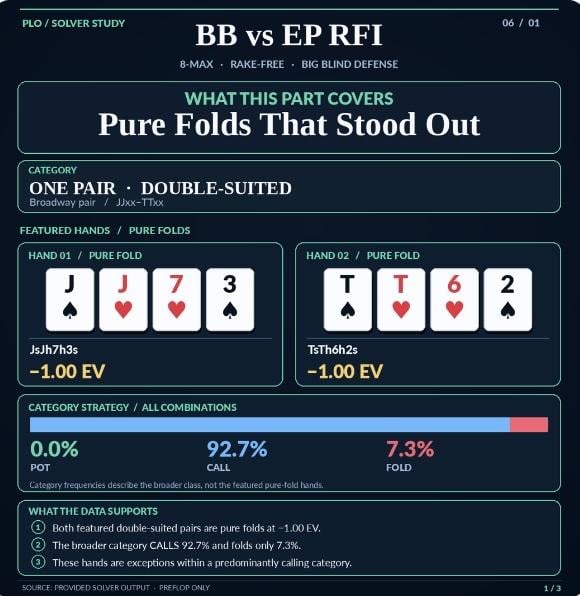%E2%99%A5) ♠ ♦ ♣ ♥ ♠ ♦ ♣ ♥ ♠ ♦ ♣ ♥ ♠ ♦ ♣ ♥ ♠ ♦ ♣ ♥ ♠ ♦ ♣ ♥
Post 6: Part 2 — Double-Suited Ace-High What I find particularly interesting is that changing which card shares the ace’s suit doesn’t change the decision here. One hand has A♠ 3♠, while the other has A♠ 6♠ yet both fold. Having a nut-flush suit clearly isn’t sufficient on its own, which makes me curious how much additional connectivity would be needed to turn these into calls.
(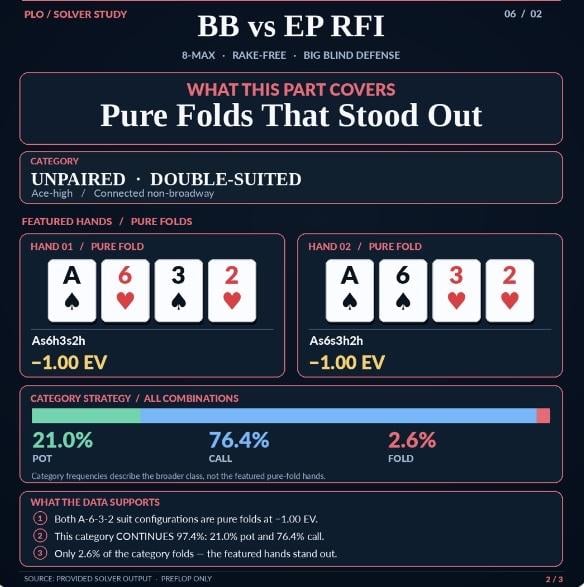%E2%99%A5) ♠ ♦ ♣ ♥ ♠ ♦ ♣ ♥ ♠ ♦ ♣ ♥ ♠ ♦ ♣ ♥ ♠ ♦ ♣ ♥ ♠ ♦ ♣ ♥
Post 6: Part 3 — Comparison & Key Takeaways I’d be interested in experimenting with one-card substitutions on these hands to identify exactly where the solver starts calling. Changing a low side card, improving connectivity, or strengthening a suit individually could help isolate which structural improvements matter most. That’s probably more useful for developing intuition than simply memorizing the four specific combinations.
(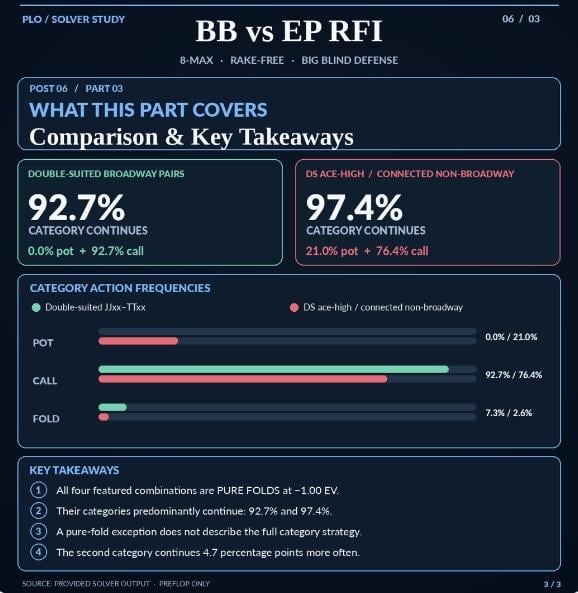%E2%99%A5) ♠ ♦ ♣ ♥ ♠ ♦ ♣ ♥ ♠ ♦ ♣ ♥ ♠ ♦ ♣ ♥ ♠ ♦ ♣ ♥ ♠ ♦ ♣ ♥
(%E2%99%A5) ♠ ♦ ♣ ♥ ♠ ♦ ♣ ♥ ♠ ♦ ♣ ♥ ♠ ♦ ♣ ♥ ♠ ♦ ♣ ♥ ♠ ♦ ♣ ♥
(%E2%99%A5) ♠ ♦ ♣ ♥ ♠ ♦ ♣ ♥ ♠ ♦ ♣ ♥ ♠ ♦ ♣ ♥ ♠ ♦ ♣ ♥ ♠ ♦ ♣ ♥
Post 7 — Two Pair Rainbow Two-pair rainbow hands like these are a good reminder that raw pair strength can be deceptive in PLO. Without suitedness or stronger side-card support, these holdings can look sturdier than they really are, especially against an opening range that starts out stronger and better structured.
(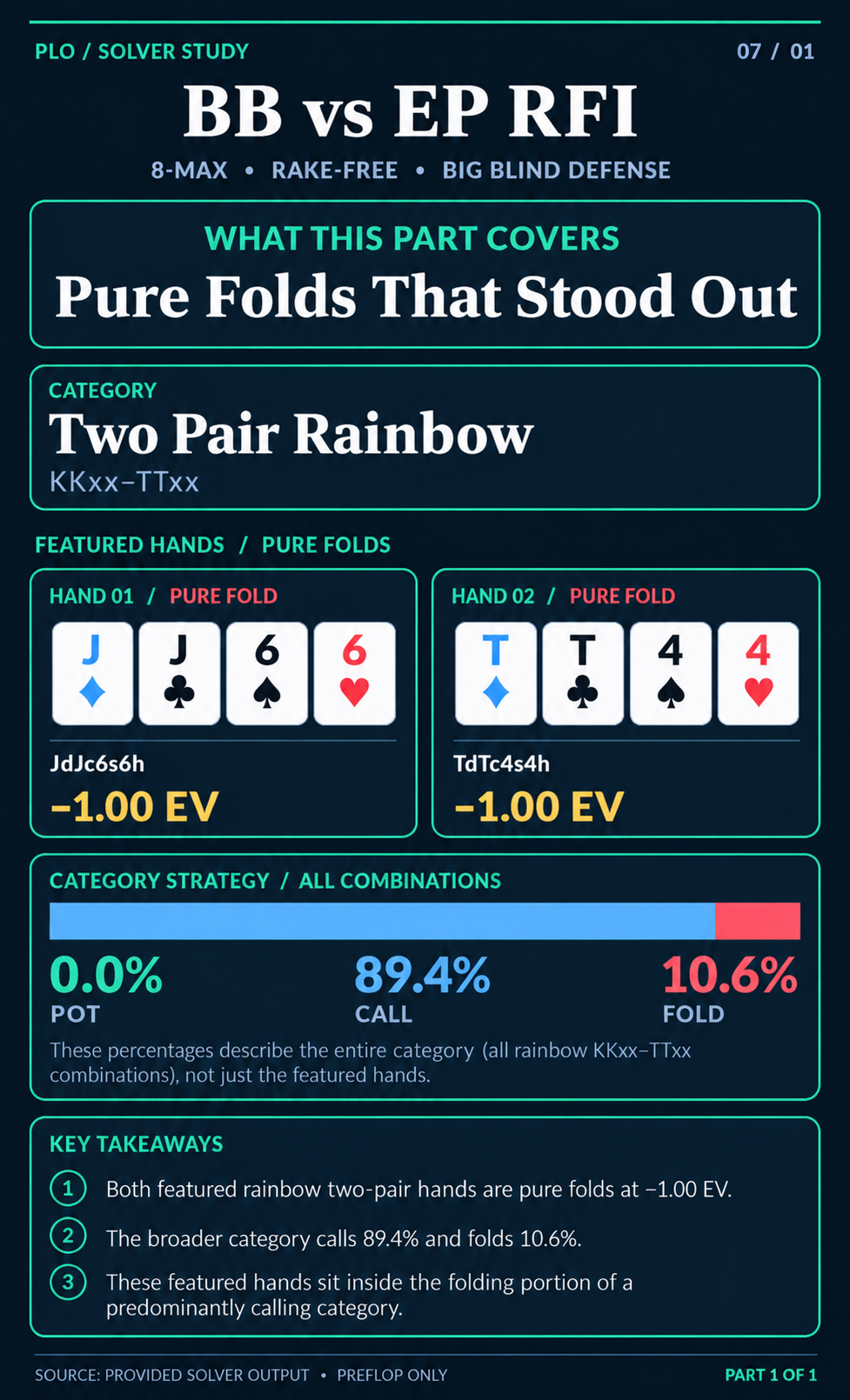%E2%99%A5) ♠ ♦ ♣ ♥ ♠ ♦ ♣ ♥ ♠ ♦ ♣ ♥ ♠ ♦ ♣ ♥ ♠ ♦ ♣ ♥ ♠ ♦ ♣ ♥
BB vs EP RFI — Post 8, Part 1: Pure Pots (8-Max, Rake-Free)
(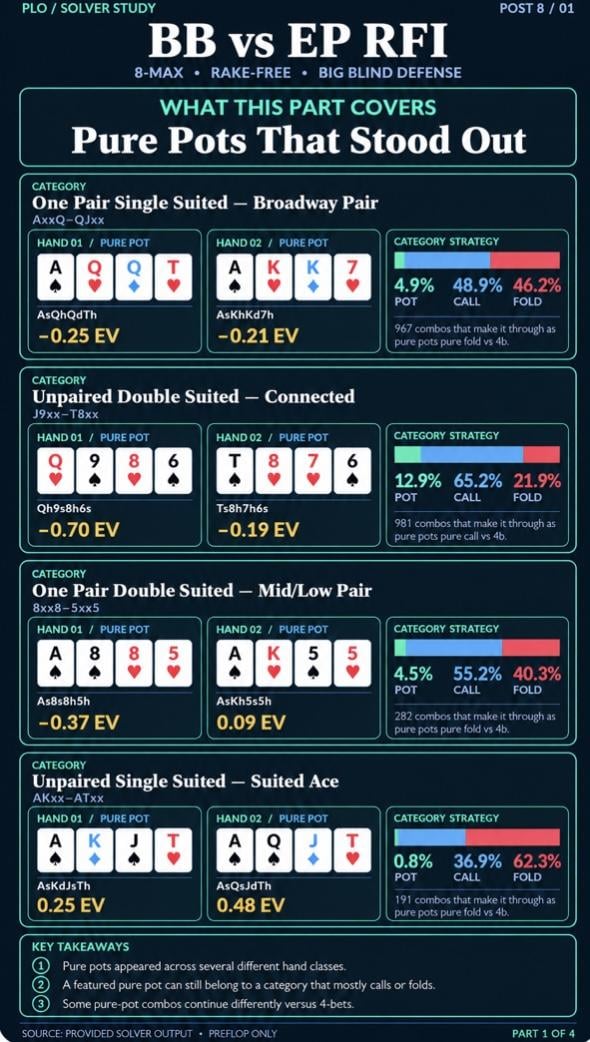%E2%99%A5) ♠ ♦ ♣ ♥ ♠ ♦ ♣ ♥ ♠ ♦ ♣ ♥ ♠ ♦ ♣ ♥ ♠ ♦ ♣ ♥ ♠ ♦ ♣ ♥
BB vs EP RFI — Post 8, Part 2: Pure Calls (8-Max, Rake-Free)
(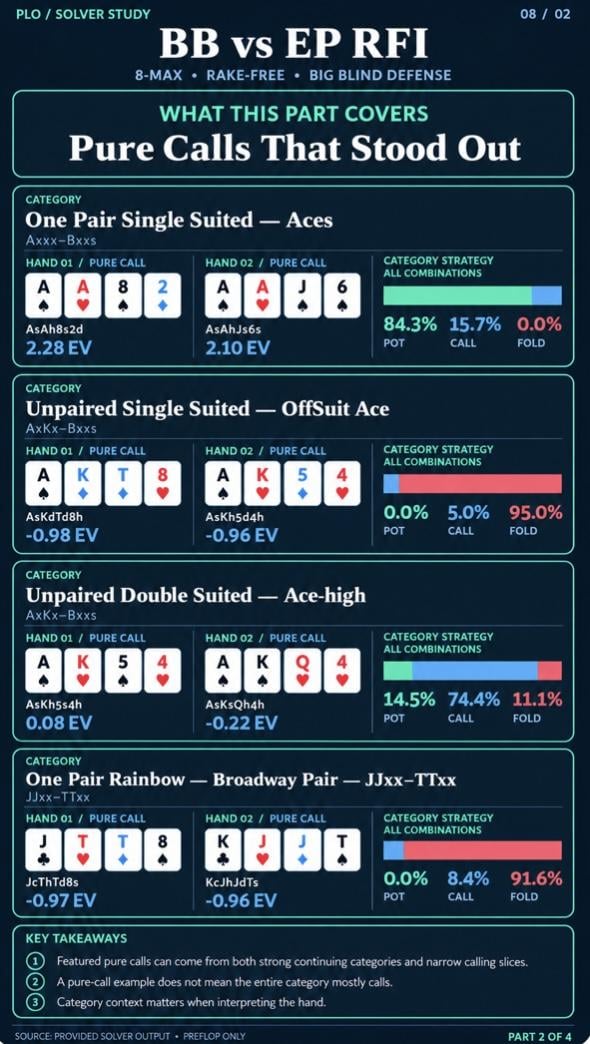%E2%99%A5) ♠ ♦ ♣ ♥ ♠ ♦ ♣ ♥ ♠ ♦ ♣ ♥ ♠ ♦ ♣ ♥ ♠ ♦ ♣ ♥ ♠ ♦ ♣ ♥
BB vs EP RFI — Post 8, Part 3: Pure Folds (8-Max, Rake-Free)
(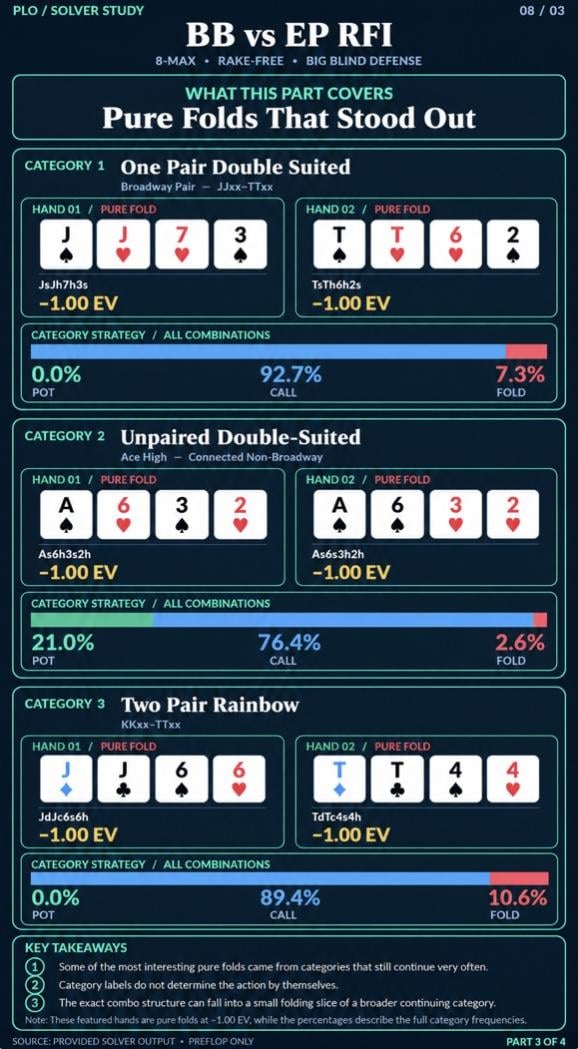%E2%99%A5) ♠ ♦ ♣ ♥ ♠ ♦ ♣ ♥ ♠ ♦ ♣ ♥ ♠ ♦ ♣ ♥ ♠ ♦ ♣ ♥ ♠ ♦ ♣ ♥
BB vs EP RFI — Post 8, Part 4: General Takeaways (8-Max, Rake-Free)
(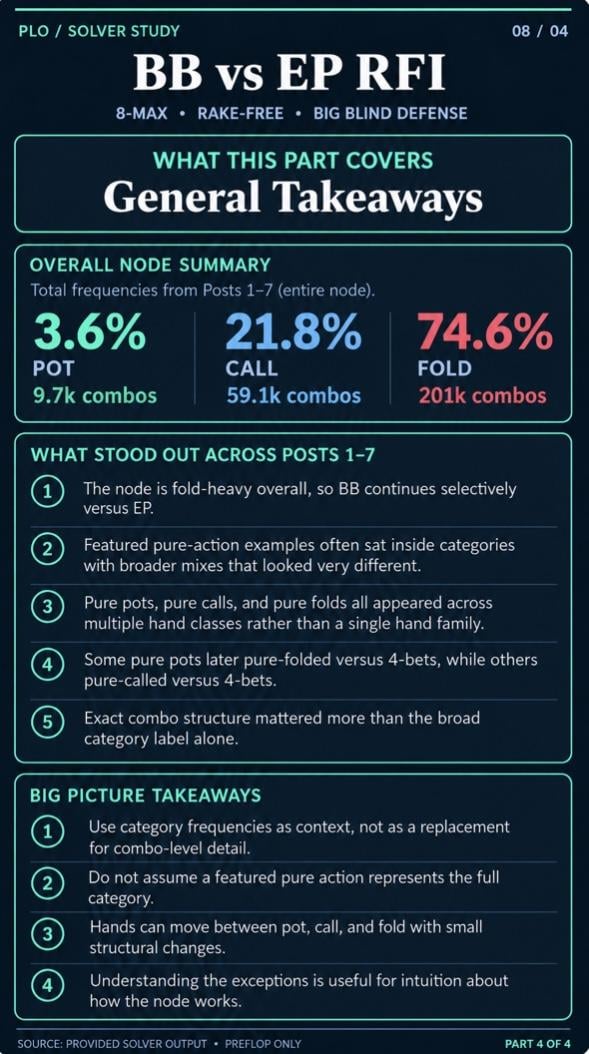%E2%99%A5) ♠ ♦ ♣ ♥ ♠ ♦ ♣ ♥ ♠ ♦ ♣ ♥ ♠ ♦ ♣ ♥ ♠ ♦ ♣ ♥ ♠ ♦ ♣ ♥